Ch. 4 - Exponential and Logarithmic Functions
Blitzer - College Algebra 8th Edition
Blitzer8th EditionCollege AlgebraISBN: 9780136970514Not the one you use?Change textbook
Chapter 5, Problem 111

In Exercises 109–112, find the domain of each logarithmic function. f(x) = log[(x+1)/(x-5)]

Verified step by step guidance
1
Recall that the domain of a logarithmic function \( f(x) = \log(g(x)) \) consists of all values of \( x \) for which the argument \( g(x) \) is positive, i.e., \( g(x) > 0 \).
Identify the argument of the logarithm in the function: \( \frac{x+1}{x-5} \). We need to find where \( \frac{x+1}{x-5} > 0 \).
Determine the critical points where the numerator or denominator is zero: \( x+1=0 \Rightarrow x=-1 \) and \( x-5=0 \Rightarrow x=5 \). These points divide the number line into intervals to test.
Test the sign of \( \frac{x+1}{x-5} \) in each interval: \( (-\infty, -1) \), \( (-1, 5) \), and \( (5, \infty) \). For each interval, pick a test value and check if the fraction is positive.
Combine the intervals where the fraction is positive, excluding points where the denominator is zero (since division by zero is undefined), to write the domain of \( f(x) \).

Verified video answer for a similar problem:

This video solution was recommended by our tutors as helpful for the problem above.
Video duration:
3m
Was this helpful?

Key Concepts

Here are the essential concepts you must grasp in order to answer the question correctly.

Domain of a Function

The domain of a function is the set of all input values (x-values) for which the function is defined. For logarithmic functions, the argument inside the log must be positive, so determining the domain involves finding all x-values that make the argument greater than zero.
Recommended video:
3:51
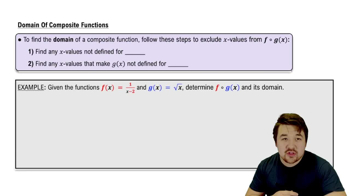
Domain Restrictions of Composed Functions

Properties of Logarithmic Functions

A logarithmic function log_b(A) is defined only when the argument A is positive (A > 0). This means that for f(x) = log[(x+1)/(x-5)], the expression (x+1)/(x-5) must be greater than zero to ensure the function is valid.
Recommended video:
5:26
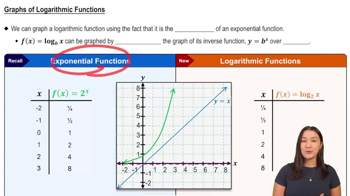
Graphs of Logarithmic Functions

Inequalities Involving Rational Expressions

To find where (x+1)/(x-5) > 0, one must solve a rational inequality. This involves determining the sign of the numerator and denominator, identifying critical points where the expression is zero or undefined, and testing intervals to find where the expression is positive.
Recommended video:
Guided course
02:58
Rationalizing Denominators