Ch. 4 - Exponential and Logarithmic Functions
Blitzer - College Algebra 8th Edition
Blitzer8th EditionCollege AlgebraISBN: 9780136970514Not the one you use?Change textbook
Chapter 5, Problem 109

In Exercises 109–112, find the domain of each logarithmic function. f(x) = ln (x² - x − 2)

Verified step by step guidance
1
Recall that the domain of a logarithmic function f(x) = ln(g(x)) requires the argument g(x) to be greater than zero, so we need to find where x² - x - 2 > 0.
Set up the inequality: x²-x-2>0.
Factor the quadratic expression: x²-x-2 = (x-2)(x+1).
Determine the critical points by setting each factor equal to zero: x-2=0 gives x=2, and x+1=0 gives x=-1.
Test intervals determined by the critical points (-∞, -1), (-1, 2), and (2, ∞) to find where the product is positive, which will give the domain of the function.

Verified video answer for a similar problem:

This video solution was recommended by our tutors as helpful for the problem above.
Video duration:
3m
Was this helpful?

Key Concepts

Here are the essential concepts you must grasp in order to answer the question correctly.

Domain of a Function

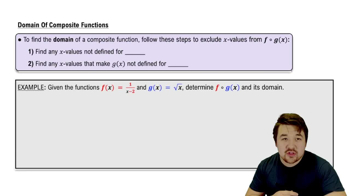
The domain of a function is the set of all input values (x-values) for which the function is defined. For logarithmic functions, the argument inside the logarithm must be positive, so determining the domain involves finding all x-values that make the expression inside the log greater than zero.
Recommended video:
3:51
Domain Restrictions of Composed Functions

Properties of Logarithmic Functions

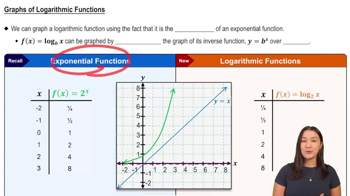
Logarithmic functions, such as the natural logarithm ln(x), are only defined for positive arguments. This means the expression inside the logarithm, here (x² - x - 2), must be greater than zero. Understanding this property is essential to correctly find the domain.
Recommended video:
5:26
Graphs of Logarithmic Functions

Solving Quadratic Inequalities

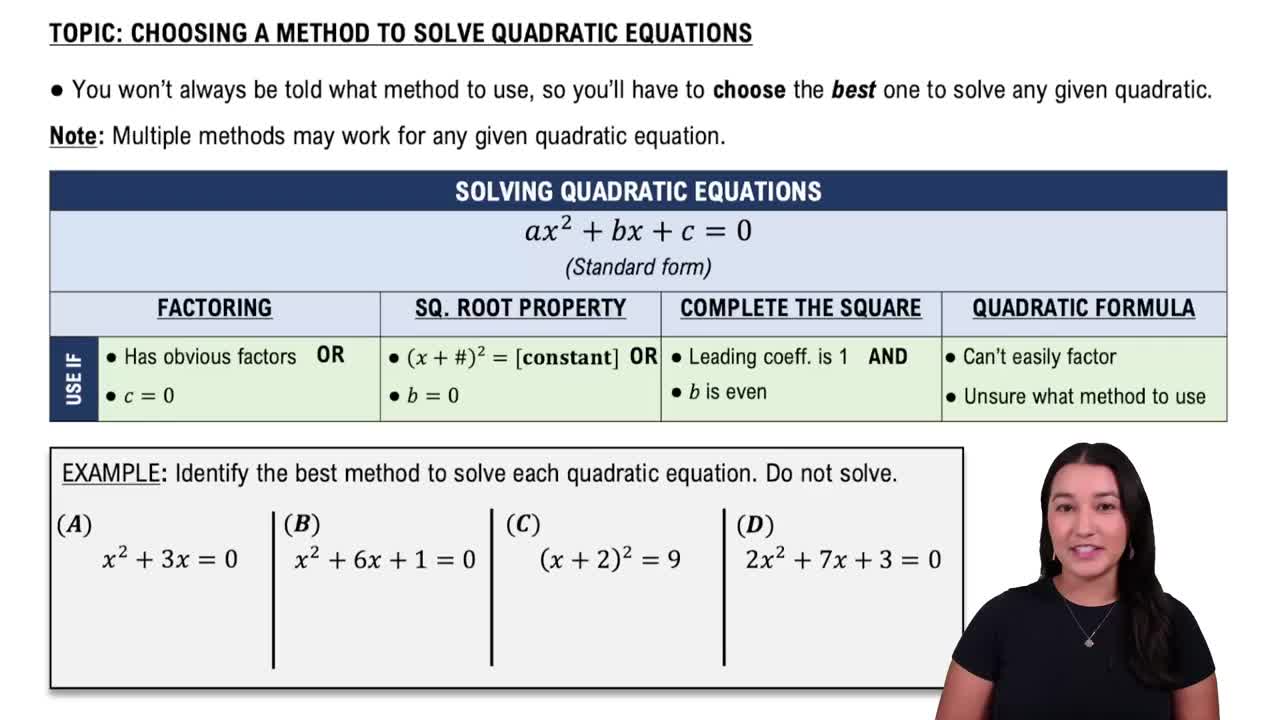
To find where the quadratic expression (x² - x - 2) is positive, you solve the inequality x² - x - 2 > 0. This involves factoring the quadratic, finding its roots, and testing intervals to determine where the expression is positive, which helps identify the domain of the logarithmic function.
Recommended video:
04:03
Choosing a Method to Solve Quadratics