
In Exercises 15–18, use the Leading Coefficient Test to determine the end behavior of the graph of the given polynomial function. Then use this end behavior to match the polynomial function with its graph. [The graphs are labeled (a) through (d).] <IMAGE>
Ch. 3 - Polynomial and Rational Functions

Chapter 4, Problem 15
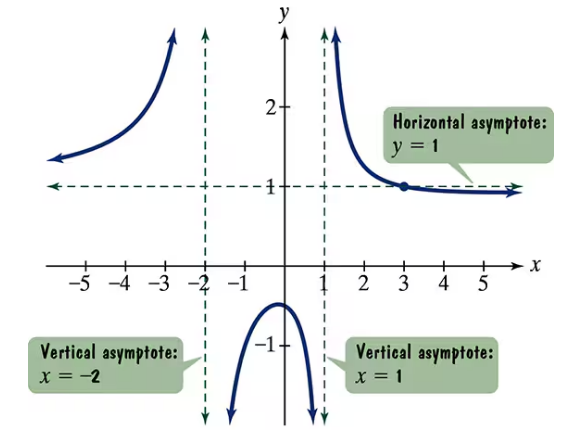
Use the graph of the rational function in the figure shown to complete each statement in Exercises 15–20.

As __
Verified step by step guidance1
Identify the vertical asymptote near the value x = 1 on the graph. Notice that the graph has vertical asymptotes at x = -16 and x = -8, but none at x = 1, so the behavior near x = 1 is not influenced by a vertical asymptote.
Observe the behavior of the function f(x) as x approaches 1 from the right (x \(\to\) 1^+). Look at the graph closely near x = 1 and see whether the function values increase, decrease, or approach a specific number.
From the graph, as x approaches 1 from the right, the function values seem to approach a certain y-value. Determine if the function is going towards positive infinity, negative infinity, or a finite number.
Since the graph near x = 1 shows the function values approaching a finite number, identify that number by looking at the y-axis value the graph approaches.
Conclude that as x \(\to\) 1^+, f(x) approaches the finite value you identified from the graph.

Verified video answer for a similar problem:
This video solution was recommended by our tutors as helpful for the problem above.
Video duration:
1mWas this helpful?
Key Concepts
Here are the essential concepts you must grasp in order to answer the question correctly.
Vertical Asymptotes
Vertical asymptotes occur where the function approaches infinity or negative infinity as x approaches a specific value. They represent values of x that make the denominator zero in a rational function, causing the function to be undefined. The graph shows the function's behavior near these lines, indicating limits from the left or right.
Recommended video:
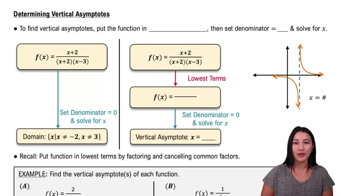
Determining Vertical Asymptotes
Horizontal Asymptotes
Horizontal asymptotes describe the behavior of a function as x approaches positive or negative infinity. They indicate the value that the function approaches but does not necessarily reach. For rational functions, horizontal asymptotes are determined by comparing the degrees of the numerator and denominator polynomials.
Recommended video:
Determining Horizontal Asymptotes
Limit Behavior Near Asymptotes
The limit of a function as x approaches a certain value from the right or left describes how the function behaves near that point. Near vertical asymptotes, the function may approach positive or negative infinity. Understanding this helps in completing statements about the function's behavior as x approaches specific values.
Recommended video:
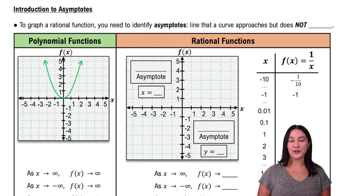
Introduction to Asymptotes
Related Practice
Textbook Question
Textbook Question
Find the coordinates of the vertex for the parabola defined by the given quadratic function. f(x)=−x2−2x+8
Textbook Question
Write an equation that expresses each relationship. Then solve the equation for y. x varies jointly as y and z and inversely as the square of w.
Textbook Question
Find the zeros for each polynomial function and give the multiplicity of each zero. State whether the graph crosses the x-axis, or touches the x-axis and turns around, at each zero.
Textbook Question
Divide using long division. State the quotient, and the remainder, r(x).
Textbook Question
Write an equation that expresses each relationship. Then solve the equation for y. x varies jointly as y and z and inversely as the square root of w.
