Ch. 3 - Polynomial and Rational Functions
Blitzer - College Algebra 8th Edition
Blitzer8th EditionCollege AlgebraISBN: 9780136970514Not the one you use?Change textbook
Chapter 4, Problem 78

Use synthetic division to show that 5 is a solution of x^4−4x^3−9x^2+16x+20=0. Then solve the polynomial equation.

Verified step by step guidance
1
Set up synthetic division by writing the coefficients of the polynomial x4 - 4x3 - 9x2 + 16x + 20. The coefficients are [1, -4, -9, 16, 20].
Since we want to test if 5 is a root, use 5 as the divisor in synthetic division. Write 5 to the left and bring down the first coefficient (1) as is.
Multiply 5 by the number just brought down (1), write the result under the next coefficient (-4), then add the column: -4 + 5 = 1. Repeat this process for each coefficient: multiply the last sum by 5, write it under the next coefficient, and add.
If the final sum (remainder) is 0, then 5 is a root of the polynomial. The numbers obtained before the remainder represent the coefficients of the quotient polynomial of degree 3.
Solve the quotient cubic polynomial obtained from synthetic division by factoring or using other methods (such as factoring by grouping, rational root theorem, or quadratic formula if it reduces to a quadratic) to find the remaining roots of the original polynomial.

Verified video answer for a similar problem:

This video solution was recommended by our tutors as helpful for the problem above.
Video duration:
6m
Was this helpful?

Key Concepts

Here are the essential concepts you must grasp in order to answer the question correctly.

Synthetic Division

Synthetic division is a shortcut method for dividing a polynomial by a linear factor of the form (x - c). It simplifies the division process by using only the coefficients of the polynomial, making it faster and less error-prone than long division. It also helps determine if c is a root by checking if the remainder is zero.
Recommended video:
05:10
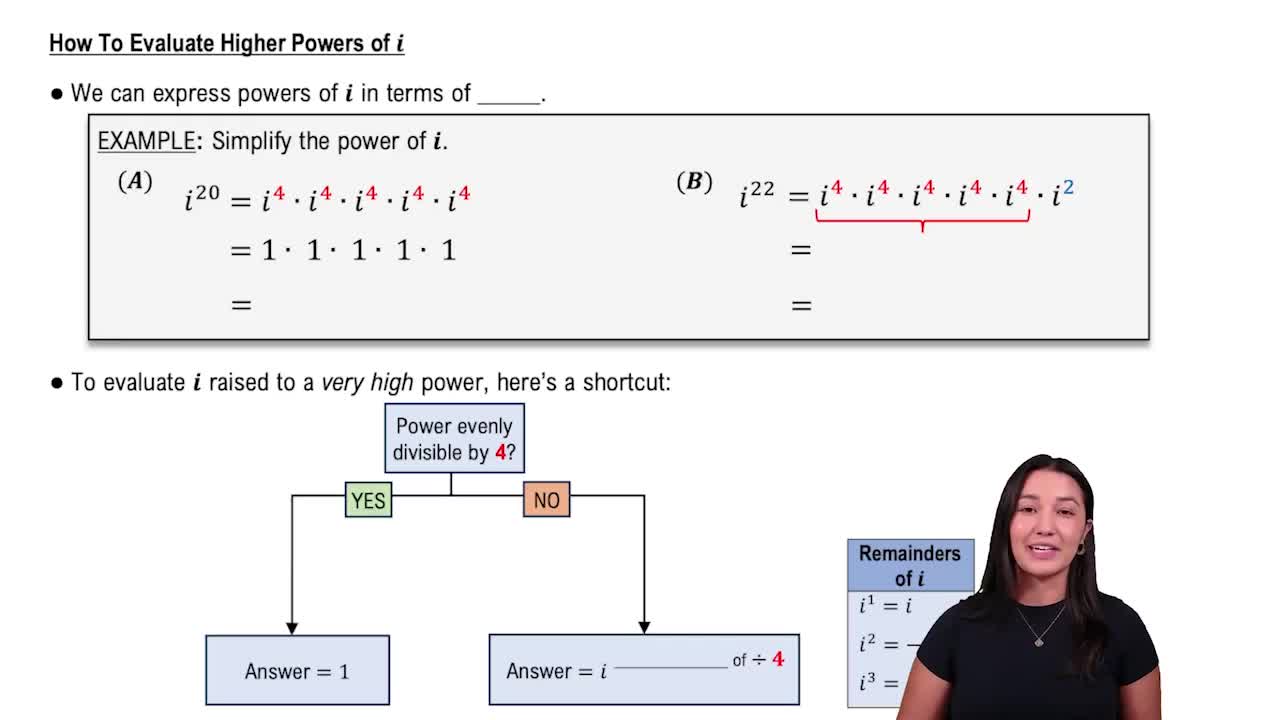
Higher Powers of i

Polynomial Roots and the Remainder Theorem

The Remainder Theorem states that when a polynomial f(x) is divided by (x - c), the remainder is f(c). If the remainder is zero, then c is a root of the polynomial, meaning (x - c) is a factor. This concept is essential for verifying solutions and factoring polynomials.
Recommended video:
02:20
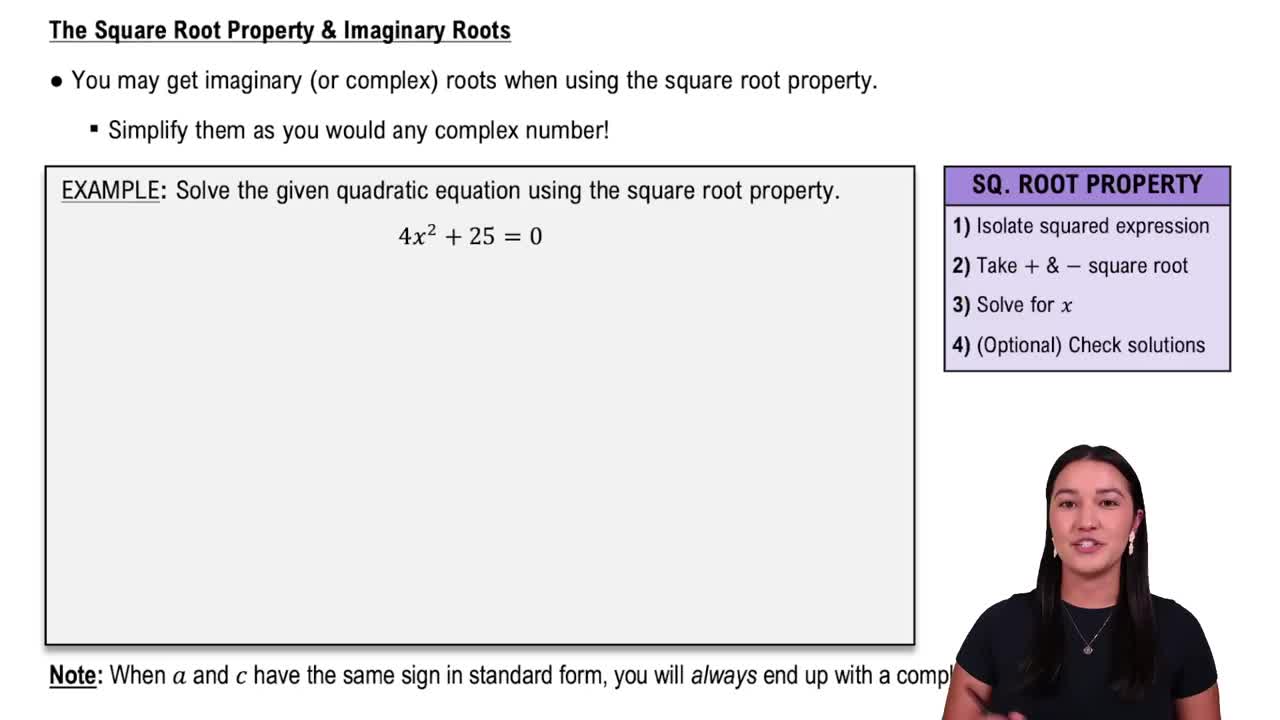
Imaginary Roots with the Square Root Property

Factoring and Solving Polynomial Equations

Once a root is found, the polynomial can be factored by dividing out the corresponding linear factor. The reduced polynomial can then be solved using factoring, the quadratic formula, or other algebraic methods. This step-by-step approach breaks down complex polynomials into simpler factors to find all solutions.
Recommended video:
Guided course
07:30
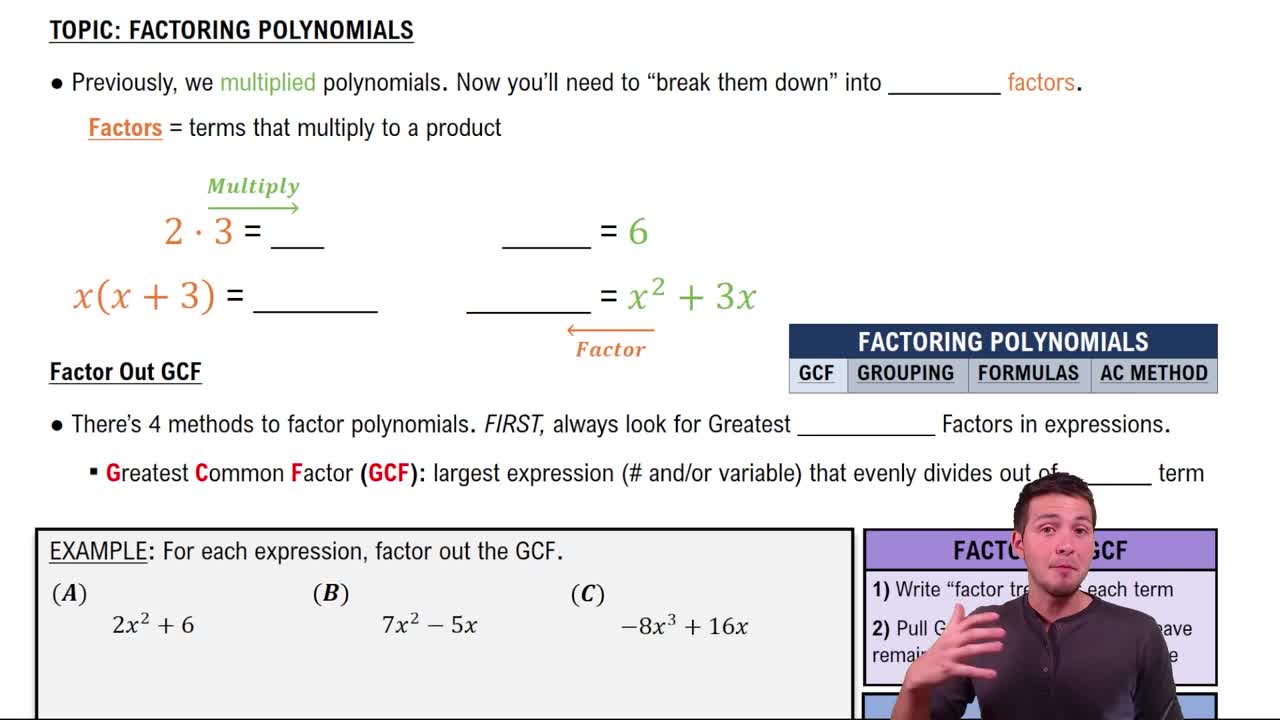
Introduction to Factoring Polynomials