Ch. 3 - Polynomial and Rational Functions
Blitzer - College Algebra 8th Edition
Blitzer8th EditionCollege AlgebraISBN: 9780136970514Not the one you use?Change textbook
Chapter 4, Problem 78

Solve the variation problems in Exercises 77–82. The distance that a body falls from rest is directly proportional to the square of the time of the fall. If skydivers fall 144 feet in 3 seconds, how far will they fall in 10 seconds?

Verified step by step guidance
1
Identify the type of variation: The problem states that the distance (d) is directly proportional to the square of the time (t). This can be expressed as d = k * t^2, where k is the constant of proportionality.
Use the given information to find the constant of proportionality (k): Substitute d = 144 and t = 3 into the equation d = k * t^2. Solve for k by isolating it on one side of the equation.
Write the general equation with the calculated value of k: Once k is determined, substitute it back into the equation d = k * t^2 to get the specific equation for this situation.
Substitute t = 10 into the specific equation: Use the equation from the previous step and replace t with 10 to find the distance (d) the skydivers fall in 10 seconds.
Simplify the expression to find the distance: Perform the necessary calculations to simplify the expression and determine the distance the skydivers fall in 10 seconds.

Verified video answer for a similar problem:

This video solution was recommended by our tutors as helpful for the problem above.
Video duration:
4m
Was this helpful?

Key Concepts

Here are the essential concepts you must grasp in order to answer the question correctly.

Direct Proportionality

Direct proportionality means that two quantities increase or decrease in tandem at a constant ratio. In this context, the distance fallen by a body is directly proportional to the square of the time, which can be expressed mathematically as d = k * t^2, where d is distance, t is time, and k is a constant of proportionality.
Recommended video:
02:44
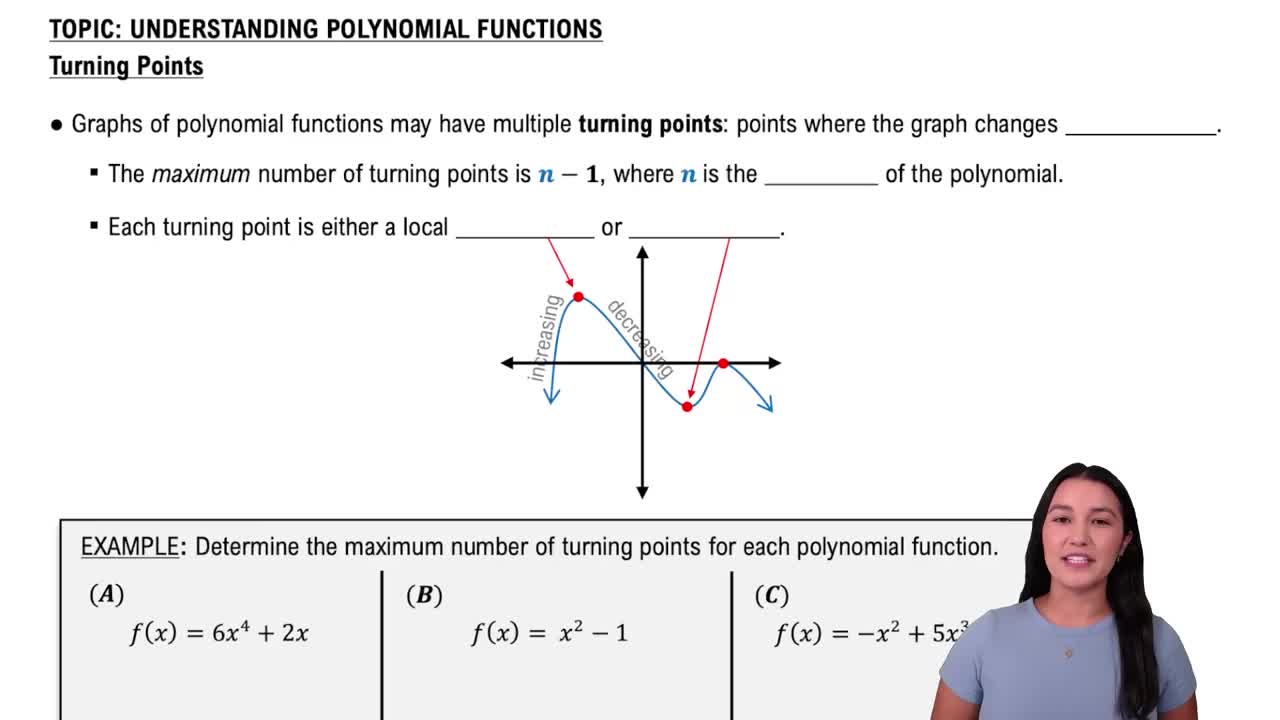
Maximum Turning Points of a Polynomial Function

Quadratic Relationships

Quadratic relationships involve equations where the variable is raised to the second power, resulting in a parabolic graph. In this problem, since distance is proportional to the square of time, the relationship can be modeled as a quadratic function, which helps in predicting distances for different time intervals.
Recommended video:
06:36
Solving Quadratic Equations Using The Quadratic Formula

Unit Conversion and Scaling

Unit conversion and scaling are essential for solving problems involving different measurements. In this case, understanding how to scale the distance fallen based on the time squared allows us to calculate the distance for 10 seconds by using the known distance for 3 seconds and applying the proportionality constant derived from that relationship.
Recommended video:
05:02
Square Roots of Negative Numbers