Ch. 3 - Polynomial and Rational Functions
Blitzer - College Algebra 8th Edition
Blitzer8th EditionCollege AlgebraISBN: 9780136970514Not the one you use?Change textbook
Chapter 4, Problem 73

In Exercises 73–74, use the graph of the rational function to solve each inequality.


1/4(x + 2) ≤ - 3/4(x - 2)
Graph of the function f(x) = (x + 1)/(x^2 - 4) with labeled axes.

Verified step by step guidance
1
Identify the inequality to solve: \(\frac{1}{4}(x + 2) \leq -\frac{3}{4}(x - 2)\).
Eliminate the fractions by multiplying both sides of the inequality by 4 to simplify the expression.
Distribute the multiplication on both sides: \(x + 2 \leq -3(x - 2)\).
Expand the right side: \(x + 2 \leq -3x + 6\).
Collect like terms by adding \$3x\( to both sides and subtracting 2 from both sides to isolate \)x$: \(x + 3x \leq 6 - 2\) which simplifies to \(4x \leq 4\).

Verified video answer for a similar problem:

This video solution was recommended by our tutors as helpful for the problem above.
Video duration:
7m
Was this helpful?

Key Concepts

Here are the essential concepts you must grasp in order to answer the question correctly.

Rational Functions and Their Graphs

A rational function is a ratio of two polynomials, and its graph can have vertical and horizontal asymptotes where the function is undefined or approaches a limit. Understanding the behavior near these asymptotes and intercepts helps analyze the function's values and solve inequalities involving the function.
Recommended video:
8:19
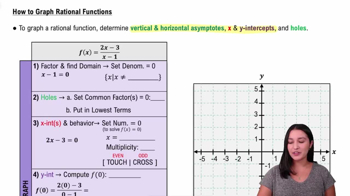
How to Graph Rational Functions

Solving Inequalities Involving Rational Expressions

To solve inequalities with rational expressions, identify critical points where the numerator or denominator is zero, then test intervals between these points to determine where the inequality holds. Graphs can visually aid in identifying solution intervals by showing where the function lies above or below a certain value.
Recommended video:
Guided course
02:58
Rationalizing Denominators

Asymptotes and Domain Restrictions

Vertical asymptotes occur where the denominator is zero, indicating values excluded from the domain. Horizontal asymptotes describe end behavior as x approaches infinity. Recognizing these helps in understanding the function's domain and range, which is crucial when solving inequalities or interpreting graphs.
Recommended video:
6:24
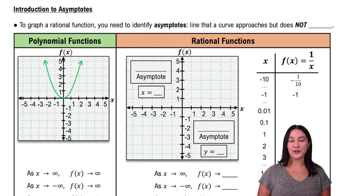
Introduction to Asymptotes