The functions in Exercises 93–95 are all one-to-one. For each function, (a) find an equation for f^(-1)x, the inverse function. (b) Verify that your equation is correct by showing that f(f^(-1)(x)) = x and f^(-1)(f(x)) = x. f(x) = (x - 7)/(x + 2)
Ch. 2 - Functions and Graphs

Chapter 3, Problem 94
Begin by graphing the absolute value function, f(x) = |x|. Then use transformations of this graph to graph the given function. g(x) = -2|x+3|+2
Verified step by step guidance1
Start by graphing the parent function f(x) = |x|. This is a V-shaped graph with its vertex at the origin (0, 0) and symmetry about the y-axis. The graph increases linearly for x > 0 and decreases linearly for x < 0.
Identify the transformations applied to f(x) = |x| to obtain g(x) = -2|x+3|+2. The transformations include: (1) a horizontal shift, (2) a vertical stretch and reflection, and (3) a vertical shift.
Apply the horizontal shift: The term |x+3| indicates a shift 3 units to the left. This moves the vertex of the graph from (0, 0) to (-3, 0).
Apply the vertical stretch and reflection: The coefficient -2 in front of |x+3| stretches the graph vertically by a factor of 2 and reflects it across the x-axis. This makes the V-shape open downward and steeper.
Apply the vertical shift: The +2 at the end of the function shifts the entire graph 2 units upward. The new vertex of the graph is at (-3, 2). Combine all these transformations to sketch the final graph of g(x).

Verified video answer for a similar problem:
This video solution was recommended by our tutors as helpful for the problem above.
Video duration:
6mKey Concepts
Here are the essential concepts you must grasp in order to answer the question correctly.
Absolute Value Function
The absolute value function, denoted as f(x) = |x|, outputs the non-negative value of x. This function has a V-shaped graph that opens upwards, with its vertex at the origin (0,0). Understanding this function is crucial as it serves as the foundation for applying transformations to graph other functions.
Recommended video:
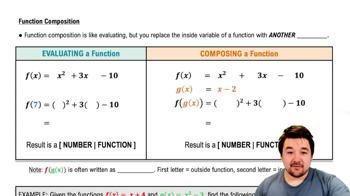
Function Composition
Transformations of Functions
Transformations involve shifting, reflecting, stretching, or compressing the graph of a function. For example, adding a constant inside the absolute value affects horizontal shifts, while adding outside affects vertical shifts. In the function g(x) = -2|x+3|+2, the transformations include a horizontal shift left by 3 units, a vertical stretch by a factor of 2, and a reflection across the x-axis.
Recommended video:
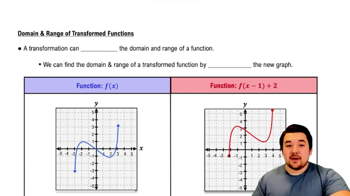
Domain & Range of Transformed Functions
Graphing Techniques
Graphing techniques involve plotting points and understanding how transformations affect the shape and position of a graph. For the function g(x), one must first graph f(x) = |x|, then apply the identified transformations systematically. This process helps visualize the final graph and understand the relationship between the original and transformed functions.
Recommended video:
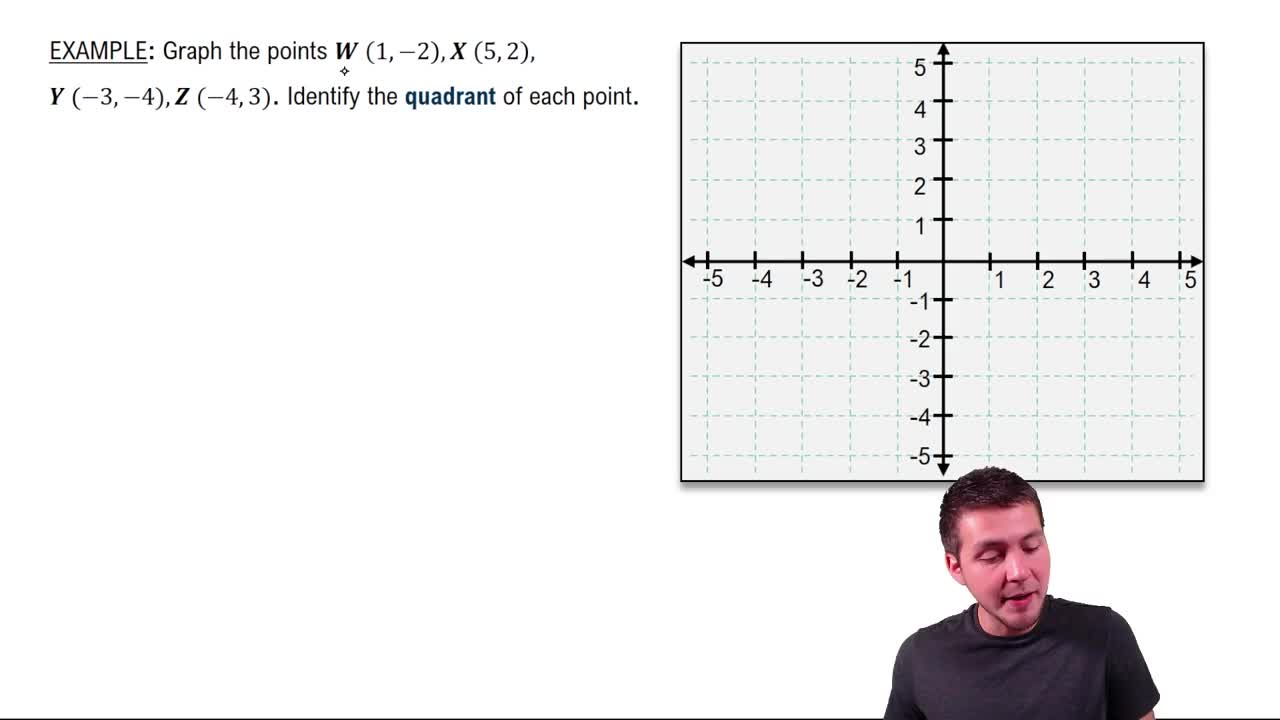
Graphs and Coordinates - Example
Related Practice
Textbook Question
1
views
Textbook Question
Use the graphs of f and g to evaluate each composite function.
(go f) (0)
Textbook Question
Let f(x) = x² − x + 4 and g(x) = 3x – 5. Find g(-1) and f(g(-1)).
Textbook Question
The functions in Exercises 93–95 are all one-to-one. For each function, (a) find an equation for f-1(x), the inverse function. (b) Verify that your equation is correct by showing that f(f-1(x)) = x and f-1(f(x)) = x. f(x) = 4x - 3
Textbook Question
Determine whether each statement is true or false. If the statement is false, make the necessary change(s) to produce a true statement.
If and , find and .
Textbook Question
Let f(x) = x² − x + 4 and g(x) = 3x – 5. Find g (1) and f(g(1)).
