Use intercepts to graph each equation. 6x-3y+15=0
Ch. 2 - Functions and Graphs

Chapter 3, Problem 73
Find a. (fog) (x) b. the domain of f o g.
f(x) = x² + 4, g(x) = √(1 − x)
Verified step by step guidance1
Step 1: Understand the composition of functions. The notation (fog)(x) represents the composition of f and g, meaning f(g(x)). To find this, substitute g(x) into f(x).
Step 2: Substitute g(x) = √(1 − x) into f(x) = x² + 4. This gives f(g(x)) = (√(1 − x))² + 4.
Step 3: Simplify the expression. Since (√(1 − x))² simplifies to 1 − x, the composition becomes f(g(x)) = 1 − x + 4.
Step 4: Combine like terms to simplify further. The final expression for (fog)(x) is f(g(x)) = 5 − x.
Step 5: Determine the domain of f o g. The domain of g(x) is restricted by the square root, so 1 − x ≥ 0, which simplifies to x ≤ 1. Additionally, f(g(x)) must be defined, and since there are no further restrictions in f(g(x)), the domain of f o g is x ≤ 1.

Verified video answer for a similar problem:
This video solution was recommended by our tutors as helpful for the problem above.
Video duration:
2mWas this helpful?
Key Concepts
Here are the essential concepts you must grasp in order to answer the question correctly.
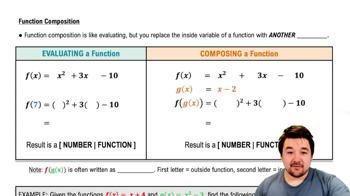
Function Composition
Function composition involves combining two functions, where the output of one function becomes the input of another. In this case, (f o g)(x) means applying g first and then applying f to the result of g. Understanding how to correctly substitute and simplify the expressions is crucial for solving the problem.
Recommended video:
Function Composition
Domain of a Function
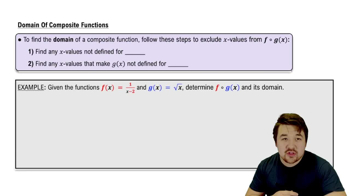
The domain of a function is the set of all possible input values (x-values) for which the function is defined. For the composition of functions, the domain of f o g is determined by the domain of g and the values that g outputs that are also valid inputs for f. This requires analyzing both functions to ensure all inputs are permissible.
Recommended video:
Domain Restrictions of Composed Functions
Square Root Function
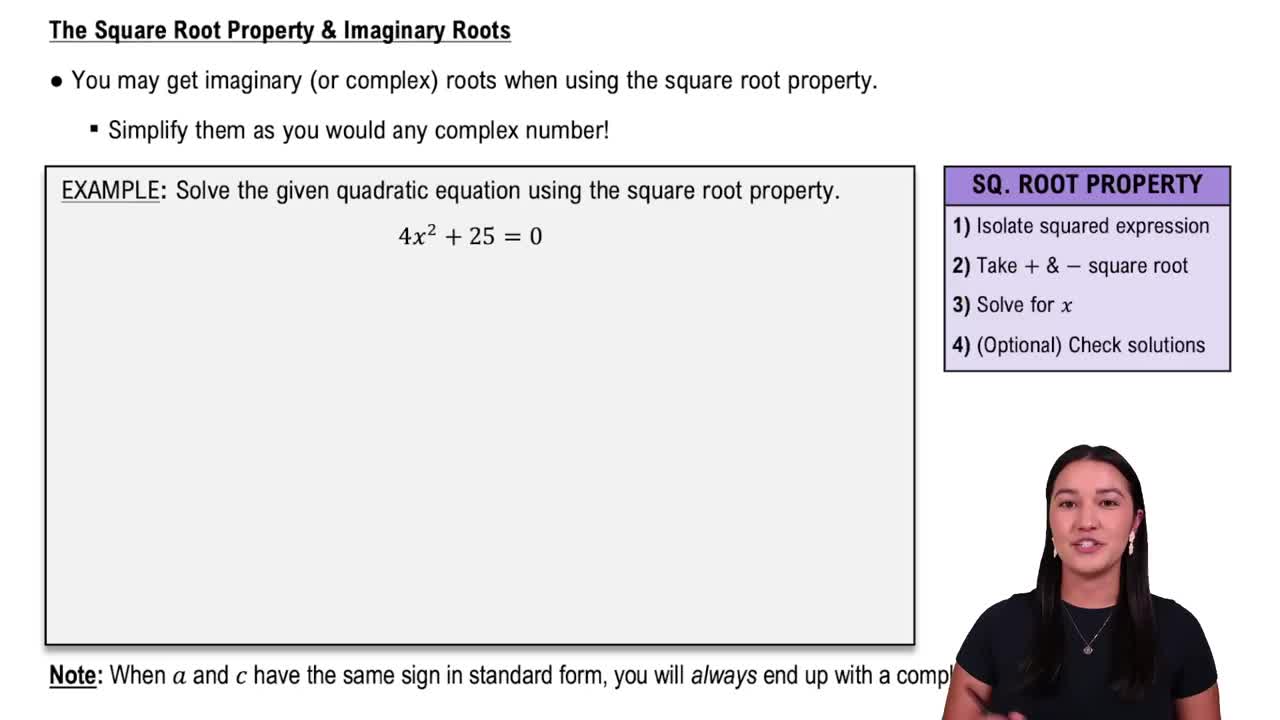
The square root function, denoted as g(x) = √(1 - x), is defined only for non-negative values under the square root. This means that the expression 1 - x must be greater than or equal to zero, which imposes restrictions on the domain of g. Understanding these restrictions is essential for determining the overall domain of the composite function f o g.
Recommended video:
Imaginary Roots with the Square Root Property
Related Practice
Textbook Question
Textbook Question
Begin by graphing the square root function, f(x) = √x. Then use transformations of this graph to graph the given function. h(x)=-√(x + 1)
Textbook Question
Begin by graphing the square root function, f(x) = √x. Then use transformations of this graph to graph the given function. h(x)=√(-x+1)
Textbook Question
Express the given function h as a composition of two functions ƒ and g so that h(x) = (fog) (x).
h(x) = (3x − 1)4
Textbook Question
Find the slope of the line passing through each pair of points or state that the slope is undefined. Assume that all variables represent positive real numbers. Then indicate whether the line through the points rises, falls, is horizontal, or is vertical. (-a, 0) and (0, -b)
Textbook Question
Use the graph of g to solve Exercises 71–76.
Find g(2)