In Exercises 39–50, graph the given functions, f and g, in the same rectangular coordinate system. Select integers for x, starting with -2 and ending with 2. Once you have obtained your graphs, describe how the graph of g is related to the graph of f. f(x) = x², g(x) = x² - 2
Ch. 2 - Functions and Graphs

Chapter 3, Problem 44
In Exercises 41–44, use the given conditions to write an equation for each line in point-slope form and slope-intercept form. Passing through (-3, 6) and perpendicular to the line whose equation is y = (1/3)x + 4
Verified step by step guidance1
Identify the slope of the given line y = (1/3)x + 4. The slope is the coefficient of x, which is 1/3.
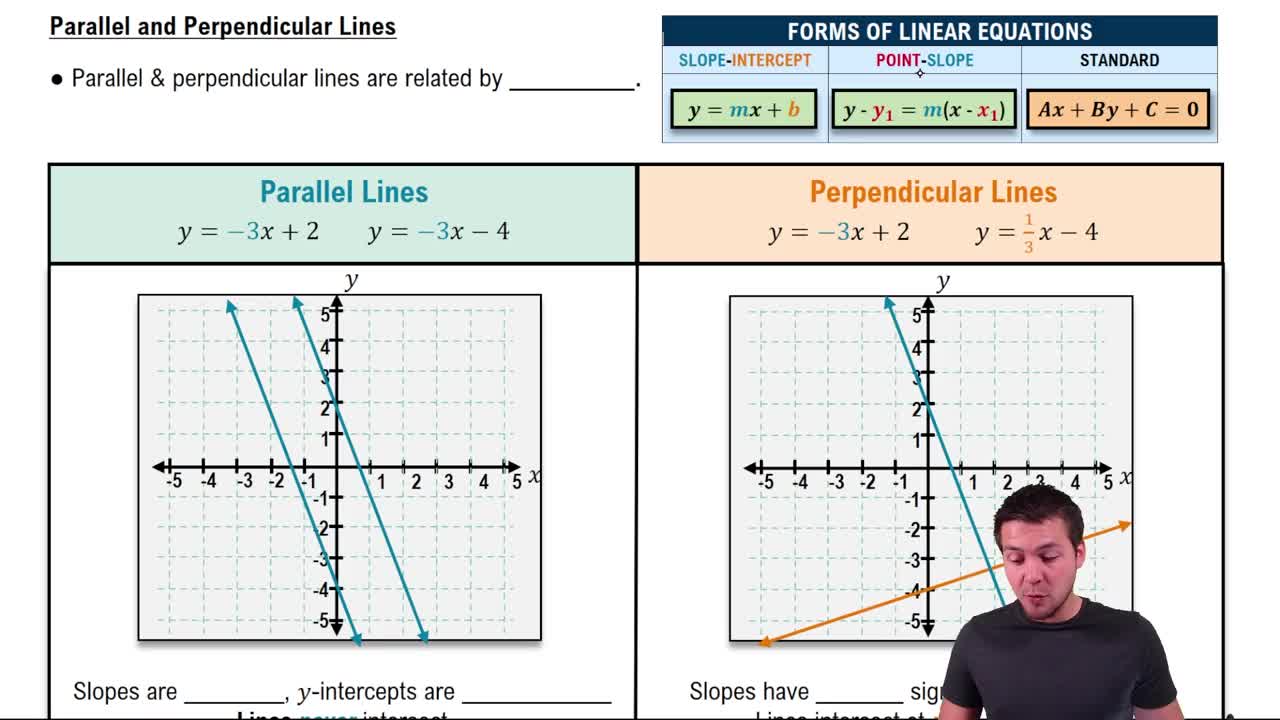
Recall that perpendicular lines have slopes that are negative reciprocals of each other. The negative reciprocal of 1/3 is -3. Therefore, the slope of the desired line is -3.
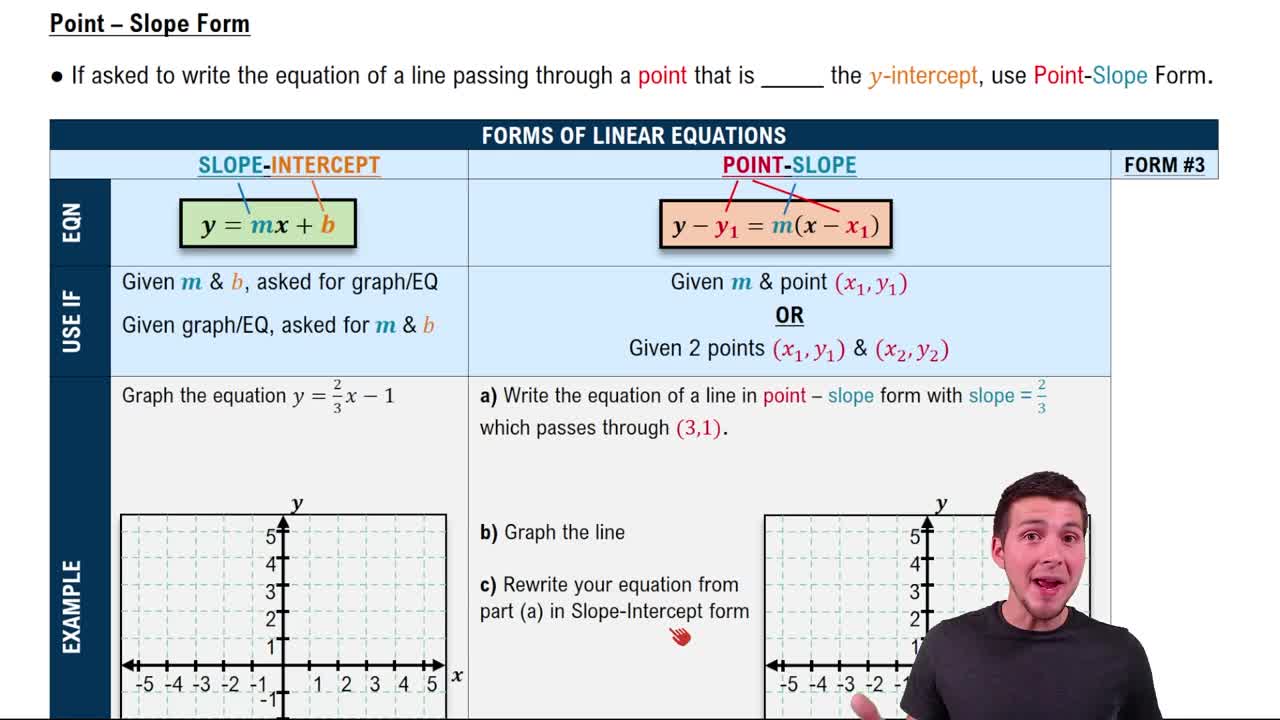
Use the point-slope form of a line equation: y - y₁ = m(x - x₁), where m is the slope and (x₁, y₁) is a point on the line. Substitute m = -3 and the point (-3, 6) into the formula: y - 6 = -3(x + 3).
Simplify the point-slope form equation if needed. For example, distribute the slope -3 to the terms inside the parentheses: y - 6 = -3x - 9.
Convert the equation to slope-intercept form (y = mx + b) by isolating y. Add 6 to both sides: y = -3x - 9 + 6, which simplifies to y = -3x - 3.

Verified video answer for a similar problem:
This video solution was recommended by our tutors as helpful for the problem above.
Video duration:
3mWas this helpful?
Key Concepts
Here are the essential concepts you must grasp in order to answer the question correctly.
Point-Slope Form
Point-slope form is a way to express the equation of a line using a specific point on the line and its slope. The formula is given by y - y1 = m(x - x1), where (x1, y1) is a point on the line and m is the slope. This form is particularly useful for quickly writing the equation of a line when you know a point and the slope.
Recommended video:
Guided course
Point-Slope Form
Slope-Intercept Form
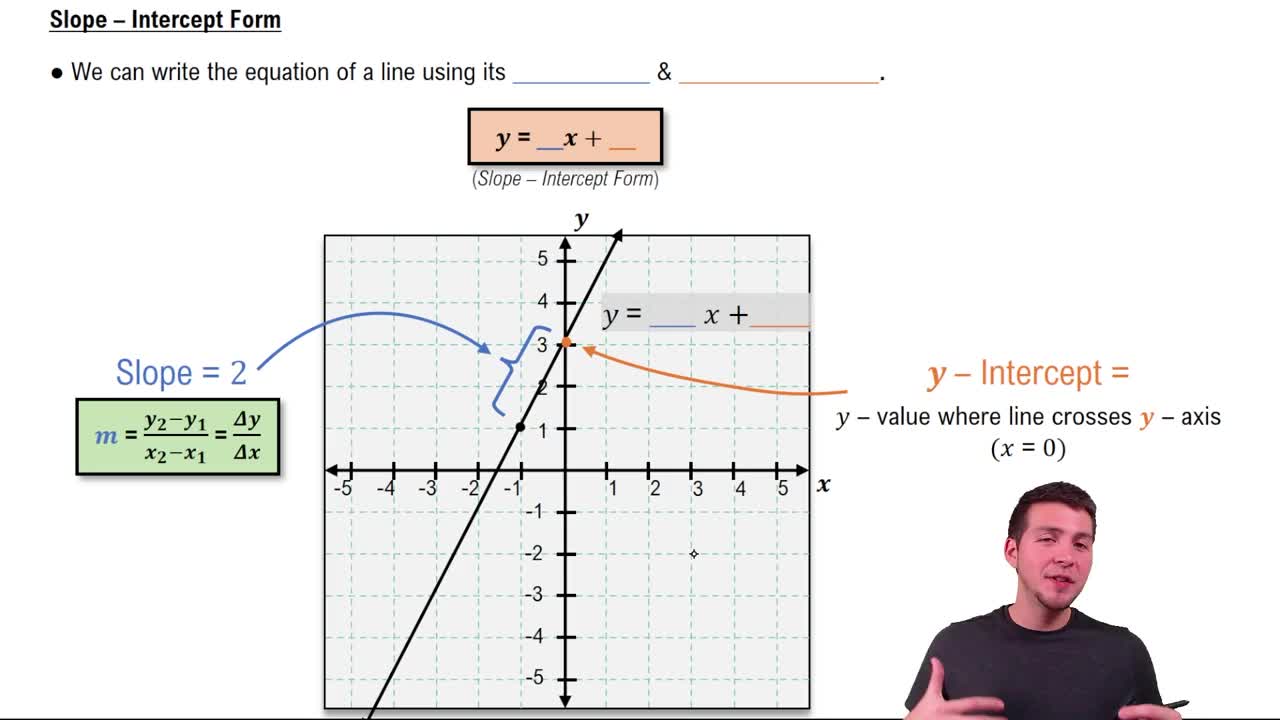
Slope-intercept form is another way to express the equation of a line, defined as y = mx + b, where m is the slope and b is the y-intercept. This form allows for easy identification of the slope and where the line crosses the y-axis. Converting from point-slope to slope-intercept form is a common task in algebra.
Recommended video:
Guided course
Slope-Intercept Form
Perpendicular Lines
Two lines are perpendicular if the product of their slopes is -1. This means that if one line has a slope of m, the slope of a line perpendicular to it will be -1/m. Understanding this relationship is crucial for finding the slope of a line that is perpendicular to a given line, which is necessary for solving the problem at hand.
Recommended video:
Guided course
Parallel & Perpendicular Lines
Related Practice
Textbook Question
Textbook Question
Find ƒ+g, f−g, fg, and f/g. Determine the domain for each function. f(x)= = (3x+1)/(x² - 25), g(x) = (2x -4)/(x² - 25)
3
views
Textbook Question
Find f/g and determine the domain for each function. f(x)= = (5x+1)/(x² - 9), g(x) = (4x -2)/(x² - 9)
5
views
Textbook Question
Find f−g and determine the domain for each function. f(x)= = (5x+1)/(x² - 9), g(x) = (4x -2)/(x² - 9)
Textbook Question
Use the graph of y = f(x) to graph each function g. g(x) = f(x-1) – 1
Textbook Question
Find fg and determine the domain for each function. f(x)= = (5x+1)/(x² - 9), g(x) = (4x -2)/(x² - 9)
1
views
