In Exercises 39–50, graph the given functions, f and g, in the same rectangular coordinate system. Select integers for x, starting with -2 and ending with 2. Once you have obtained your graphs, describe how the graph of g is related to the graph of f. f(x) = x², g(x) = x² - 2
Ch. 2 - Functions and Graphs

Chapter 3, Problem 43d
Find f/g and determine the domain for each function. f(x)= = (5x+1)/(x² - 9), g(x) = (4x -2)/(x² - 9)
Verified step by step guidance1
Step 1: Understand the problem. You are tasked with finding the quotient of two functions, f(x) and g(x), which is represented as (f/g)(x) = f(x)/g(x). Additionally, you need to determine the domain of the resulting function.
Step 2: Write the given functions. f(x) = (5x + 1)/(x² - 9) and g(x) = (4x - 2)/(x² - 9). To find (f/g)(x), divide f(x) by g(x): (f/g)(x) = [f(x)] / [g(x)].
Step 3: Simplify the division. Dividing two fractions involves multiplying the numerator of the first fraction by the reciprocal of the second fraction. So, (f/g)(x) = [(5x + 1)/(x² - 9)] * [(x² - 9)/(4x - 2)].
Step 4: Cancel out common factors. Notice that (x² - 9) appears in both the numerator and denominator, so it cancels out, leaving (f/g)(x) = (5x + 1)/(4x - 2).
Step 5: Determine the domain. The domain of a function is the set of all x-values for which the function is defined. For (f/g)(x), the denominator of both f(x) and g(x) must not be zero, and g(x) itself must not be zero. Solve x² - 9 = 0 to find x-values that make the denominator zero, and solve 4x - 2 = 0 to find x-values that make g(x) zero. Exclude these values from the domain.

Verified video answer for a similar problem:
This video solution was recommended by our tutors as helpful for the problem above.
Video duration:
11mWas this helpful?
Key Concepts
Here are the essential concepts you must grasp in order to answer the question correctly.
Rational Functions
Rational functions are expressions formed by the ratio of two polynomials. In this case, f(x) and g(x) are both rational functions, where the numerator and denominator are polynomials. Understanding how to manipulate and simplify these functions is crucial for finding their quotient and determining their domains.
Recommended video:
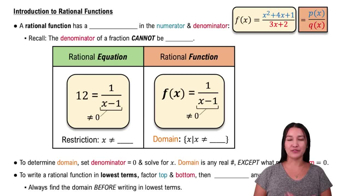
Intro to Rational Functions
Domain of a Function
The domain of a function refers to the set of all possible input values (x-values) for which the function is defined. For rational functions, the domain is restricted by values that make the denominator zero, as division by zero is undefined. Identifying these restrictions is essential for determining the valid inputs for f/g.
Recommended video:
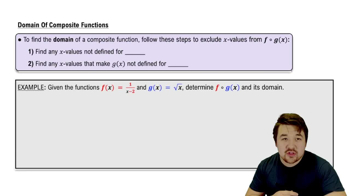
Domain Restrictions of Composed Functions
Quotient of Functions
The quotient of two functions, denoted as f/g, is calculated by dividing the output of function f by the output of function g. This operation requires careful attention to the domains of both functions to ensure that the resulting function is defined. Additionally, simplifying the quotient may involve factoring and canceling common terms in the numerator and denominator.
Recommended video:
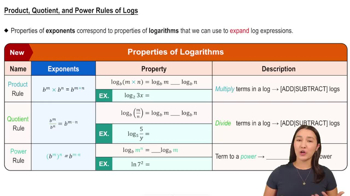
Product, Quotient, and Power Rules of Logs
Related Practice
Textbook Question
Textbook Question
In Exercises 39-52, a. Find an equation for ƒ¯¹(x). b. Graph ƒ and ƒ¯¹(x) in the same rectangular coordinate system. c. Use interval notation to give the domain and the range off and ƒ¯¹. f(x) = (x − 1)², x ≤ 1
Textbook Question
Find ƒ+g, f−g, fg, and f/g. Determine the domain for each function. f(x)= = (3x+1)/(x² - 25), g(x) = (2x -4)/(x² - 25)
3
views
Textbook Question
Find f−g and determine the domain for each function. f(x)= = (5x+1)/(x² - 9), g(x) = (4x -2)/(x² - 9)
Textbook Question
In Exercises 41–44, use the given conditions to write an equation for each line in point-slope form and slope-intercept form. Passing through (-3, 6) and perpendicular to the line whose equation is y = (1/3)x + 4
Textbook Question
Find fg and determine the domain for each function. f(x)= = (5x+1)/(x² - 9), g(x) = (4x -2)/(x² - 9)
1
views
