Ch. 2 - Functions and Graphs
Blitzer - College Algebra 8th Edition
Blitzer8th EditionCollege AlgebraISBN: 9780136970514Not the one you use?Change textbook
Chapter 3, Problem 46

Give the slope and y-intercept of each line whose equation is given. Then graph the linear function. y = -2x/5+6

Verified step by step guidance
1
Identify the given linear equation: \(y = -\frac{2x}{5} + 6\).
Rewrite the equation in slope-intercept form \(y = mx + b\), where \(m\) is the slope and \(b\) is the y-intercept. Here, the equation is already in this form with \(m = -\frac{2}{5}\) and \(b = 6\).
Determine the slope \(m = -\frac{2}{5}\), which means the line falls 2 units vertically for every 5 units it moves horizontally to the right.
Identify the y-intercept \(b = 6\), which is the point where the line crosses the y-axis, at \((0, 6)\).
To graph the line, start by plotting the y-intercept \((0, 6)\) on the coordinate plane, then use the slope to find another point by moving 5 units to the right and 2 units down, and draw the line through these points.

Verified video answer for a similar problem:

This video solution was recommended by our tutors as helpful for the problem above.
Video duration:
2m
Was this helpful?

Key Concepts

Here are the essential concepts you must grasp in order to answer the question correctly.

Slope of a Linear Function

The slope represents the rate of change of the function and indicates how steep the line is. It is the coefficient of x in the equation y = mx + b, where m is the slope. A negative slope means the line decreases as x increases.
Recommended video:
06:07
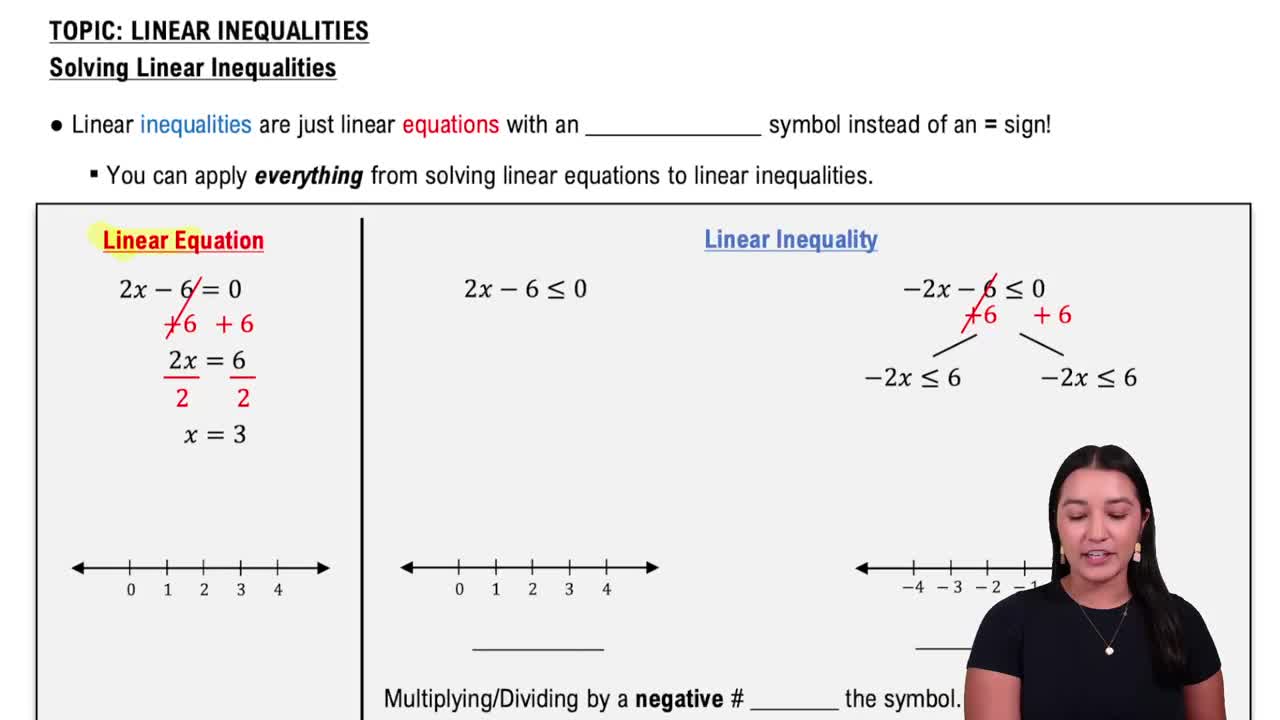
Linear Inequalities

Y-Intercept of a Linear Function

The y-intercept is the point where the line crosses the y-axis, given by the constant term b in y = mx + b. It shows the value of y when x is zero and helps in graphing the line accurately.
Recommended video:
06:07
Linear Inequalities

Graphing Linear Functions

Graphing involves plotting the y-intercept on the coordinate plane and using the slope to find other points by rising and running from the intercept. Connecting these points forms the line representing the function.
Recommended video:
5:26
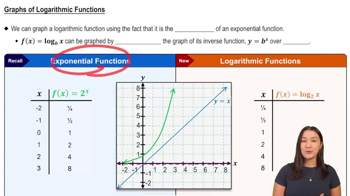
Graphs of Logarithmic Functions