In Exercises 39-52, a. Find an equation for ƒ¯¹(x). b. Graph ƒ and ƒ¯¹(x) in the same rectangular coordinate system. c. Use interval notation to give the domain and the range off and ƒ¯¹. f(x) = x³ − 1
Ch. 2 - Functions and Graphs

Chapter 3, Problem 45d
Find f/g and determine the domain for each function. f(x)= = 8x/(x - 2), g(x) = 6/(x+3)
Verified step by step guidance1
Step 1: Understand the problem. You are tasked with finding the quotient of two functions, f(x) and g(x), which is represented as (f/g)(x) = f(x)/g(x). Additionally, you need to determine the domain of the resulting function.
Step 2: Write the expression for (f/g)(x). Substitute the given functions into the formula: (f/g)(x) = (8x / (x - 2)) / (6 / (x + 3)).
Step 3: Simplify the division of fractions. Recall that dividing by a fraction is equivalent to multiplying by its reciprocal. Rewrite the expression as: (f/g)(x) = (8x / (x - 2)) * ((x + 3) / 6).
Step 4: Multiply the numerators and denominators. Combine the fractions: (f/g)(x) = (8x * (x + 3)) / ((x - 2) * 6). Simplify the numerator and denominator if possible.
Step 5: Determine the domain. The domain of (f/g)(x) is all real numbers except where the denominator equals zero. Identify the restrictions by setting (x - 2) = 0 and (x + 3) = 0, and exclude these values from the domain. Additionally, exclude any x-values that make g(x) = 0, as division by zero is undefined.

Verified video answer for a similar problem:
This video solution was recommended by our tutors as helpful for the problem above.
Video duration:
5mWas this helpful?
Key Concepts
Here are the essential concepts you must grasp in order to answer the question correctly.
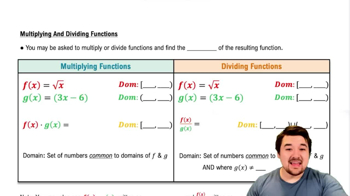
Function Division
Function division involves creating a new function by dividing one function by another. In this case, f/g means taking the function f(x) and dividing it by g(x). The resulting function will be expressed as (8x/(x - 2)) / (6/(x + 3)), which can be simplified by multiplying by the reciprocal of g(x).
Recommended video:
Multiplying & Dividing Functions
Domain of a Function
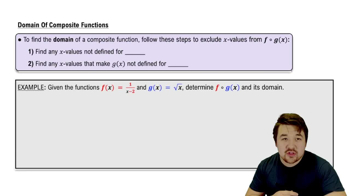
The domain of a function is the set of all possible input values (x-values) for which the function is defined. For rational functions, the domain is restricted by values that make the denominator zero. In this case, we need to identify values of x that would make either g(x) or the denominator of f(x) equal to zero.
Recommended video:
Domain Restrictions of Composed Functions
Finding Restrictions
When determining the domain of the function f/g, it is essential to find the restrictions imposed by the denominators of both f(x) and g(x). Specifically, we need to solve the equations x - 2 = 0 and x + 3 = 0 to find the values of x that must be excluded from the domain, which are x = 2 and x = -3.
Recommended video:
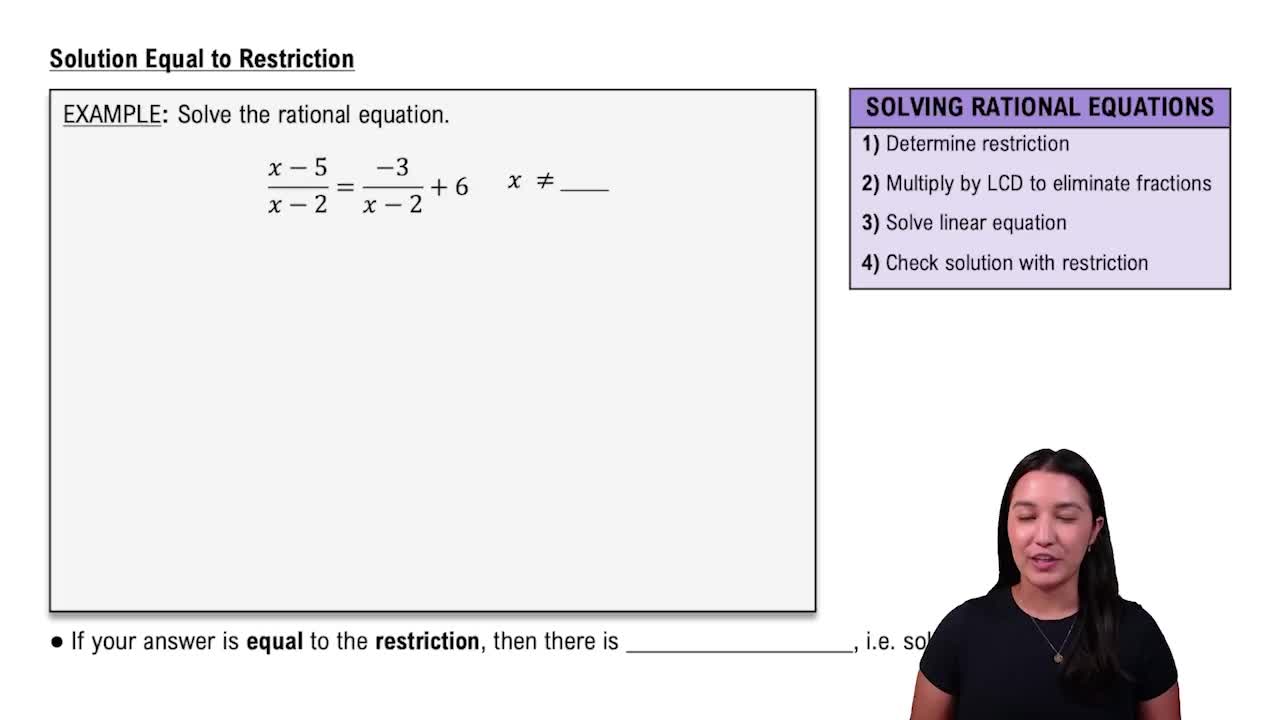
Restrictions on Rational Equations
Related Practice
Textbook Question
Textbook Question
Find fg and determine the domain for each function. f(x)= = 8x/(x - 2), g(x) = 6/(x+3)
Textbook Question
Solve: 2x2/3 - 5x1/3 -3 = 0.
7
views
Textbook Question
In Exercises 39–50, graph the given functions, f and g, in the same rectangular coordinate system. Select integers for x, starting with -2 and ending with 2. Once you have obtained your graphs, describe how the graph of g is related to the graph of f. f(x)= |x|, g(x) = |x| +1
Textbook Question
Give the slope and y-intercept of each line whose equation is given. Then graph the linear function. y = -2x/5+6
Textbook Question
Find f−g and determine the domain for each function. f(x)= = 8x/(x - 2), g(x) = 6/(x+3)
1
views