Ch. 2 - Functions and Graphs
Blitzer - College Algebra 8th Edition
Blitzer8th EditionCollege AlgebraISBN: 9780136970514Not the one you use?Change textbook
Chapter 3, Problem 39d

Find f/g and determine the domain for each function. f(x) = √x, g(x) = x − 4

Verified step by step guidance
1
Step 1: Understand the problem. We are tasked with finding the quotient of two functions, f(x) and g(x), which is represented as (f/g)(x) = f(x)/g(x). Additionally, we need to determine the domain of the resulting function.
Step 2: Write the quotient of the functions. Substitute the given functions into the formula: (f/g)(x) = f(x)/g(x) = √x / (x - 4).
Step 3: Analyze the domain of f(x). The function f(x) = √x is defined only when x ≥ 0, because the square root of a negative number is not a real number. This gives the restriction x ≥ 0.
Step 4: Analyze the domain of g(x). The function g(x) = x - 4 is defined for all real numbers except when x = 4, because division by zero is undefined. This gives the restriction x ≠ 4.
Step 5: Combine the restrictions. The domain of (f/g)(x) is the set of all x-values that satisfy both restrictions: x ≥ 0 and x ≠ 4. Write the domain in interval notation, excluding x = 4 from the valid range.

Verified video answer for a similar problem:

This video solution was recommended by our tutors as helpful for the problem above.
Video duration:
3m
Was this helpful?

Key Concepts

Here are the essential concepts you must grasp in order to answer the question correctly.

Function Division

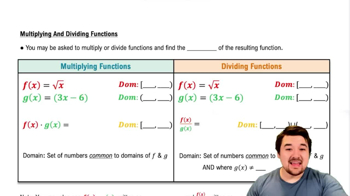
Function division involves creating a new function by dividing one function by another. In this case, f/g means f(x) divided by g(x), which requires understanding how to manipulate and simplify the resulting expression. The division must also consider the values of x that make the denominator zero, as these values are excluded from the domain.
Recommended video:
7:24
Multiplying & Dividing Functions

Domain of a Function

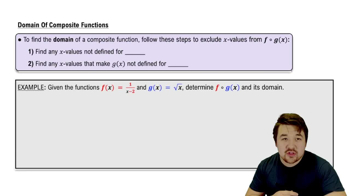
The domain of a function is the set of all possible input values (x-values) for which the function is defined. For the function f/g, the domain must exclude any values that make the denominator zero, as well as any values that would result in undefined expressions, such as negative values under a square root in f(x).
Recommended video:
3:51
Domain Restrictions of Composed Functions

Square Root Function

The square root function, denoted as √x, is defined only for non-negative values of x. This means that for f(x) = √x, the input x must be greater than or equal to zero. Understanding this restriction is crucial when determining the overall domain of the function f/g, as it will affect the valid input values for the combined function.
Recommended video:
02:20
Imaginary Roots with the Square Root Property