Use the vertical line test to identify graphs in which y is a function of x.
Ch. 2 - Functions and Graphs

Chapter 3, Problem 15
Find the average rate of change of the function from x1 to x2. f(x) = x² + 2x from x1 = 3 to x2 = 5
Verified step by step guidance1
Identify the function given: \(f(x) = x^{2} + 2x\).
Note the interval over which to find the average rate of change: from \(x_1 = 3\) to \(x_2 = 5\).
Calculate the function values at the endpoints: find \(f(3)\) and \(f(5)\) by substituting \(x = 3\) and \(x = 5\) into the function.
Use the formula for average rate of change: \(\frac{f(x_2) - f(x_1)}{x_2 - x_1}\).
Substitute the values of \(f(5)\), \(f(3)\), \(x_2\), and \(x_1\) into the formula and simplify the expression to find the average rate of change.

Verified video answer for a similar problem:
This video solution was recommended by our tutors as helpful for the problem above.
Video duration:
3mWas this helpful?
Key Concepts
Here are the essential concepts you must grasp in order to answer the question correctly.
Average Rate of Change
The average rate of change of a function over an interval measures how much the function's output changes per unit change in input. It is calculated as the difference in function values divided by the difference in input values, similar to the slope of a secant line between two points on the graph.
Recommended video:
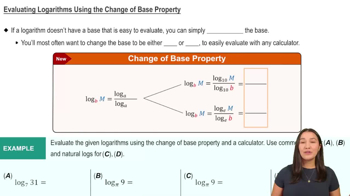
Change of Base Property
Function Evaluation
Function evaluation involves substituting specific input values into the function to find corresponding output values. For example, to find f(3) and f(5) for f(x) = x² + 2x, substitute 3 and 5 into the expression and simplify to get the function values needed for the average rate of change.
Recommended video:
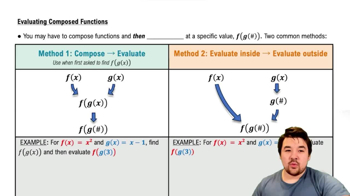
Evaluating Composed Functions
Quadratic Functions
A quadratic function is a polynomial of degree two, typically in the form f(x) = ax² + bx + c. Its graph is a parabola, and understanding its shape helps interpret changes in function values. Here, f(x) = x² + 2x is quadratic, so its rate of change varies across intervals.
Recommended video:
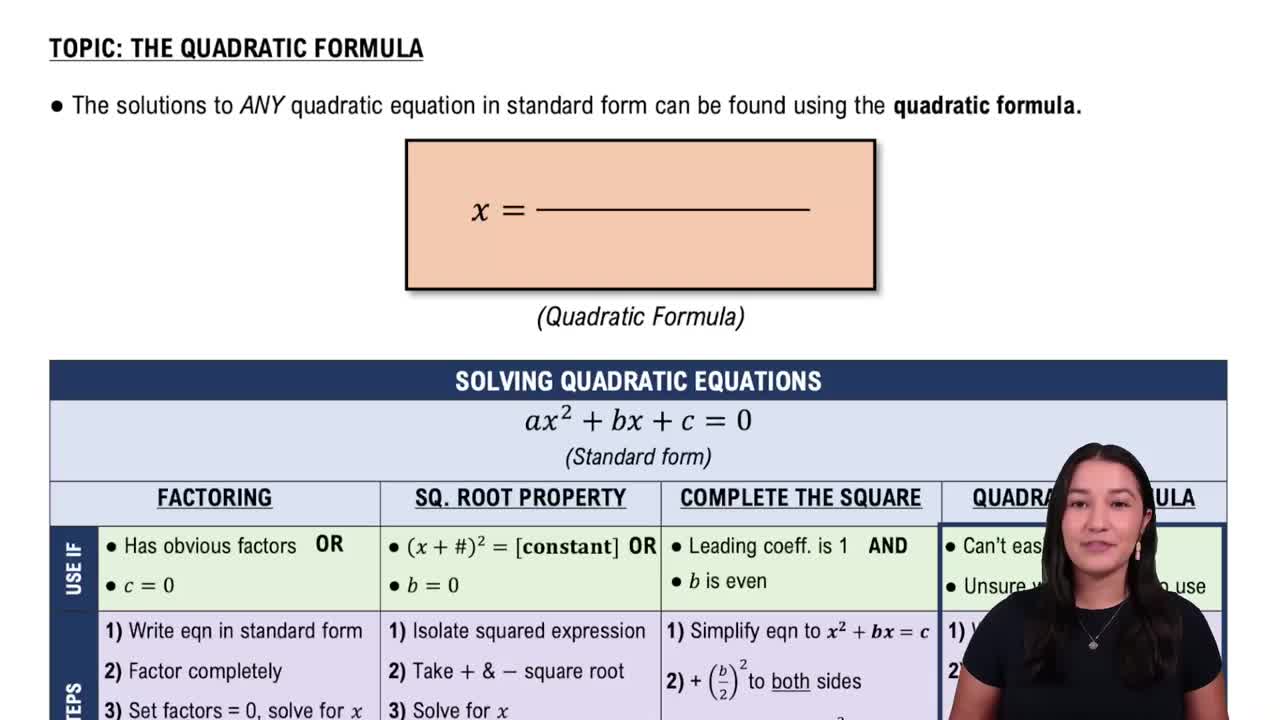
Solving Quadratic Equations Using The Quadratic Formula
Related Practice
Textbook Question
Textbook Question
Use the graph of y = f(x) to graph each function g.
g(x) = −ƒ( x/2) +1
1
views
Textbook Question
Use the given conditions to write an equation for each line in point-slope form and slope-intercept form. Slope = 8, passing through (4, −1)
1
views
Textbook Question
The functions in Exercises 11-28 are all one-to-one. For each function, a. Find an equation for f-1(x), the inverse function. b. Verify that your equation is correct by showing that f(ƒ-1 (x)) = = x and ƒ-1 (f(x)) = x. f(x) = 2x + 3
Textbook Question
Find the distance between each pair of points. If necessary, express answers in simplified radical form and then round to two decimal places. (3√3, √5) and (−√3, 4√5)
1
views
Textbook Question
In Exercises 11–26, determine whether each equation defines y as a function of x. x² + y = 25