Ch. 1 - Equations and Inequalities
Blitzer - College Algebra 8th Edition
Blitzer8th EditionCollege AlgebraISBN: 9780136970514Not the one you use?Change textbook
Chapter 2, Problem 97

Solve each equation in Exercises 83–108 by the method of your choice. 4x216=04x^2 - 16 = 0

Verified step by step guidance
1
Start with the given equation: \(4x^2 - 16 = 0\).
Add 16 to both sides to isolate the quadratic term: \(4x^2 = 16\).
Divide both sides by 4 to simplify: \(x^2 = 4\).
Take the square root of both sides, remembering to include both positive and negative roots: \(x = \pm \sqrt{4}\).
Simplify the square root to find the two possible values for \(x\).

Verified video answer for a similar problem:

This video solution was recommended by our tutors as helpful for the problem above.
Video duration:
1m
Was this helpful?

Key Concepts

Here are the essential concepts you must grasp in order to answer the question correctly.

Solving Quadratic Equations

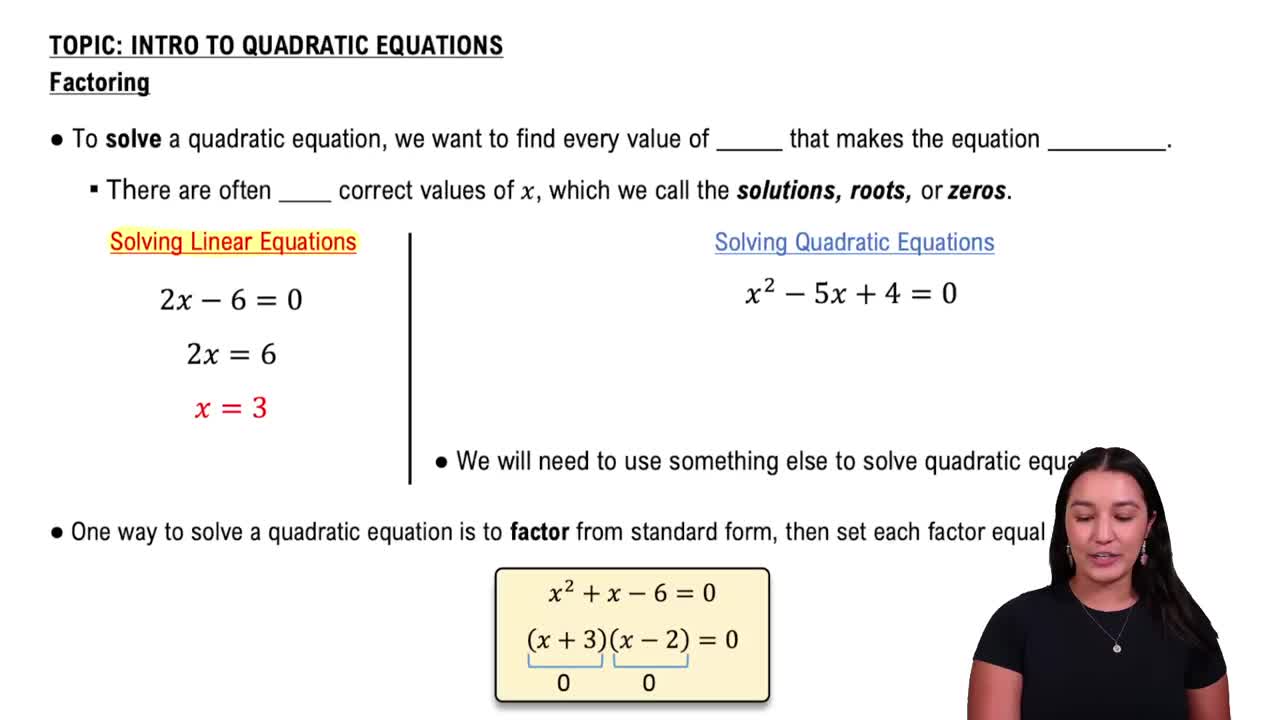
A quadratic equation is a polynomial equation of degree two, typically in the form ax² + bx + c = 0. Solving it involves finding values of x that satisfy the equation. Common methods include factoring, using the quadratic formula, completing the square, or isolating terms.
Recommended video:
06:08
Solving Quadratic Equations by Factoring

Factoring Quadratic Expressions

Factoring involves rewriting a quadratic expression as a product of two binomials or simpler expressions. This method is useful when the quadratic can be expressed as (mx + n)(px + q) = 0, allowing the use of the zero product property to find solutions.
Recommended video:
06:08
Solving Quadratic Equations by Factoring

Zero Product Property

The zero product property states that if the product of two factors equals zero, then at least one of the factors must be zero. This principle is essential when solving equations after factoring, as it allows setting each factor equal to zero to find the roots.
Recommended video:
3:49
Product, Quotient, and Power Rules of Logs