Ch. 1 - Equations and Inequalities
Blitzer - College Algebra 8th Edition
Blitzer8th EditionCollege AlgebraISBN: 9780136970514Not the one you use?Change textbook
Chapter 2, Problem 96a

Use interval notation to represent all values of x satisfying the given conditions. y1 = (2/3)(6x - 9) + 4, y2 = 5x + 1, and y1 > y2

Verified step by step guidance
1
Step 1: Start by setting up the inequality y1 > y2. Substitute the given expressions for y1 and y2 into the inequality: \( \frac{2}{3}(6x - 9) + 4 > 5x + 1 \).
Step 2: Simplify the left-hand side of the inequality. Distribute \( \frac{2}{3} \) across \( (6x - 9) \): \( \frac{2}{3} \cdot 6x - \frac{2}{3} \cdot 9 + 4 > 5x + 1 \). This simplifies to \( 4x - 6 + 4 > 5x + 1 \).
Step 3: Combine like terms on the left-hand side: \( 4x - 2 > 5x + 1 \).
Step 4: Isolate x by subtracting \( 4x \) from both sides: \( -2 > x + 1 \). Then subtract 1 from both sides: \( -3 > x \), or equivalently \( x < -3 \).
Step 5: Represent the solution in interval notation. Since \( x < -3 \), the interval is \( (-\infty, -3) \).

Verified video answer for a similar problem:

This video solution was recommended by our tutors as helpful for the problem above.
Video duration:
4m
Was this helpful?

Key Concepts

Here are the essential concepts you must grasp in order to answer the question correctly.

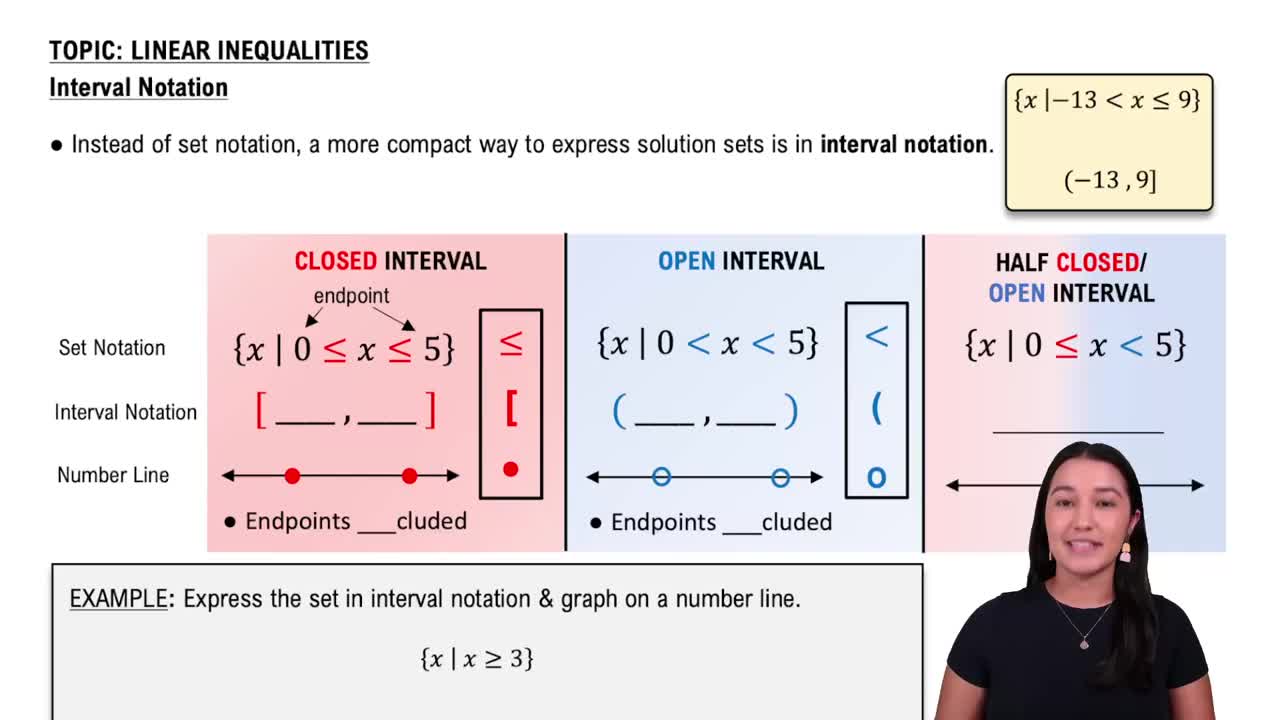
Interval Notation

Interval notation is a mathematical notation used to represent a range of values on the number line. It uses parentheses and brackets to indicate whether endpoints are included (closed intervals) or excluded (open intervals). For example, the interval (2, 5] includes all numbers greater than 2 and up to 5, including 5 but not 2.
Recommended video:
05:18
Interval Notation

Inequalities

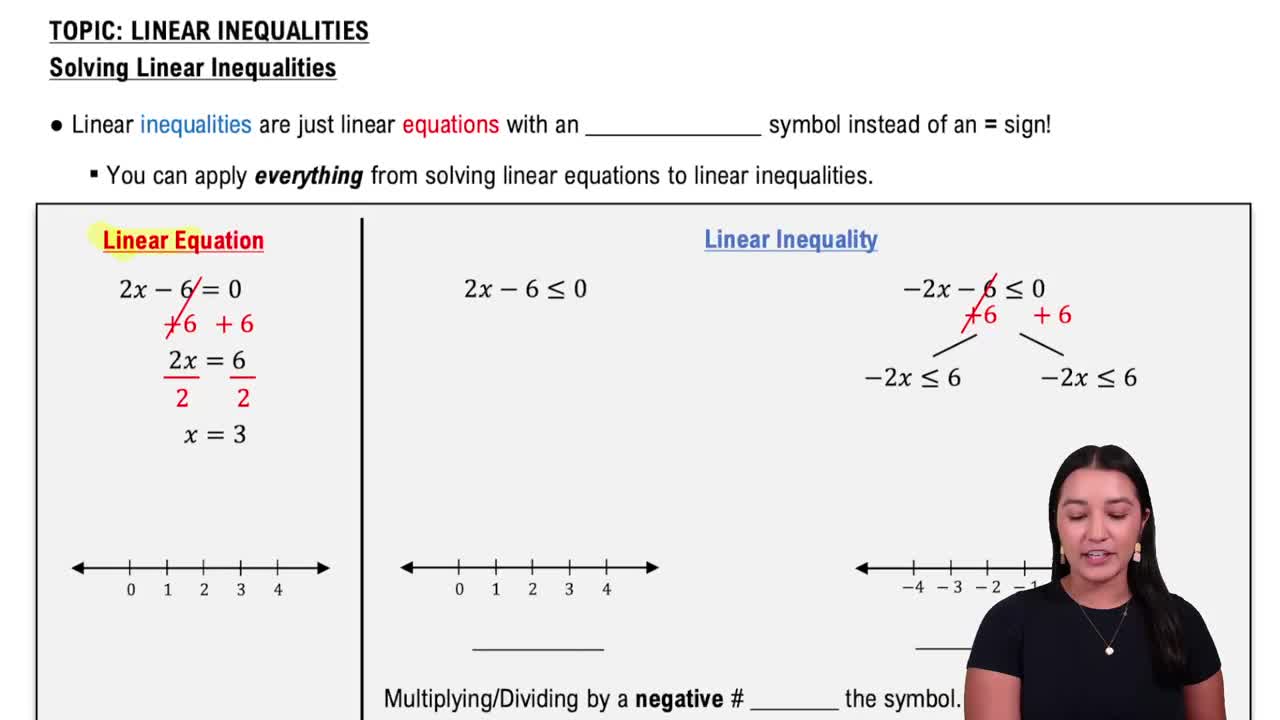
Inequalities express the relationship between two expressions that are not necessarily equal. In this context, the inequality y1 > y2 indicates that the values of y1 must be greater than those of y2 for certain values of x. Understanding how to manipulate and solve inequalities is crucial for determining the range of x that satisfies the given condition.
Recommended video:
06:07
Linear Inequalities

Linear Functions

Linear functions are mathematical expressions that create a straight line when graphed. They can be represented in the form y = mx + b, where m is the slope and b is the y-intercept. In this problem, both y1 and y2 are linear functions of x, and analyzing their intersection points will help determine the values of x that satisfy the inequality.
Recommended video:
06:07
Linear Inequalities