Ch. 1 - Equations and Inequalities
Blitzer - College Algebra 8th Edition
Blitzer8th EditionCollege AlgebraISBN: 9780136970514Not the one you use?Change textbook
Chapter 2, Problem 87

Solve each equation in Exercises 83–108 by the method of your choice. 3x2=603x^2 = 60

Verified step by step guidance
1
Start with the given equation: \(3x^2 = 60\).
Isolate the \(x^2\) term by dividing both sides of the equation by 3: \(x^2 = \frac{60}{3}\).
Simplify the right side to get \(x^2 = 20\).
To solve for \(x\), take the square root of both sides: \(x = \pm \sqrt{20}\).
Simplify the square root if possible to express the solution in simplest radical form.

Verified video answer for a similar problem:

This video solution was recommended by our tutors as helpful for the problem above.
Video duration:
1m
Was this helpful?

Key Concepts

Here are the essential concepts you must grasp in order to answer the question correctly.

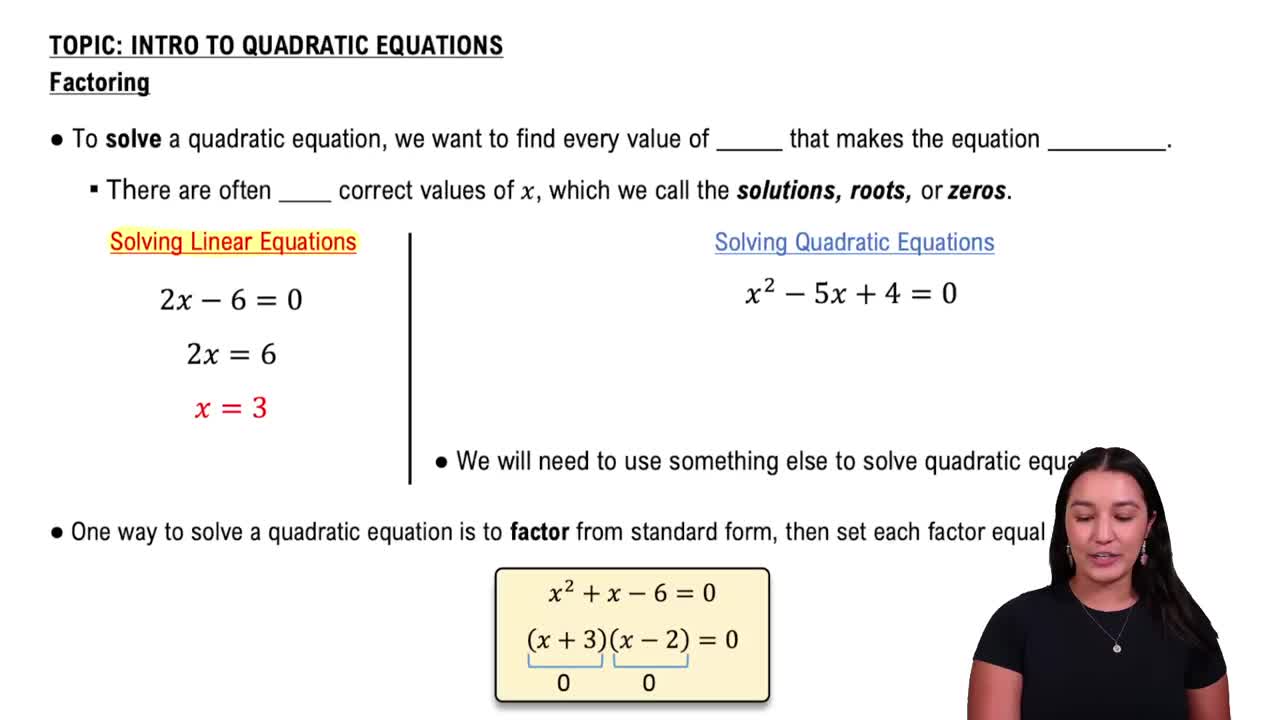
Solving Quadratic Equations

A quadratic equation is a polynomial equation of degree two, typically in the form ax² + bx + c = 0. Solving such equations involves finding the values of x that satisfy the equation. Methods include factoring, completing the square, using the quadratic formula, or isolating the variable when possible.
Recommended video:
06:08
Solving Quadratic Equations by Factoring

Isolating the Variable

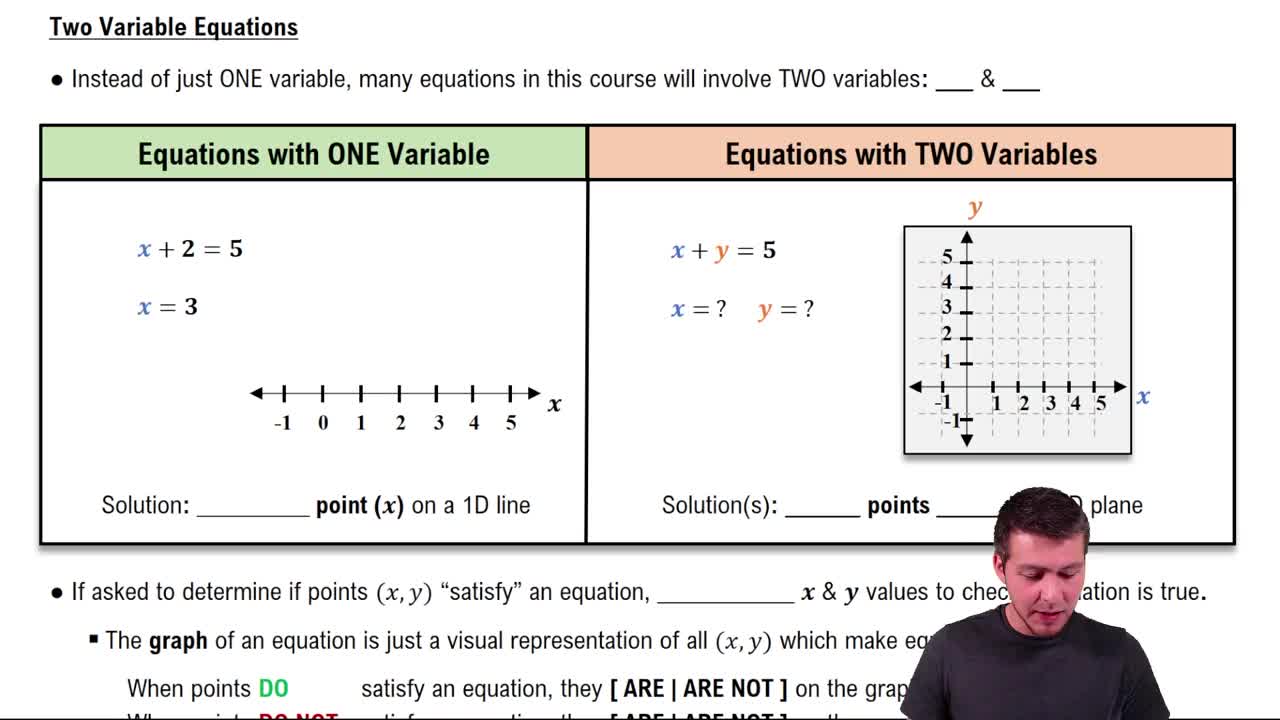
Isolating the variable means manipulating the equation to get the variable alone on one side. This often involves performing inverse operations such as division, multiplication, addition, or subtraction. For example, dividing both sides by the coefficient of x² helps simplify the equation before solving.
Recommended video:
Guided course
05:28
Equations with Two Variables

Square Roots and Their Properties

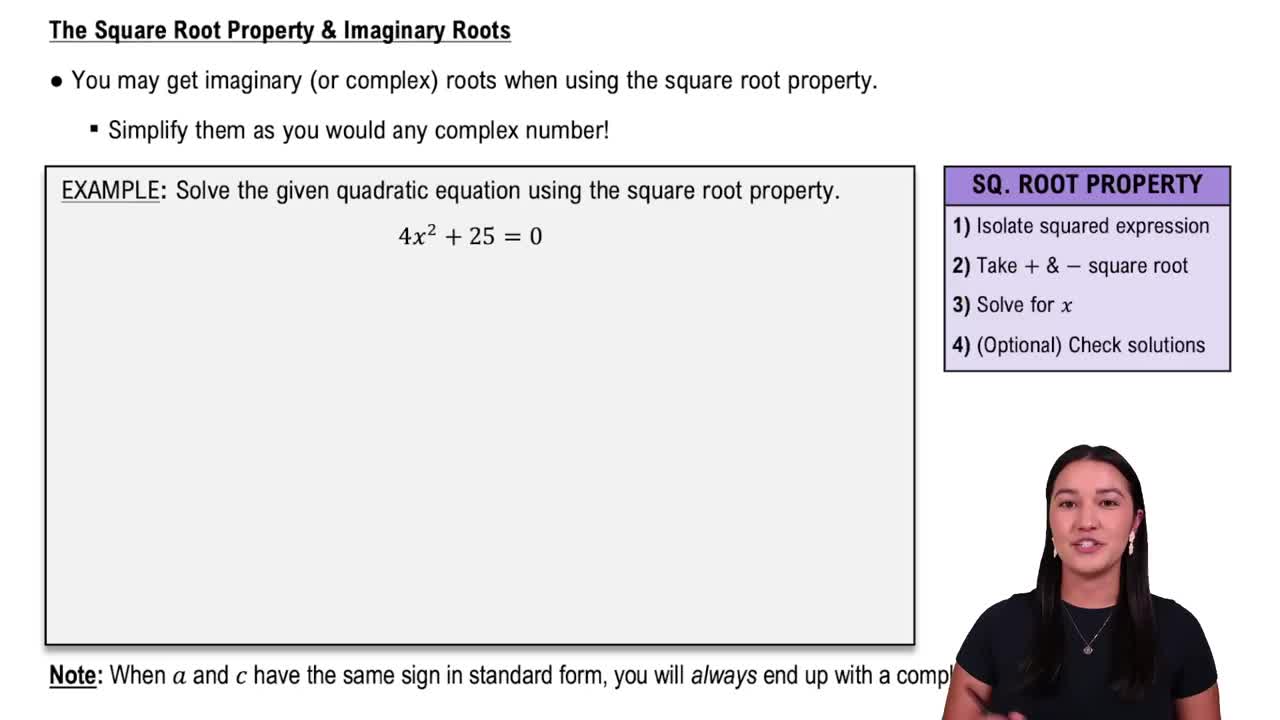
When an equation involves x², taking the square root of both sides can help solve for x. Remember that both positive and negative roots must be considered, since (±√a)² = a. Understanding how to apply square roots correctly is essential for solving quadratic equations without linear terms.
Recommended video:
02:20
Imaginary Roots with the Square Root Property