Exercises 41–60 contain rational equations with variables in denominators. For each equation, a. write the value or values of the variable that make a denominator zero. These are the restrictions on the variable. b. Keeping the restrictions in mind, solve the equation. 5/2x - 8/9 = 1/18 - 1/3x
Ch. 1 - Equations and Inequalities

Chapter 2, Problem 45
Solve each equation in Exercises 41–60 by making an appropriate substitution. x - 13√x + 40 = 0
Verified step by step guidance1
Identify the substitution to simplify the equation. Since the equation contains both \( x \) and \( \sqrt{x} \), let \( t = \sqrt{x} \). This means \( x = t^2 \).
Rewrite the original equation \( x - 13\sqrt{x} + 40 = 0 \) in terms of \( t \). Substitute \( x = t^2 \) and \( \sqrt{x} = t \) to get \( t^2 - 13t + 40 = 0 \).
Recognize that the equation \( t^2 - 13t + 40 = 0 \) is a quadratic equation in standard form. Use factoring, completing the square, or the quadratic formula to solve for \( t \).
After finding the values of \( t \), recall that \( t = \sqrt{x} \). To find \( x \), square each solution for \( t \) to get \( x = t^2 \).
Check each solution for \( x \) in the original equation to ensure it is valid, especially since \( \sqrt{x} \) implies \( x \geq 0 \). Discard any extraneous solutions.

Verified video answer for a similar problem:
This video solution was recommended by our tutors as helpful for the problem above.
Video duration:
4mWas this helpful?
Key Concepts
Here are the essential concepts you must grasp in order to answer the question correctly.
Substitution Method
The substitution method involves replacing a complex expression with a simpler variable to transform the equation into a more manageable form. In this problem, letting √x = t simplifies the equation, making it easier to solve for t before back-substituting to find x.
Recommended video:
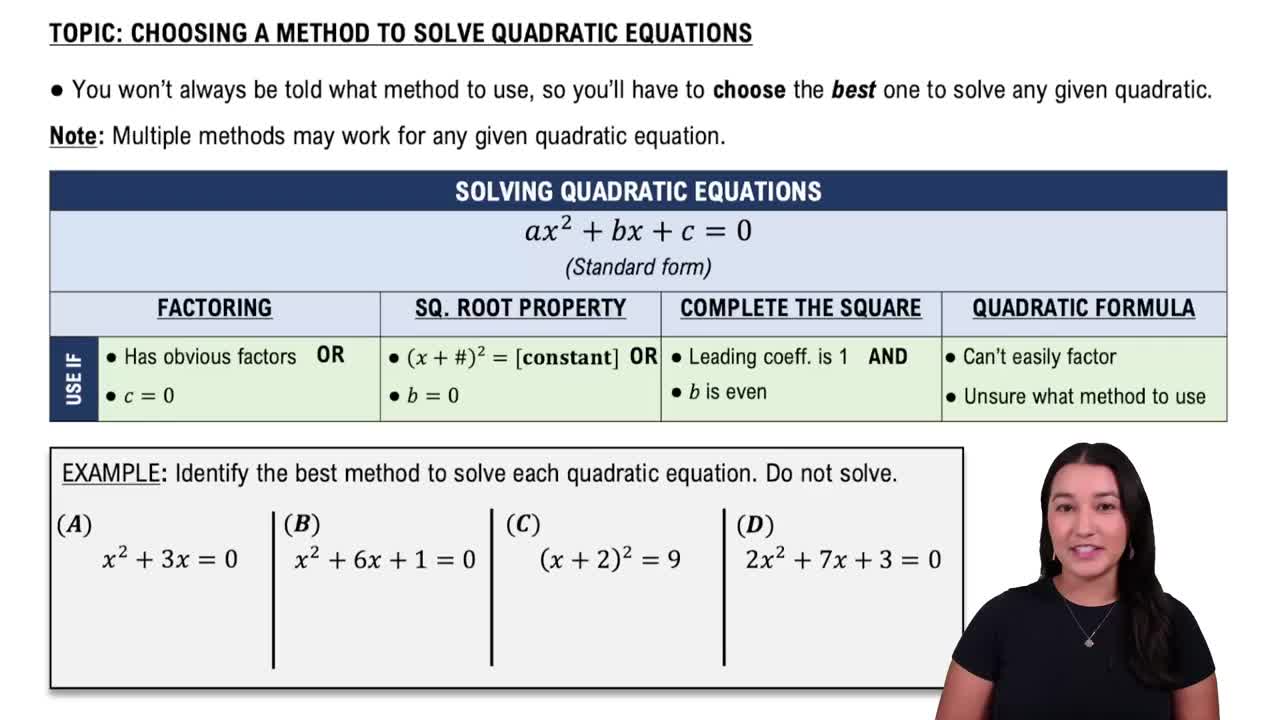
Choosing a Method to Solve Quadratics
Quadratic Equations
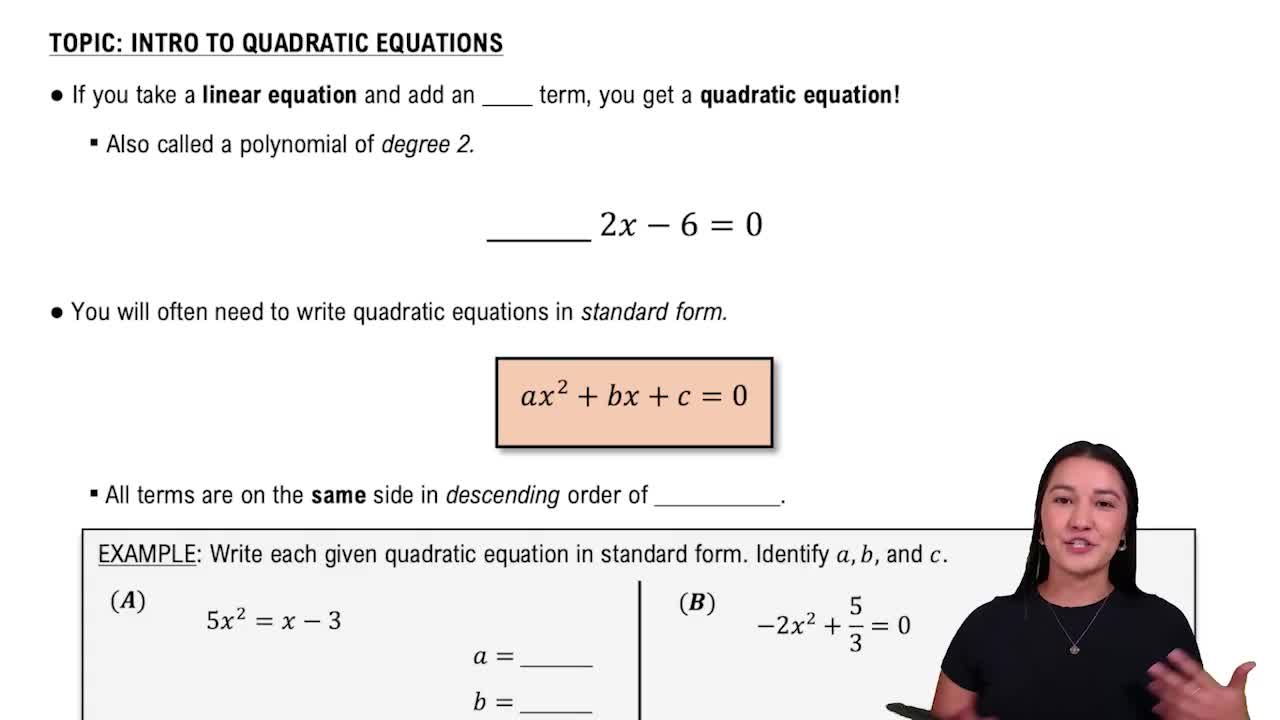
A quadratic equation is a second-degree polynomial equation typically in the form ax² + bx + c = 0. After substitution, the given equation becomes quadratic in terms of the new variable, allowing the use of factoring, completing the square, or the quadratic formula to find solutions.
Recommended video:
Introduction to Quadratic Equations
Domain Restrictions for Square Roots
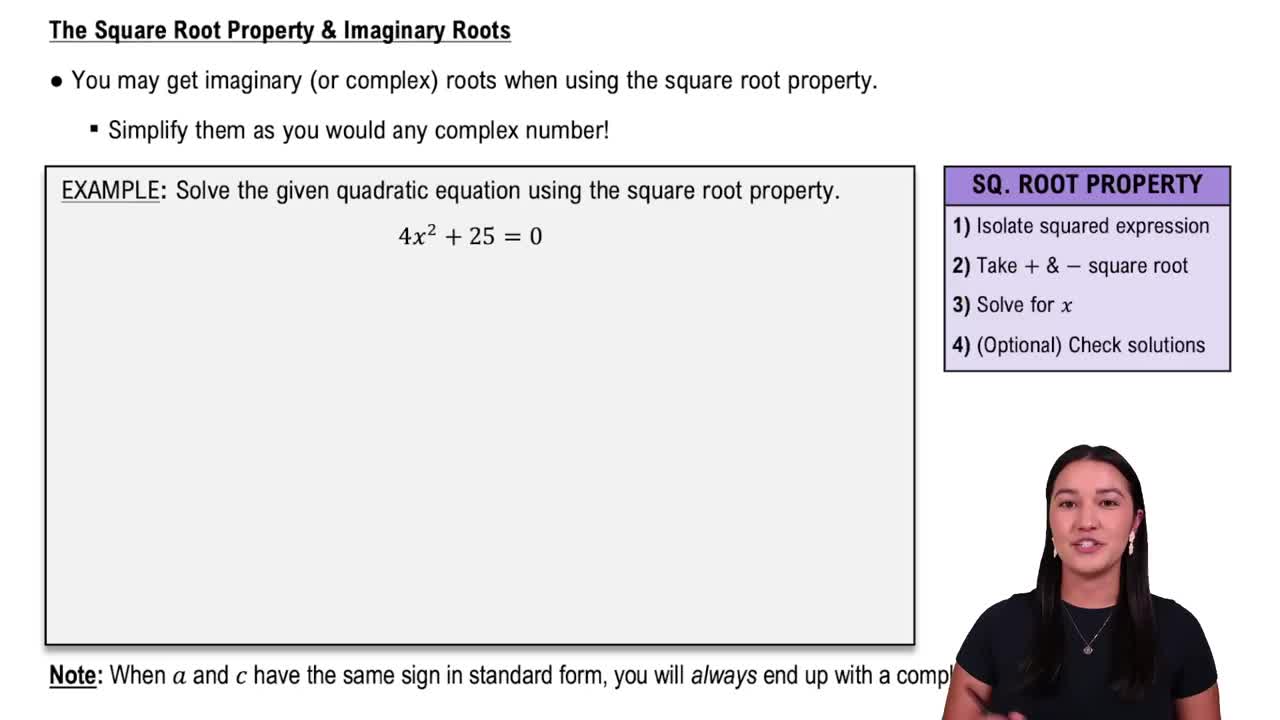
Since √x represents the principal (non-negative) square root, the variable x must be non-negative (x ≥ 0). Additionally, solutions obtained after substitution must be checked to ensure they satisfy this domain restriction to avoid extraneous roots.
Recommended video:
Imaginary Roots with the Square Root Property
Related Practice
Textbook Question
Textbook Question
Use the graph to a. determine the x-intercepts, if any; b. determine the y-intercepts, if any. For each graph, tick marks along the axes represent one unit each.
Textbook Question
In all exercises, other than exercises with no solution, use interval notation to express solution sets and graph each solution set on a number line. In Exercises 27–50, solve each linear inequality. (x - 4)/6 ≥ (x - 2)/9 + 5/18
Textbook Question
In Exercises 45–47, solve each formula for the specified variable. vt + gt^2 = s for g
1
views
Textbook Question
In Exercises 35–46, determine the constant that should be added to the binomial so that it becomes a perfect square trinomial. Then write and factor the trinomial.
Textbook Question
In Exercises 37–52, perform the indicated operations and write the result in standard form. (- 8 + √-32)/24
2
views
