
Textbook Question
Solve each equation in Exercises 41–60 by making an appropriate substitution.

 Verified step by step guidance
 04:10
04:10
 05:10
05:10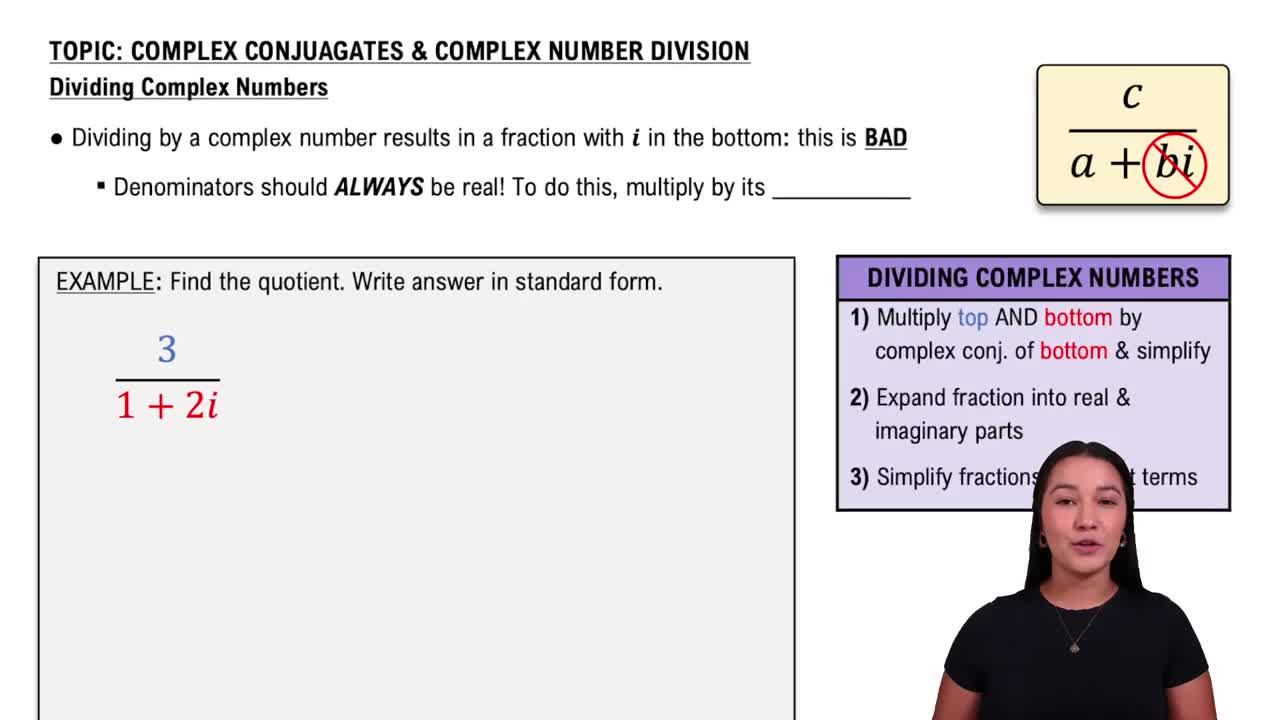 04:22
04:22Solve each equation in Exercises 41–60 by making an appropriate substitution.
In Exercises 48–57, perform the indicated operations and write the result in standard form. 6/(5+i)
Exercises 41–60 contain rational equations with variables in denominators. For each equation, a. write the value or values of the variable that make a denominator zero. These are the restrictions on the variable. b. Keeping the restrictions in mind, solve the equation. 3/(2x - 2) + 1/2 = 2/(x - 1)
Solve each equation in Exercises 47–64 by completing the square.
Exercises 41–60 contain rational equations with variables in denominators. For each equation, a. write the value or values of the variable that make a denominator zero. These are the restrictions on the variable. b. Keeping the restrictions in mind, solve the equation. 2/(x - 2) = x/(x - 2) - 2
In Exercises 51–58, solve each compound inequality. - 3 ≤ x - 2 < 1