Solve each equation in Exercises 41–60 by making an appropriate substitution.
Ch. 1 - Equations and Inequalities

Chapter 2, Problem 53
In Exercises 51–58, solve each compound inequality. - 3 ≤ x - 2 < 1
Verified step by step guidance1
Start by understanding that the compound inequality \(-3 \leq x - 2 < 1\) means that \(x - 2\) is simultaneously greater than or equal to \(-3\) and less than \(1\).
To isolate \(x\), add \(2\) to all three parts of the inequality to maintain the balance. This gives: \(-3 + 2 \leq x - 2 + 2 < 1 + 2\).
Simplify each part: \(-1 \leq x < 3\).
Interpret the solution as all values of \(x\) that are greater than or equal to \(-1\) and less than \(3\).
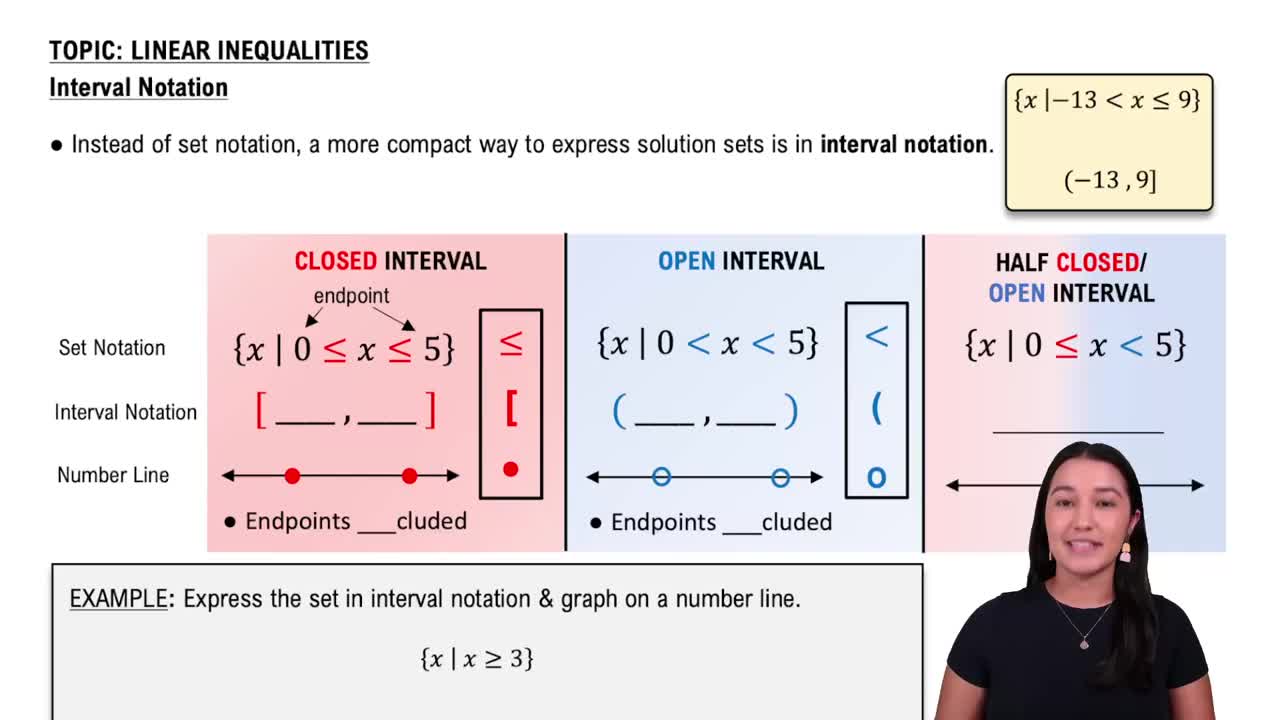
Express the solution in interval notation as \([-1, 3)\), where the square bracket means inclusive of \(-1\) and the parenthesis means exclusive of \(3\).

Verified video answer for a similar problem:
This video solution was recommended by our tutors as helpful for the problem above.
Video duration:
1mWas this helpful?
Key Concepts
Here are the essential concepts you must grasp in order to answer the question correctly.
Compound Inequalities
A compound inequality involves two inequalities joined together, often by 'and' or 'or'. In this problem, the compound inequality 3 ≤ x - 2 < 1 means x - 2 is simultaneously greater than or equal to 3 and less than 1. Understanding how to interpret and solve such inequalities is essential.
Recommended video:
Linear Inequalities
Solving Linear Inequalities
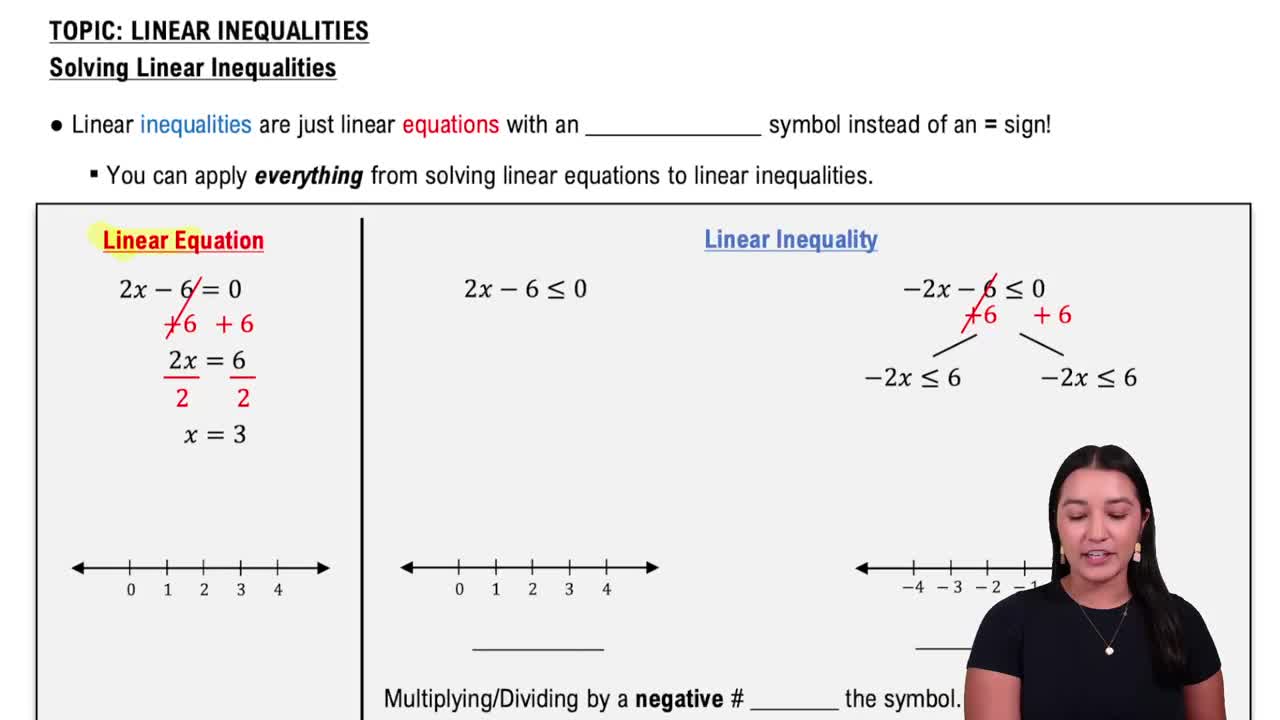
Solving linear inequalities involves isolating the variable on one side by performing inverse operations, similar to solving equations. When dealing with inequalities, special attention is needed when multiplying or dividing by negative numbers, as this reverses the inequality sign.
Recommended video:
Linear Inequalities
Interval Notation and Solution Sets
After solving inequalities, the solution is often expressed as an interval or set of values that satisfy the inequality. Understanding how to write and interpret these intervals helps communicate the solution clearly, especially for compound inequalities that define a range of values.
Recommended video:
Interval Notation
Related Practice
Textbook Question
Textbook Question
In Exercises 48–57, perform the indicated operations and write the result in standard form. 6/(5+i)
Textbook Question
In Exercises 35–54, solve each formula for the specified variable. Do you recognize the formula? If so, what does it describe? A = 2lw + 2lh + 2wh for h
Textbook Question
Solve each equation in Exercises 47–64 by completing the square.
Textbook Question
Exercises 41–60 contain rational equations with variables in denominators. For each equation, a. write the value or values of the variable that make a denominator zero. These are the restrictions on the variable. b. Keeping the restrictions in mind, solve the equation. 2/(x - 2) = x/(x - 2) - 2
Textbook Question
In Exercises 53–60, write each power of i as as i, - 1, - i, or 1. i31
1
views