In Exercises 29–36, simplify and write the result in standard form. √(12 - 4 × 0.5 × 5)
Ch. 1 - Equations and Inequalities

Chapter 2, Problem 35
In Exercises 35–46, determine the constant that should be added to the binomial so that it becomes a perfect square trinomial. Then write and factor the trinomial.
Verified step by step guidance1
Identify the coefficient of the linear term in the binomial. Here, the binomial is \(x^2 + 12x\), so the coefficient of \(x\) is 12.
To complete the square, take half of the coefficient of \(x\), which is \(\frac{12}{2} = 6\).
Square this value: \(6^2 = 36\). This is the constant that should be added to the binomial to make it a perfect square trinomial.
Add the constant to the binomial to form the trinomial: \(x^2 + 12x + 36\).
Write the trinomial as a squared binomial: \((x + 6)^2\).

Verified video answer for a similar problem:
This video solution was recommended by our tutors as helpful for the problem above.
Video duration:
4mWas this helpful?
Key Concepts
Here are the essential concepts you must grasp in order to answer the question correctly.
Perfect Square Trinomial
A perfect square trinomial is a quadratic expression that can be factored into the square of a binomial, typically in the form (x + a)^2 = x^2 + 2ax + a^2. Recognizing this form helps in rewriting and factoring quadratics efficiently.
Recommended video:
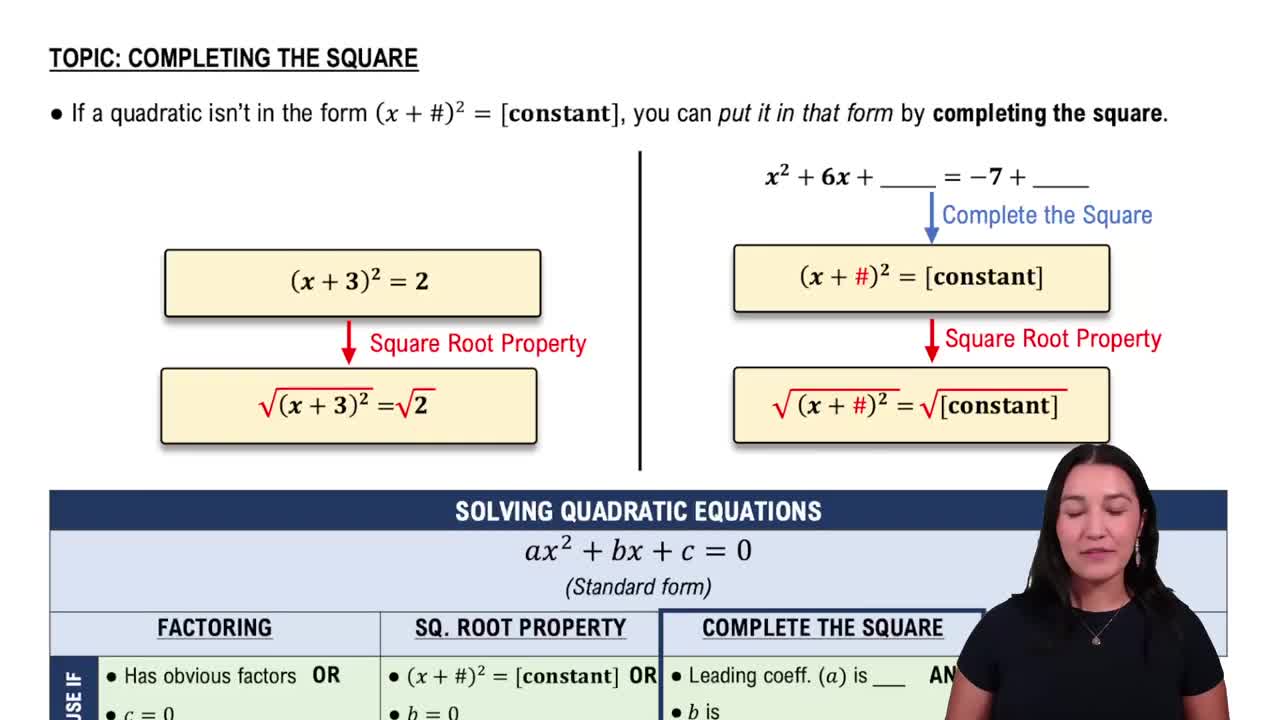
Solving Quadratic Equations by Completing the Square
Completing the Square
Completing the square involves adding a constant term to a quadratic expression to form a perfect square trinomial. This constant is found by taking half the coefficient of x, then squaring it, which allows the expression to be factored as a binomial squared.
Recommended video:
Solving Quadratic Equations by Completing the Square
Factoring Quadratic Expressions
Factoring quadratic expressions means rewriting them as a product of binomials. For perfect square trinomials, this process simplifies to expressing the trinomial as (x + a)^2, which is useful for solving equations and analyzing functions.
Recommended video:
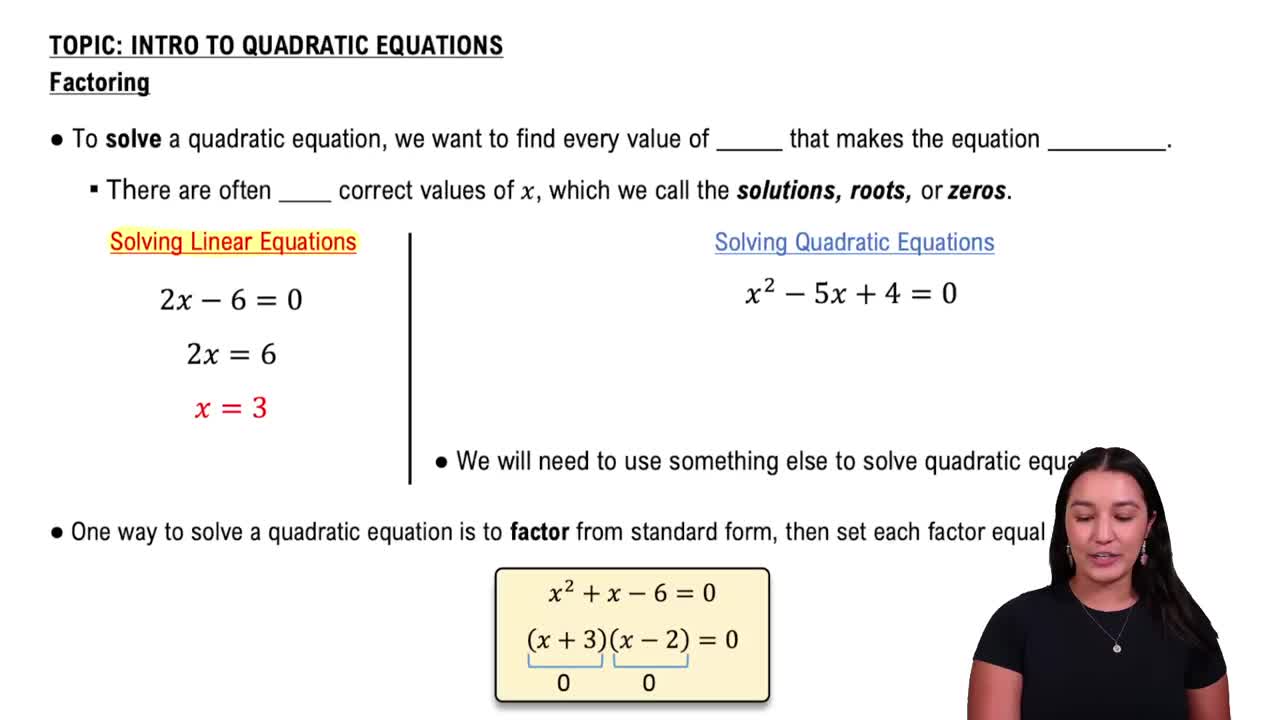
Solving Quadratic Equations by Factoring
Related Practice
Textbook Question
1
views
Textbook Question
Solve each equation in Exercises 15–34 by the square root property. (2x + 8)2 = 27
Textbook Question
In Exercises 35–54, solve each formula for the specified variable. Do you recognize the formula? If so, what does it describe? A = (1/2)bh for b
Textbook Question
Exercises 27–40 contain linear equations with constants in denominators. Solve each equation. (x + 3)/6 = 3/8 + (x - 5)/4
Textbook Question
In all exercises, other than exercises with no solution, use interval notation to express solution sets and graph each solution set on a number line. In Exercises 27–50, solve each linear inequality. 4(x + 1) + 2 ≥ 3x + 6
Textbook Question
Solve each formula for the specified variable. Do you recognize the formula? If so, what does it describe? D = RT for R