Ch. 1 - Equations and Inequalities
Blitzer - College Algebra 8th Edition
Blitzer8th EditionCollege AlgebraISBN: 9780136970514Not the one you use?Change textbook
Chapter 2, Problem 35

In Exercises 29–36, simplify and write the result in standard form. √(12 - 4 × 0.5 × 5)

Verified step by step guidance
1
Start by identifying the expression inside the square root: \(1^2 - 4 \times 0.5 \times 5\). This is the discriminant of a quadratic equation, but here we are simply simplifying it.
Simplify \(1^2\). Recall that \(1^2 = 1\).
Simplify the product \(4 \times 0.5 \times 5\). Multiply these numbers step by step: first \(4 \times 0.5\), then multiply the result by \(5\).
Subtract the result of \(4 \times 0.5 \times 5\) from \(1\). This gives the value inside the square root.
Finally, take the square root of the resulting value. If the value inside the square root is negative, the result will involve imaginary numbers, and you should express it in terms of \(i\), where \(i = \sqrt{-1}\).

Verified video answer for a similar problem:

This video solution was recommended by our tutors as helpful for the problem above.
Video duration:
3m
Was this helpful?

Key Concepts

Here are the essential concepts you must grasp in order to answer the question correctly.

Square Root

The square root of a number is a value that, when multiplied by itself, gives the original number. In this context, the expression involves calculating the square root of a result derived from a mathematical operation. Understanding how to simplify square roots is essential for solving the problem.
Recommended video:
02:20
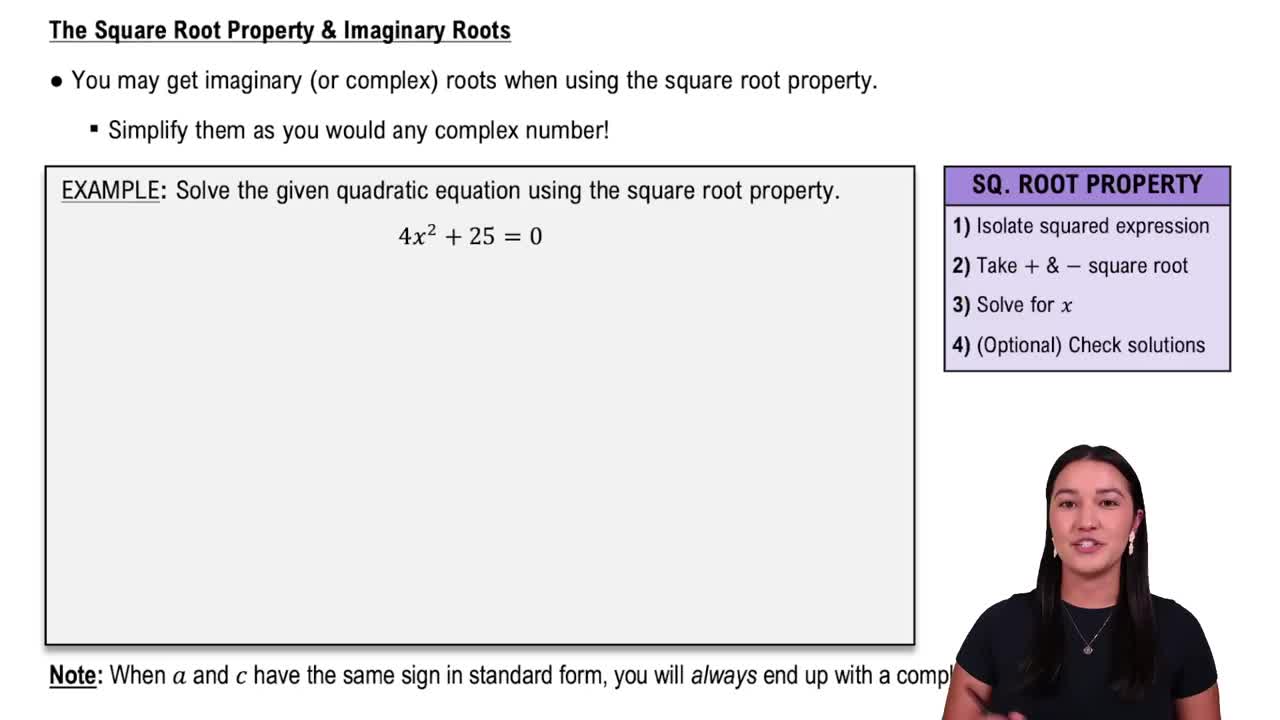
Imaginary Roots with the Square Root Property

Order of Operations

Order of operations is a set of rules that dictates the sequence in which mathematical operations should be performed to ensure consistent results. The acronym PEMDAS (Parentheses, Exponents, Multiplication and Division, Addition and Subtraction) helps remember this order. Applying these rules correctly is crucial for simplifying the expression accurately.
Recommended video:
Guided course
8:38
Performing Row Operations on Matrices

Standard Form

Standard form in mathematics typically refers to expressing numbers in a conventional way, such as writing a polynomial in descending order of its degree or representing complex numbers in the form a + bi. In this exercise, simplifying the expression to standard form means presenting the final result clearly and concisely, which is important for clarity in mathematical communication.
Recommended video:
Guided course
05:16
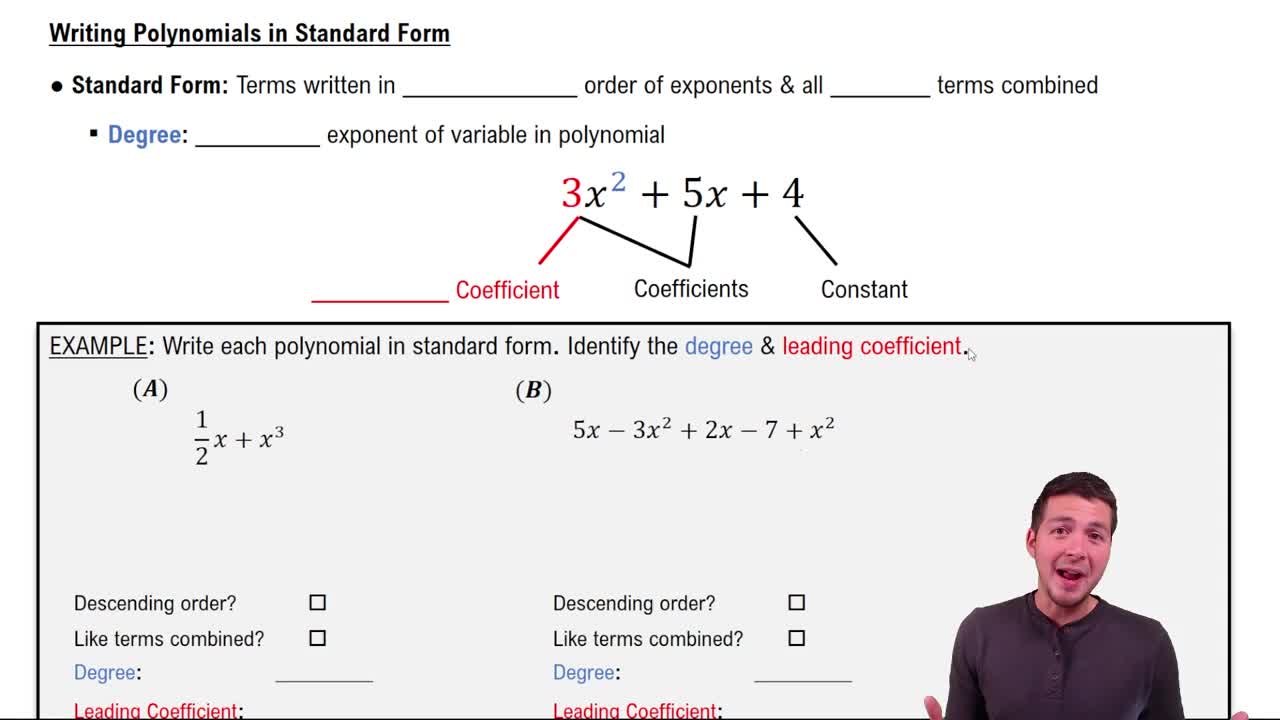
Standard Form of Polynomials