In Exercises 21–28, divide and express the result in standard form. (2 + 3i)/(2 + i)
Ch. 1 - Equations and Inequalities

Chapter 2, Problem 27
Solve each equation. Then state whether the equation is an identity, a conditional equation, or an inconsistent equation. (3x+1)/3 - 13/2 = (1-x)/4
Verified step by step guidance1
Start by writing down the given equation: \(\frac{3x+1}{3} - \frac{13}{2} = \frac{1 - x}{4}\).
To eliminate the fractions, find the least common denominator (LCD) of 3, 2, and 4, which is 12. Multiply every term on both sides of the equation by 12 to clear the denominators.
Distribute 12 to each term: \(12 \times \frac{3x+1}{3} - 12 \times \frac{13}{2} = 12 \times \frac{1 - x}{4}\).
Simplify each term after multiplication: \(4(3x+1) - 6(13) = 3(1 - x)\).
Now, expand the parentheses and solve the resulting linear equation for \(x\). After finding \(x\), check if the solution satisfies the original equation to determine if it is an identity, conditional, or inconsistent equation.

Verified video answer for a similar problem:
This video solution was recommended by our tutors as helpful for the problem above.
Video duration:
4mWas this helpful?
Key Concepts
Here are the essential concepts you must grasp in order to answer the question correctly.
Solving Linear Equations
Solving linear equations involves isolating the variable on one side to find its value. This often requires clearing fractions by finding a common denominator or multiplying both sides by the least common multiple. Understanding how to manipulate equations step-by-step is essential to find the solution accurately.
Recommended video:
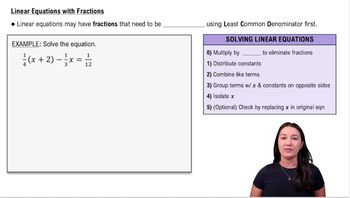
Solving Linear Equations with Fractions
Types of Equations: Identity, Conditional, and Inconsistent
An identity is true for all values of the variable, a conditional equation is true for specific values, and an inconsistent equation has no solution. Recognizing these types helps interpret the solution set after solving the equation, indicating whether the equation holds universally, sometimes, or never.
Recommended video:
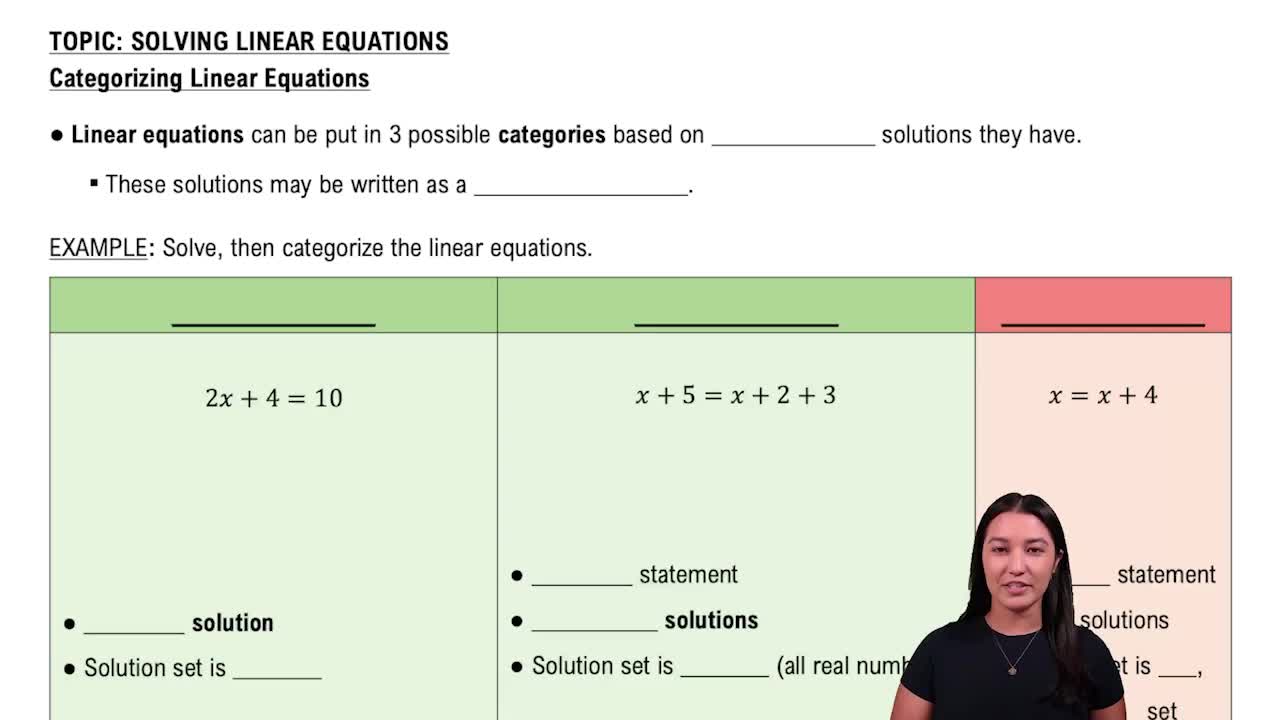
Categorizing Linear Equations
Working with Rational Expressions
Rational expressions are fractions with polynomials in the numerator and denominator. Solving equations involving them requires careful handling of denominators to avoid division by zero and to simplify expressions correctly. Clearing denominators by multiplying through is a common strategy to simplify the equation.
Recommended video:
Guided course
Rationalizing Denominators
Related Practice
Textbook Question
Textbook Question
The length of the rectangular tennis court at Wimbledon is 6 feet longer than twice the width. If the court's perimeter is 228 feet, what are the court's dimensions?
Textbook Question
A rectangular swimming pool is three times as long as it is wide. If the perimeter of the pool is 320 feet, what are its dimensions?
1
views
Textbook Question
In all exercises, other than exercises with no solution, use interval notation to express solution sets and graph each solution set on a number line. In Exercises 27–50, solve each linear inequality. 5x + 11 < 26
Textbook Question
Solve each radical equation in Exercises 11–30. Check all proposed solutions. √(2x + 3) + √(x - 2) = 2
Textbook Question
Solve each equation in Exercises 15–34 by the square root property.