Ch. 1 - Equations and Inequalities
Blitzer - College Algebra 8th Edition
Blitzer8th EditionCollege AlgebraISBN: 9780136970514Not the one you use?Change textbook
Chapter 2, Problem 108

If a number is decreased by 3, the principal square root of this difference is 5 less than the number. Find the number(s).

Verified step by step guidance
1
Let the number be represented by the variable \(x\).
Translate the problem statement into an equation: "If a number is decreased by 3" becomes \(x - 3\), and "the principal square root of this difference is 5 less than the number" becomes \(\sqrt{x - 3} = x - 5\).
Square both sides of the equation to eliminate the square root: \((\sqrt{x - 3})^2 = (x - 5)^2\), which simplifies to \(x - 3 = (x - 5)^2\).
Expand the right side: \((x - 5)^2 = x^2 - 10x + 25\), so the equation becomes \(x - 3 = x^2 - 10x + 25\).
Rearrange the equation to standard quadratic form by moving all terms to one side: \(0 = x^2 - 10x + 25 - x + 3\), which simplifies to \(0 = x^2 - 11x + 28\). This quadratic equation can now be solved for \(x\).

Verified video answer for a similar problem:

This video solution was recommended by our tutors as helpful for the problem above.
Video duration:
5m
Was this helpful?

Key Concepts

Here are the essential concepts you must grasp in order to answer the question correctly.

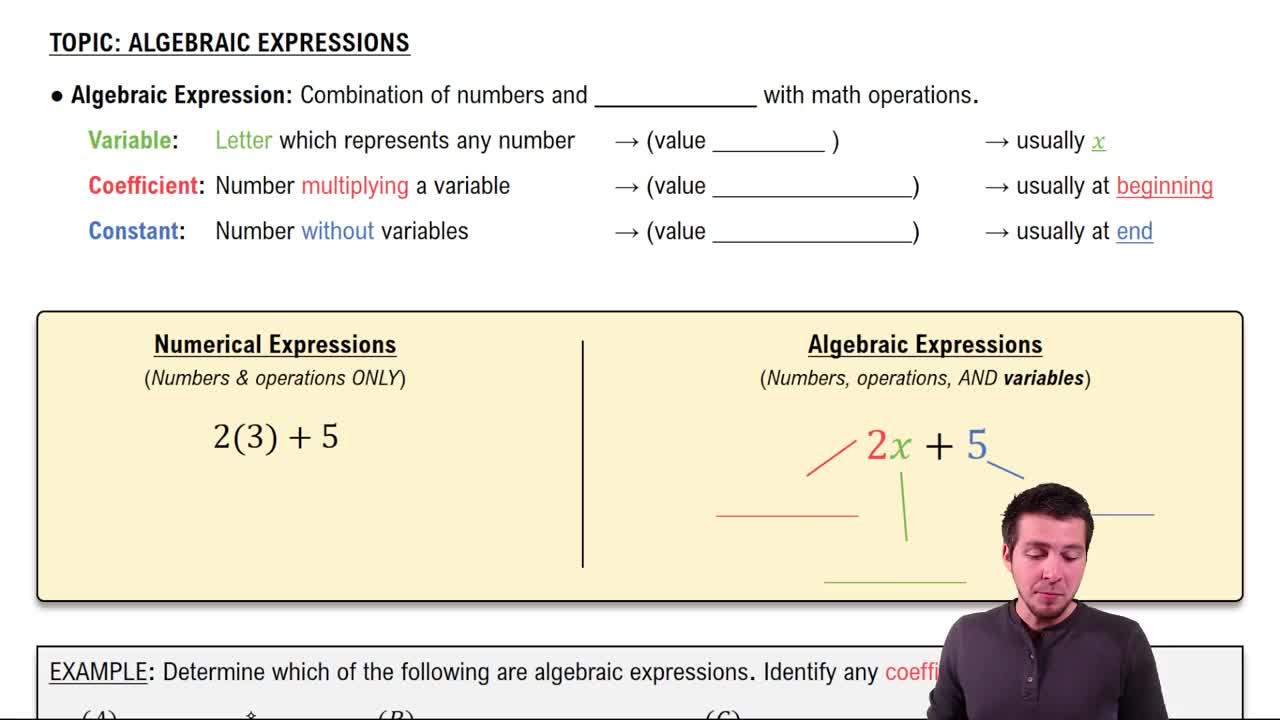
Setting up Algebraic Equations

This involves translating a word problem into an algebraic equation using variables to represent unknown quantities. Identifying relationships described in the problem allows you to form equations that can be solved systematically.
Recommended video:
Guided course
05:09
Introduction to Algebraic Expressions

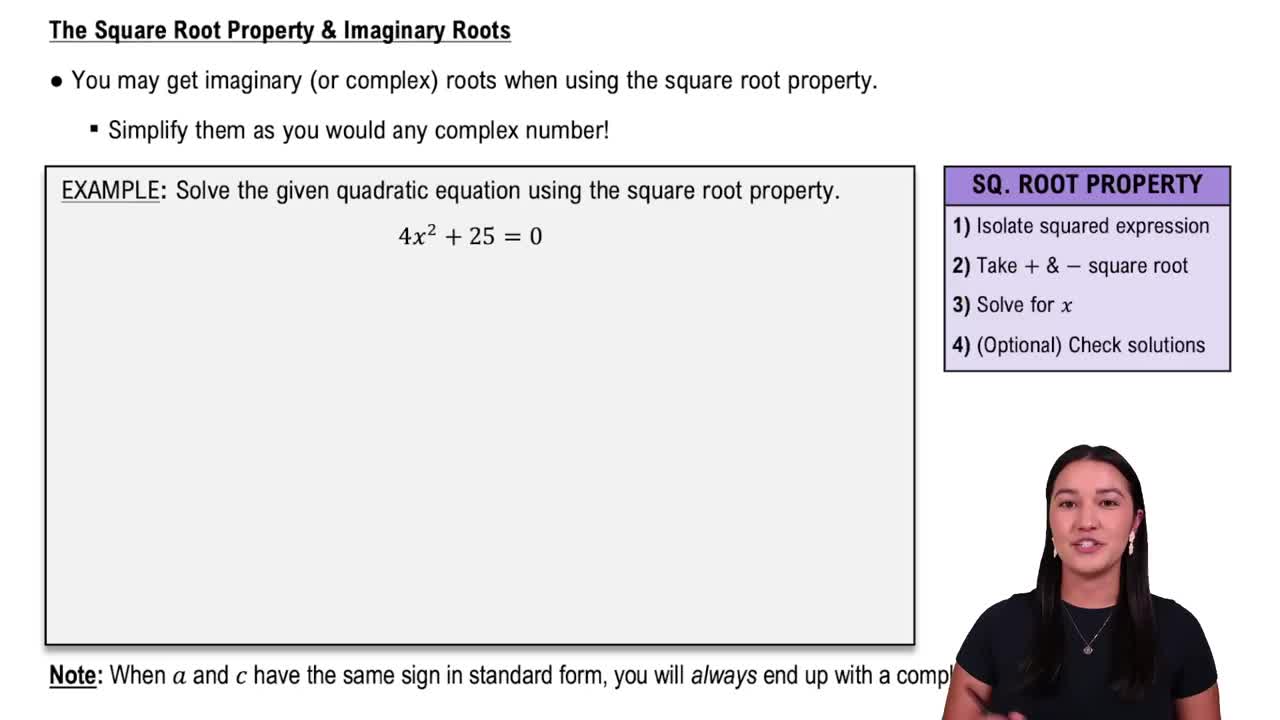
Square Roots and Principal Square Root

The principal square root of a number is the non-negative root. Understanding how to work with square roots, including isolating the root and squaring both sides of an equation, is essential for solving equations involving roots.
Recommended video:
02:20
Imaginary Roots with the Square Root Property

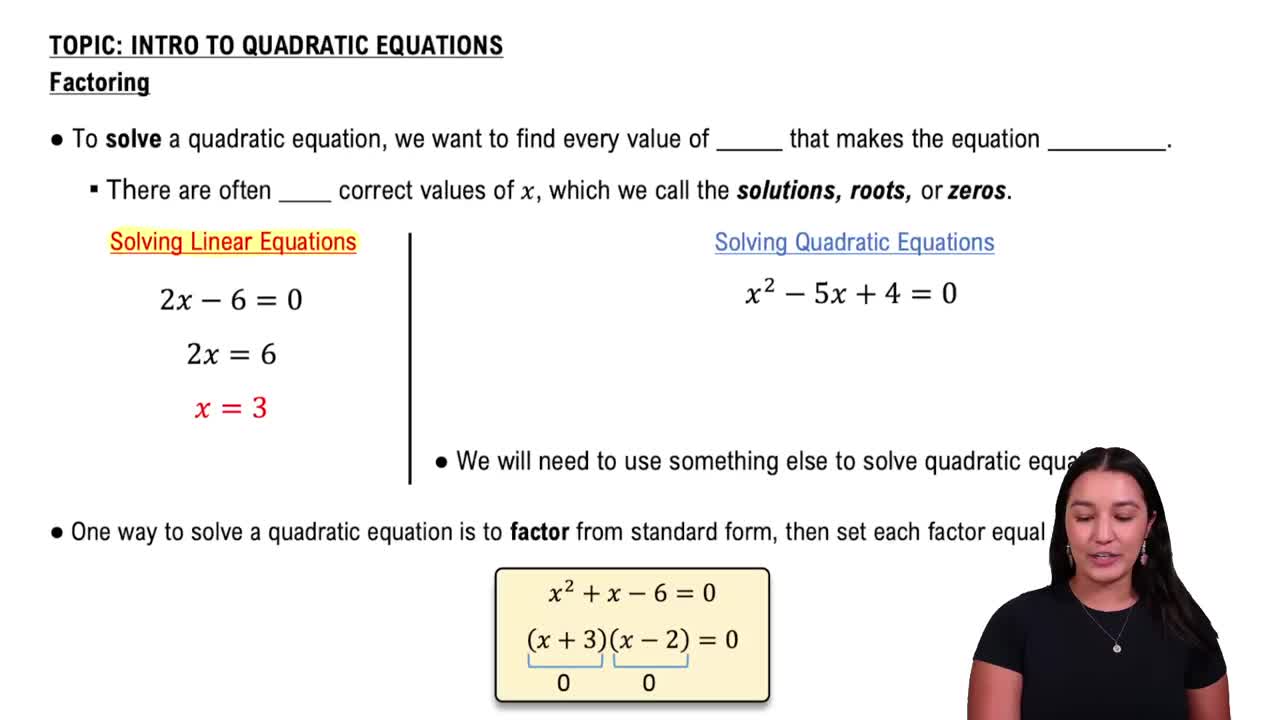
Solving Quadratic Equations

After forming an equation, you may need to rearrange it into a quadratic form and solve using factoring, completing the square, or the quadratic formula. Checking solutions is important because squaring can introduce extraneous roots.
Recommended video:
06:08
Solving Quadratic Equations by Factoring