Back
BackLinear Equations: Definitions, Concepts, and Solution Steps
Study Guide - Smart Notes
 Tailored notes based on your materials, expanded with key definitions, examples, and context.
Basic Concepts of Linear Equations
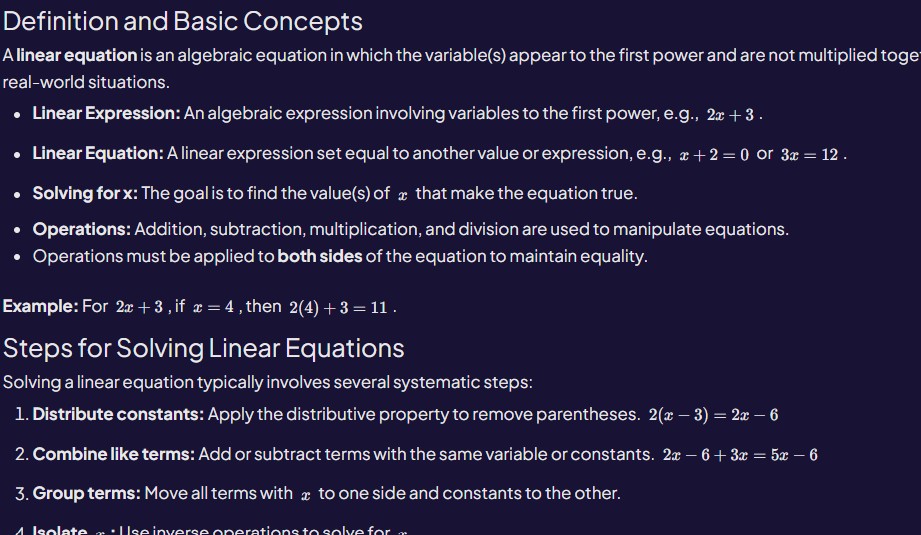
Linear equations are foundational in algebra, describing relationships where variables appear only to the first power and are not multiplied together. These equations are widely used to model real-world situations and solve for unknown values.
Linear Expression: An algebraic expression involving variables to the first power, such as 2x + 3.
Linear Equation: An equation where a linear expression is set equal to another value or expression, for example, x + 2 = 0 or 3x = 12.
Solving for x: The process of finding the value(s) of x that make the equation true.
Operations: Addition, subtraction, multiplication, and division are used to manipulate equations. These operations must be applied to both sides of the equation to maintain equality.
Example: For the equation 2x + 3, if x = 4, then 2(4) + 3 = 11.
Steps for Solving Linear Equations
Solving a linear equation typically involves several systematic steps to isolate the variable and find its value:
Distribute constants: Apply the distributive property to remove parentheses.
Combine like terms: Add or subtract terms with the same variable or constants.
Group terms: Move all terms with x to one side and constants to the other.
Isolate the variable: Use inverse operations to solve for the variable.
Key Points:
Always perform the same operation on both sides of the equation to maintain equality.
Check your solution by substituting the value back into the original equation.