Ch. 1 - Equations and Inequalities
Blitzer - College Algebra 8th Edition
Blitzer8th EditionCollege AlgebraISBN: 9780136970514Not the one you use?Change textbook
Chapter 2, Problem 7

In Exercises 1–8, add or subtract as indicated and write the result in standard form. 8i - (14 - 9i)

Verified step by step guidance
1
Identify the expression to simplify: \(8i - (14 - 9i)\).
Distribute the negative sign across the terms inside the parentheses: \(8i - 14 + 9i\).
Group the real parts and the imaginary parts separately: \((-14) + (8i + 9i)\).
Combine like terms: the real part remains \(-14\), and the imaginary parts add up to \$17i$.
Write the final expression in standard form $a + bi$: \(-14 + 17i\).

Verified video answer for a similar problem:

This video solution was recommended by our tutors as helpful for the problem above.
Video duration:
1m

Key Concepts

Here are the essential concepts you must grasp in order to answer the question correctly.

Complex Numbers and Standard Form

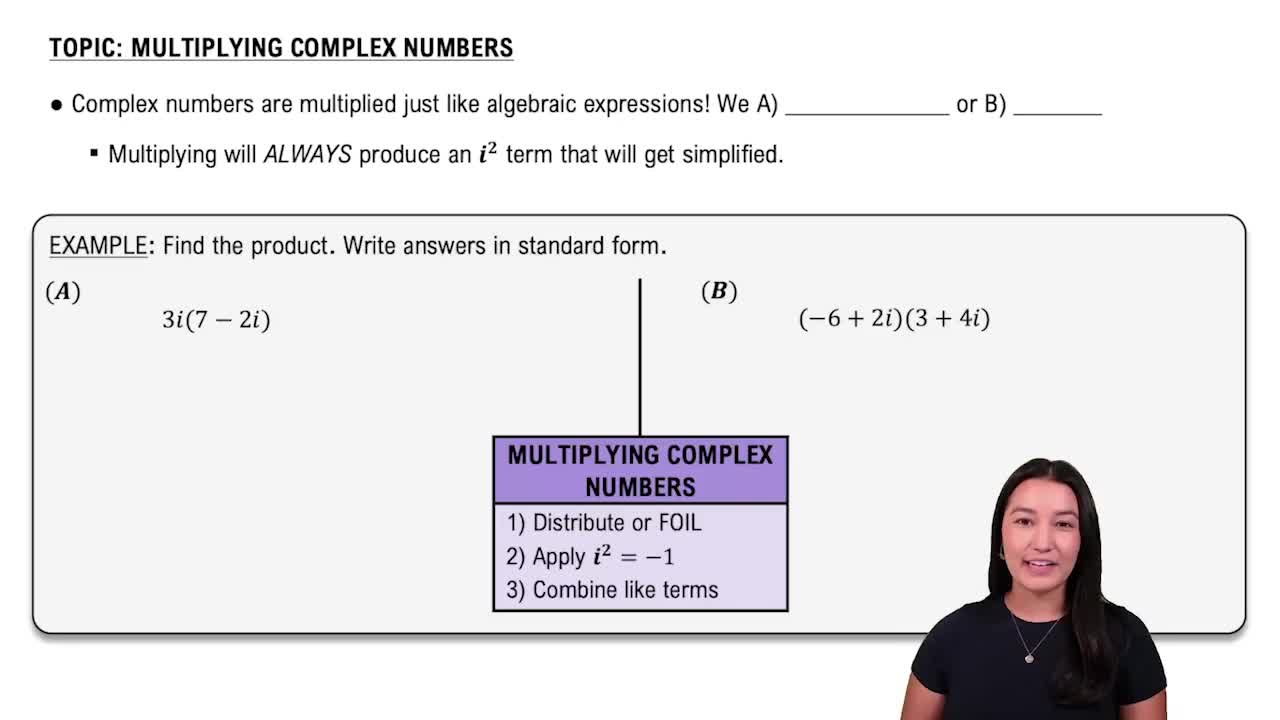
Complex numbers are expressed in the form a + bi, where a is the real part and b is the imaginary part. Writing the result in standard form means combining like terms so the expression is clearly separated into real and imaginary components.
Recommended video:
05:02
Multiplying Complex Numbers

Distributive Property

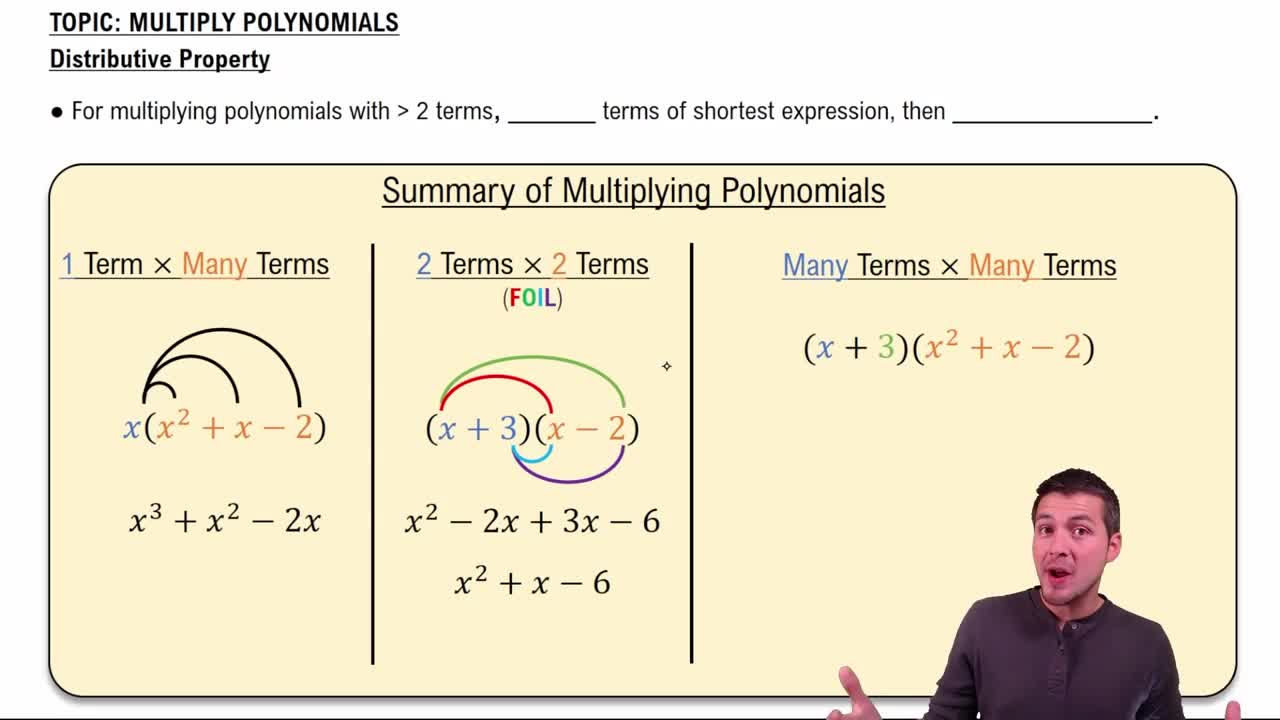
The distributive property allows you to remove parentheses by multiplying a term outside the parentheses by each term inside. For example, subtracting (14 - 9i) means distributing the negative sign to both 14 and -9i.
Recommended video:
04:15
Multiply Polynomials Using the Distributive Property

Combining Like Terms

After distributing, combine the real parts together and the imaginary parts together. This simplifies the expression into a single complex number in standard form, making it easier to interpret and use.
Recommended video:
5:22
Combinations