Ch. 8 - Sequences, Induction, and Probability
Blitzer - College Algebra 8th Edition
Blitzer8th EditionCollege AlgebraISBN: 9780136970514Not the one you use?Change textbook
Chapter 9, Problem 19

In Exercises 17–20, you are dealt one card from a standard 52-card deck. Find the probability of being dealt a picture card.

Verified step by step guidance
1
Identify the total number of possible outcomes. Since you are dealt one card from a standard deck, the total number of outcomes is 52.
Determine what a picture card is. In a standard deck, picture cards are Jacks, Queens, and Kings.
Count the number of picture cards in the deck. There are 4 suits, and each suit has 3 picture cards (Jack, Queen, King), so multiply 4 by 3 to get the total number of picture cards.
Set up the probability formula: Probability = (Number of favorable outcomes) / (Total number of possible outcomes).
Substitute the values into the formula: Probability = (Number of picture cards) / 52.

Verified video answer for a similar problem:

This video solution was recommended by our tutors as helpful for the problem above.
Video duration:
2m

Key Concepts

Here are the essential concepts you must grasp in order to answer the question correctly.

Probability

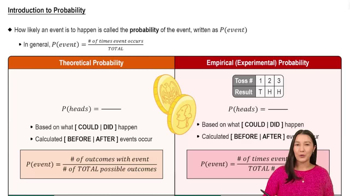
Probability measures the likelihood of an event occurring, expressed as a ratio of favorable outcomes to total possible outcomes. It ranges from 0 (impossible event) to 1 (certain event). In card problems, probability helps determine how likely it is to draw a specific type of card.
Recommended video:
5:37
Introduction to Probability

Sample Space

The sample space is the set of all possible outcomes in an experiment. For a standard deck of 52 cards, the sample space includes every individual card. Understanding the sample space is essential to calculate probabilities accurately.
Recommended video:
5:37
Introduction to Probability

Picture Cards

Picture cards, also called face cards, are the Jack, Queen, and King in each suit. Since there are 4 suits, there are 12 picture cards in total. Identifying the number of favorable outcomes (picture cards) is key to solving the probability question.
Recommended video:
4:23
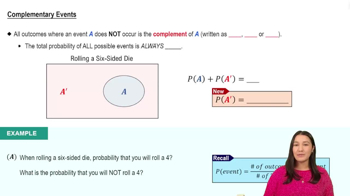
Complementary Events