
Textbook Question
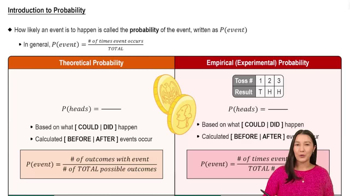
In Exercises 17–20, you are dealt one card from a standard 52-card deck. Find the probability of being dealt a picture card.

 Verified step by step guidance
 5:37
5:37 5:37
5:37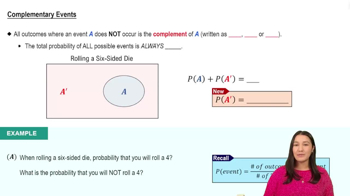 4:23
4:23In Exercises 17–20, you are dealt one card from a standard 52-card deck. Find the probability of being dealt a picture card.
Write a formula for the general term (the nth term) of each geometric sequence. Then use the formula for an to find a7, the seventh term of the sequence. 3, 12, 48, 192, ...
Find the indicated term of the arithmetic sequence with first term, and common difference, d. Find a50 when a1 = 7, d = 5.
The sequences in Exercises 13–18 are defined using recursion formulas. Write the first four terms of each sequence. a1=4 and an=2an-1 + 3 for n≥2
Use the Binomial Theorem to expand each binomial and express the result in simplified form. (y-3)4
In Exercises 19–22, the general term of a sequence is given and involves a factorial. Write the first four terms of each sequence. an = n2/n!