Use the given conditions to write an equation for each line in point-slope form and slope-intercept form. Passing through (-2, 0) and (0, 2)
Table of contents
- 0. Review of Algebra4h 18m
- 1. Equations & Inequalities3h 18m
- 2. Graphs of Equations1h 43m
- 3. Functions2h 17m
- 4. Polynomial Functions1h 44m
- 5. Rational Functions1h 23m
- 6. Exponential & Logarithmic Functions2h 28m
- 7. Systems of Equations & Matrices4h 5m
- 8. Conic Sections2h 23m
- 9. Sequences, Series, & Induction1h 22m
- 10. Combinatorics & Probability1h 45m
- Appendix 1. Review of Real Numbers2h 24m
- Appendix 2. Linear Equations and Inequalities3h 42m
- OLD 9. Sequences, Induction, and Probability Coming soon
- 1. - OLD - Fundamental Concepts of Algebra Coming soon
- 2. - OLD - Equations and Inequalities Coming soon
- OLD 4. Rational Functions Coming soon
- OLD 2. Functions & Graphs Coming soon
- OLD 6. Exponential and Logarithmic Functions Coming soon
- OLD 7. Systems of Equations and Inequalities Coming soon
- OLD 8. Matrices and Determinants Coming soon
- OLD 9. Conic Sections Coming soon
2. Graphs of Equations
Lines
Problem 41
Textbook Question
In Exercises 41–44, use the given conditions to write an equation for each line in point-slope form and slope-intercept form. Passing through (-3, 2) with slope - 6
Verified step by step guidance1
Identify the point-slope form of a linear equation, which is given by: , where is the slope and is a point on the line.
Substitute the given slope and the point into the point-slope form. This gives: .
Simplify the equation from step 2 to get the point-slope form: .
To convert to slope-intercept form, expand the equation from step 3. Distribute across , resulting in: .
Solve for by adding to both sides of the equation: . This is the slope-intercept form of the equation.
Verified video answer for a similar problem:This video solution was recommended by our tutors as helpful for the problem above
Video duration:
2mPlay a video:
0 Comments
Key Concepts
Here are the essential concepts you must grasp in order to answer the question correctly.
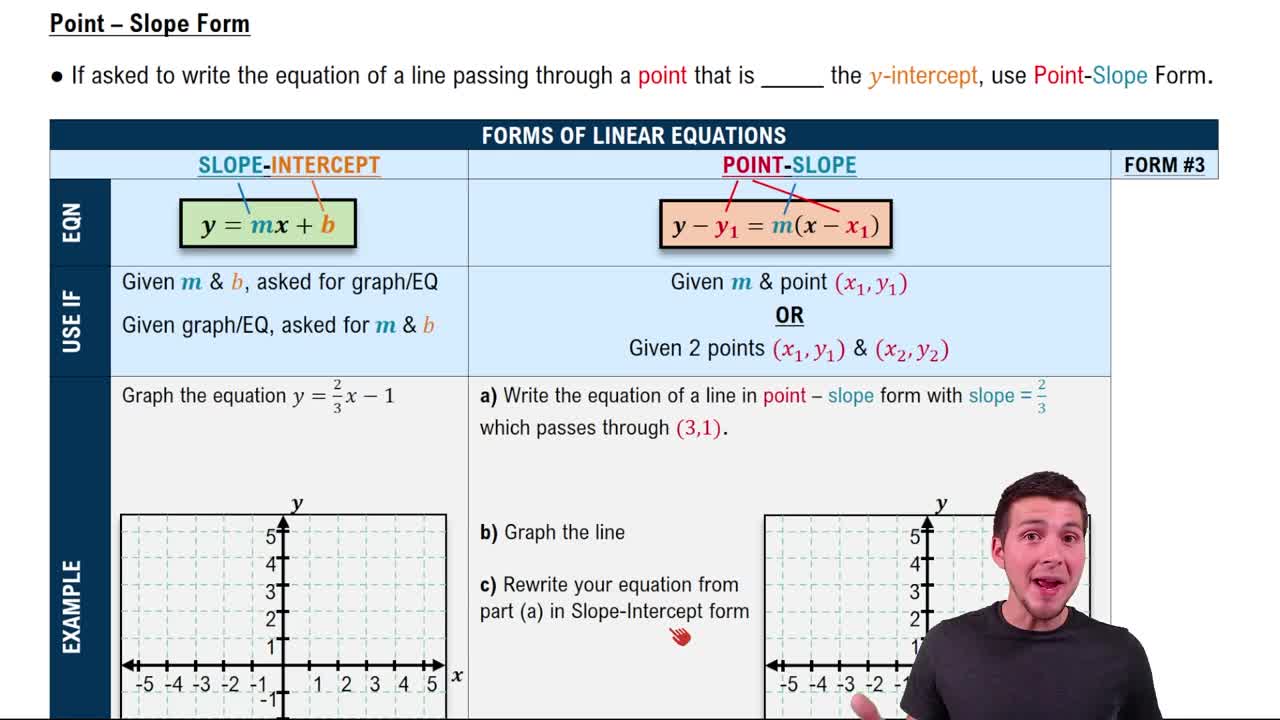
Point-Slope Form
The point-slope form of a linear equation is expressed as y - y1 = m(x - x1), where (x1, y1) is a point on the line and m is the slope. This form is particularly useful for writing equations when you know a point on the line and the slope. In this case, with the point (-3, 2) and a slope of -6, you can directly substitute these values into the formula.
Recommended video:
Guided course
Point-Slope Form
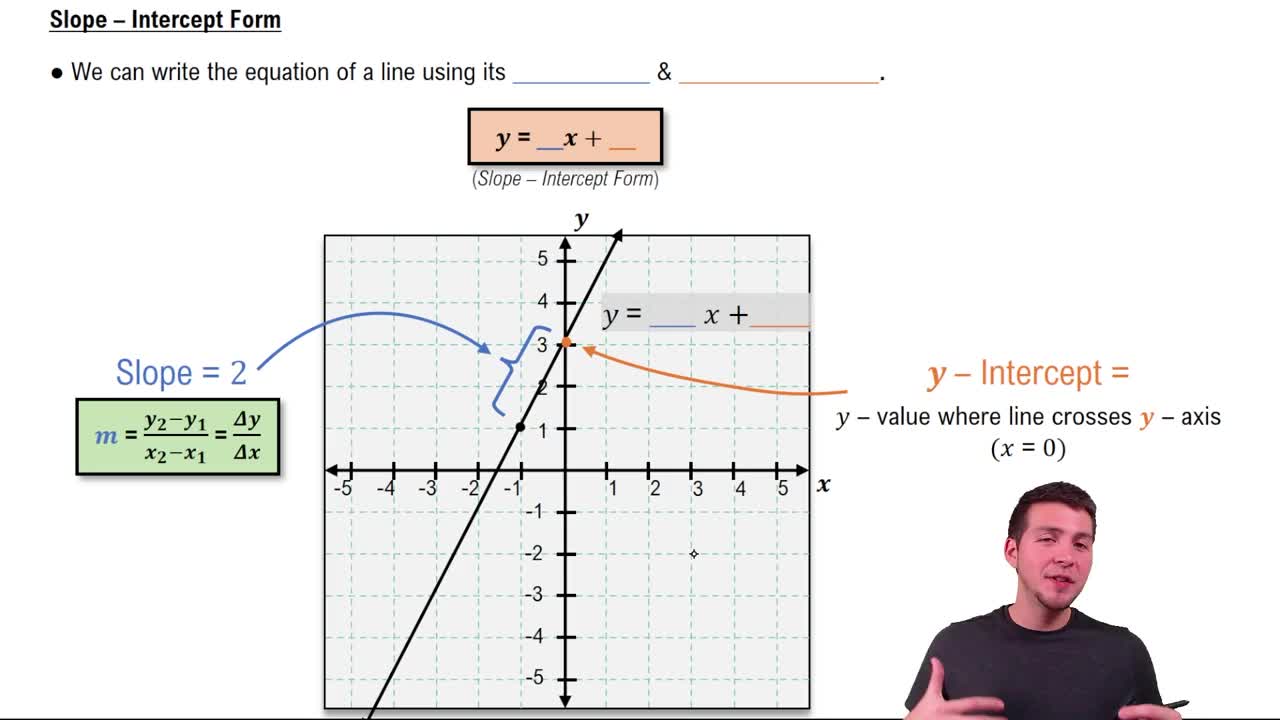
Slope-Intercept Form
The slope-intercept form of a linear equation is given by y = mx + b, where m represents the slope and b is the y-intercept. This form is advantageous for quickly identifying the slope and where the line crosses the y-axis. To convert from point-slope to slope-intercept form, you can rearrange the equation after substituting the known values.
Recommended video:
Guided course
Slope-Intercept Form
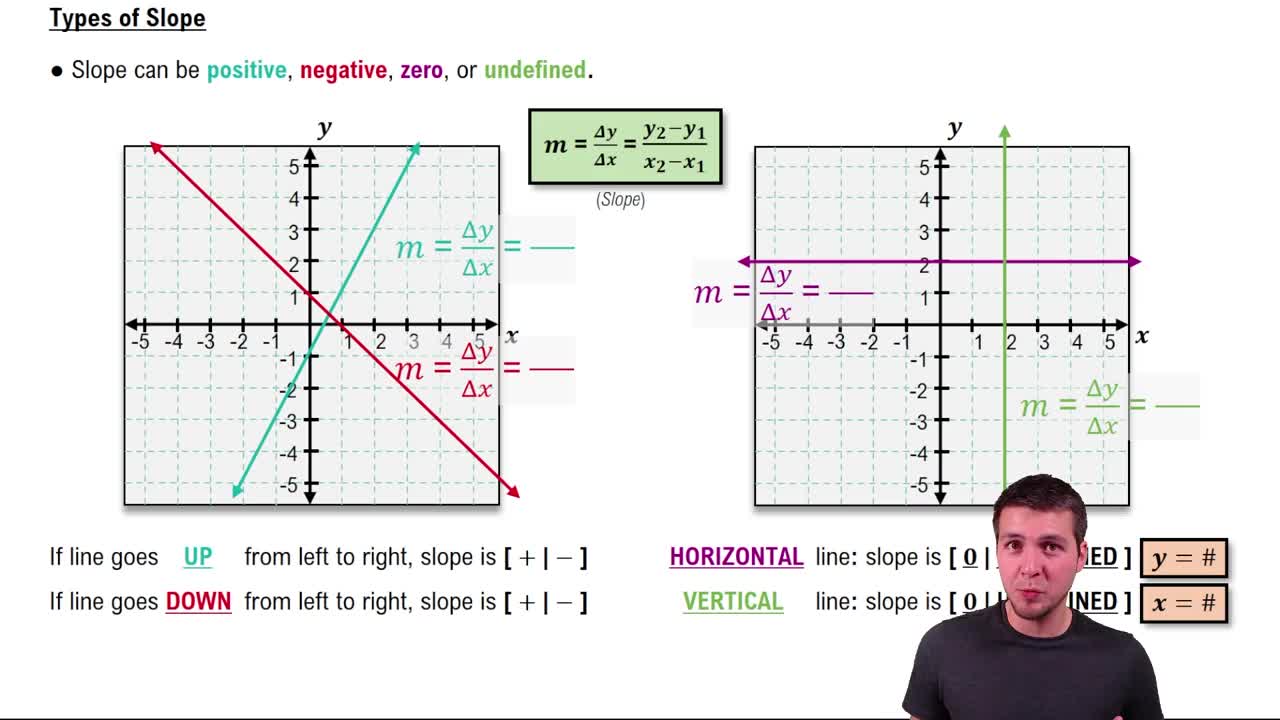
Slope
Slope is a measure of the steepness or incline of a line, calculated as the change in y divided by the change in x (rise over run). A negative slope indicates that as x increases, y decreases, which is the case here with a slope of -6. Understanding slope is crucial for interpreting the direction of the line and for converting between different forms of linear equations.
Recommended video:
Guided course
Types of Slope
Related Videos
Related Practice
Textbook Question