What is the primary function of protein kinase receptors?
Protein kinase receptors are transmembrane proteins that add phosphate groups to target proteins upon ligand binding, initiating intracellular signaling.
What are the two main types of kinases involved in cell signaling?
The two main types are receptor kinases (such as receptor tyrosine kinases and serine/threonine kinases) and non-receptor kinases, which bind to activated receptors.
What is transautophosphorylation in receptor tyrosine kinases?
Transautophosphorylation is when one receptor in a dimer phosphorylates the other, activating both receptors for downstream signaling.
What types of intracellular signaling molecules are recruited to phosphorylated receptor tails?
Phosphorylated receptor tails recruit adapter proteins, docking proteins, transcription factors, and other signaling enzymes.
What domain allows signaling proteins to bind phosphorylated tyrosines on receptor kinases?
The SH2 domain enables signaling proteins to bind phosphorylated tyrosines on receptor kinases.
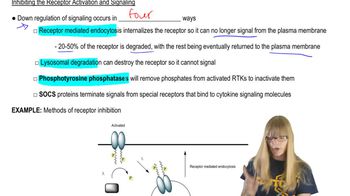
Name one method by which cells inhibit receptor activation and signaling.
Cells can inhibit receptor activation through receptor-mediated endocytosis, lysosomal degradation, phosphotyrosine phosphatases, or SOX proteins.
How does receptor-mediated endocytosis downregulate signaling?
Receptor-mediated endocytosis internalizes the receptor, removing it from the plasma membrane and stopping its signaling.
What is the role of phosphotyrosine phosphatases in receptor inhibition?
Phosphotyrosine phosphatases remove phosphate groups from receptor tyrosine kinases, inactivating them.
Which pathway is commonly activated by receptor tyrosine kinases and is important in cancer research?
The RAS pathway is commonly activated by receptor tyrosine kinases and is crucial in cancer research due to its role in cell signaling and frequent mutations.
Describe the MAP kinase signaling pathway cascade.
The MAP kinase pathway involves sequential activation of MAP kinase kinase kinase, MAP kinase kinase, and MAP kinase, ultimately regulating gene expression.
What is the function of the PI3 kinase pathway in cells?
The PI3 kinase pathway promotes cell survival by activating AKT, which inhibits the pro-apoptotic protein BAD.
Which protein does AKT inhibit to prevent apoptosis?
AKT inhibits the protein BAD, thereby preventing apoptosis and promoting cell survival.
What type of kinases are involved in the transforming growth factor beta (TGF-β) pathway?
The TGF-β pathway involves serine/threonine kinases, which regulate gene expression through SNAD transcription factors.
What is the main function of SNAD transcription factors in the TGF-β pathway?
SNAD transcription factors are activated by the TGF-β pathway and regulate gene expression in the nucleus.
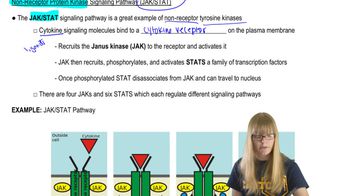
How does the JAK-STAT pathway regulate gene expression?
The JAK-STAT pathway is activated by cytokines, recruits JAK kinases and STAT transcription factors, which then move to the nucleus to regulate gene expression.
 Back
Back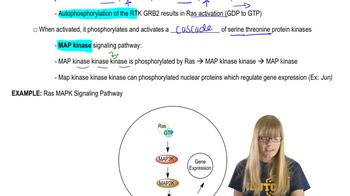
 09:06
09:06