Skip to main content
Cell Biology
My Course
Learn
Exam Prep
AI Tutor
Study Guides
Flashcards
Explore
Try the app
My Course
Learn
Exam Prep
AI Tutor
Study Guides
Flashcards
Explore
Try the app
Back
Protein Kinase Receptors definitions
You can tap to flip the card.
Protein Kinase Receptor
You can tap to flip the card.
👆
Protein Kinase Receptor
Transmembrane protein activated by ligand binding, triggering intracellular signaling via phosphorylation of specific amino acids.
Track progress
Control buttons has been changed to "navigation" mode.
1/15
Related flashcards
Related practice
Recommended videos
Protein Kinase Receptors quiz
Protein Kinase Receptors
15 Terms
Protein Kinase Receptors
14. Cell Signaling
7 problems
Topic
Intracellular messnegers: Hormones and Nitric Oxide
14. Cell Signaling
7 problems
Topic
14. Cell Signaling - Part 1 of 2
4 topics
12 problems
Chapter
14. Cell Signaling - Part 2 of 2
4 topics
12 problems
Chapter
Guided course
09:06
Common Pathways
5
views
Guided course
03:25
Inhibition
3
views
Guided course
03:18
Non-Receptor Protein Kinases
5
views
Terms in this set (15)
Hide definitions
Protein Kinase Receptor
Transmembrane protein activated by ligand binding, triggering intracellular signaling via phosphorylation of specific amino acids.
Receptor Tyrosine Kinase
Largest class of enzyme-coupled receptors that phosphorylate tyrosine residues upon dimerization and ligand binding.
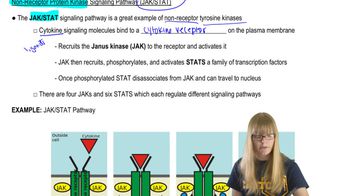
Non-Receptor Kinase
Cytosolic enzyme recruited to activated receptors, enabling phosphorylation events without being part of the receptor itself.
Transautophosphorylation
Process where two dimerized receptors phosphorylate each other's cytosolic domains, amplifying the signal.
Adapter Protein
Molecule that links different signaling proteins, facilitating the assembly of signaling complexes at activated receptors.
Docking Protein
Molecule providing binding sites for other proteins at phosphorylated receptor regions, organizing downstream signaling.
Transcription Factor
Protein recruited to phosphorylated receptors, later entering the nucleus to regulate gene expression.
SH2 Domain
Amino acid sequence in signaling proteins that recognizes and binds phosphorylated tyrosines on activated receptors.
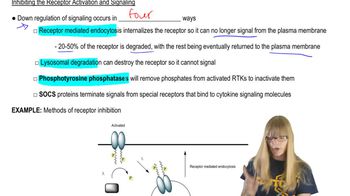
Receptor-Mediated Endocytosis
Cellular process internalizing receptors from the plasma membrane, reducing their signaling activity.
Lysosomal Degradation
Pathway where internalized receptors are broken down, permanently terminating their signaling potential.
Phosphotyrosine Phosphatase
Enzyme that removes phosphate groups from phosphorylated tyrosines, inactivating receptor signaling.
RAS Pathway
Signaling cascade initiated by GTP-binding protein, central to cell proliferation and often mutated in cancers.
MAP Kinase Pathway
Cascade involving sequential activation of kinases, ultimately regulating gene expression in response to extracellular signals.
PI3 Kinase Pathway
Signaling route promoting cell survival by phosphorylating membrane lipids and activating AKT to inhibit apoptosis.
JAK-STAT Pathway
Non-receptor tyrosine kinase cascade where cytokine binding leads to STAT activation and direct regulation of gene expression.
 BackBack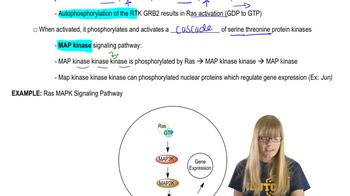
 09:06
09:06