Back

Polymerase Chain Reaction - PCR quiz

Control buttons has been changed to "navigation" mode.
1/15
  • What is the main purpose of Polymerase Chain Reaction (PCR)?

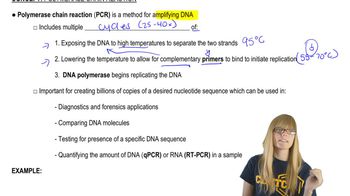
    PCR is used to amplify DNA, generating billions of copies for analysis, diagnostics, or forensics.
  • How many cycles are typically involved in PCR?

    PCR usually involves 25 to 40 cycles of replication.
  • What happens to DNA during the first step of PCR?

    High temperatures separate the two DNA strands by breaking hydrogen bonds.
  • At what temperature are DNA strands separated in PCR?

    DNA strands are separated at around 95 degrees Celsius.
  • What is the role of primers in PCR?

    Primers are short nucleotide sequences that bind to DNA and indicate the sequence to replicate.
  • Why is the temperature lowered after DNA strand separation in PCR?

    The temperature is lowered to allow primers to bind to the DNA.
  • What enzyme is added during PCR to replicate DNA?

    DNA polymerase is added to replicate the DNA at a moderate temperature.
  • How does PCR help in disease diagnosis or forensic science?

    PCR generates enough DNA copies to analyze and compare sequences for diagnostics or forensic identification.
  • What is qPCR and how does it differ from standard PCR?

    qPCR is quantitative PCR, which allows calculation of the exact amount of DNA present in a sample.
  • What is RT-PCR used for?

    RT-PCR is used when starting with RNA, converting it to DNA before amplification.
  • Why do scientists need to amplify DNA using PCR?

    Amplification provides enough DNA for analysis, as a single molecule is insufficient for most techniques.
  • What happens after each cycle of PCR?

    The number of DNA copies doubles, leading to exponential amplification.
  • How do scientists design primers for PCR?

    Primers are designed to match the start and stop sites of the DNA sequence to be replicated.
  • What is the significance of multiple cycles in PCR?

    Multiple cycles ensure exponential increase in DNA copies, making the sample suitable for analysis.
  • How can PCR be used to test for the presence of a specific DNA sequence?

    If the sequence is present, PCR will amplify it; if not, no amplification occurs.