Back

Polymerase Chain Reaction - PCR definitions

Control buttons has been changed to "navigation" mode.
1/15
  • Polymerase Chain Reaction

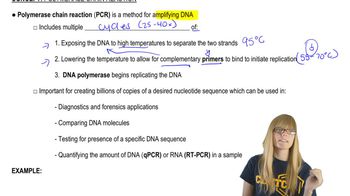
    A laboratory technique enabling exponential amplification of specific DNA sequences through repeated thermal cycling.
  • Amplification

    The process of generating billions of identical DNA copies from a small initial sample for analysis or diagnostics.
  • Thermal Cycling

    A sequence of temperature changes repeated multiple times to facilitate DNA denaturation, primer binding, and synthesis.
  • Denaturation

    The high-temperature step, typically at 95°C, where double-stranded DNA separates into single strands.
  • Annealing

    The cooling phase, usually 55–70°C, allowing primers to attach to complementary DNA sequences.
  • Extension

    The moderate-temperature phase where DNA polymerase synthesizes new DNA strands from primers.
  • Primer

    A short nucleotide sequence designed to bind specific DNA regions, marking start and stop sites for replication.
  • DNA Polymerase

    An enzyme stable at elevated temperatures, responsible for synthesizing new DNA strands during PCR.
  • qPCR

    A quantitative technique measuring the exact amount of DNA present in a sample using fluorescent dyes.
  • RT-PCR

    A variant of PCR starting with RNA, converting it to DNA before amplification, useful for gene expression studies.
  • Hydrogen Bonds

    Weak interactions between DNA strands disrupted during denaturation to allow strand separation.
  • Replication Cycle

    A single sequence of denaturation, annealing, and extension steps, repeated 25–40 times in PCR.
  • Forensics

    An application area where amplified DNA is used to identify individuals or analyze crime scene evidence.
  • Diagnostics

    The use of amplified DNA to detect the presence of specific genetic material associated with diseases.
  • Template DNA

    The original DNA fragment targeted for amplification, serving as the pattern for new strand synthesis.