DNA supercoiling is when the DNA helix twists upon itself, forming a more compact structure that can interfere with processes like replication and gene expression.
Why can supercoiling be problematic for DNA function?
Supercoiling can prevent essential processes such as replication and gene expression from occurring properly.
What type of enzyme helps manage DNA supercoiling?
Topoisomerases are enzymes that help manage DNA supercoiling by converting DNA between supercoiled and relaxed states.
How do Type I topoisomerases relieve supercoiling?
Type I topoisomerases relieve supercoiling by making single-strand breaks in the DNA to release tension.
What is the function of Type II topoisomerases?
Type II topoisomerases make double-strand breaks in DNA to relieve supercoiling and tension.
What is DNA denaturation?
DNA denaturation is the process of separating the two DNA strands by breaking the hydrogen bonds between them.
Name three ways DNA can be denatured.
DNA can be denatured by increasing heat, changing pH, or exposing it to UV light.
What is DNA renaturation?
DNA renaturation is the rejoining of separated DNA strands to reform the double helix.
What does the DNA melting temperature represent?
The DNA melting temperature is the specific temperature at which the DNA strands separate due to the breaking of hydrogen bonds.
How does GC content affect DNA melting temperature?
Higher GC content increases the DNA melting temperature because GC pairs have three hydrogen bonds, making them harder to separate.
How many hydrogen bonds are between GC base pairs?
GC base pairs are held together by three hydrogen bonds.
How many hydrogen bonds are between AT base pairs?
AT base pairs are held together by two hydrogen bonds.
Why is it important to quantify DNA melting temperature in the laboratory?
Quantifying DNA melting temperature helps determine the conditions needed to separate DNA strands for experiments.
Can supercoiling occur in both circular and linear DNA?
Yes, supercoiling can occur in both circular and linear DNA molecules.
What happens to DNA structure when topoisomerases introduce breaks?
When topoisomerases introduce breaks, they relieve tension and allow the DNA to return to a relaxed, functional state.
 Back
Back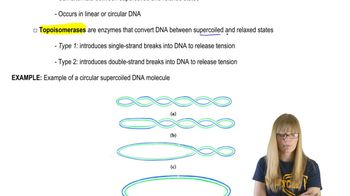
 04:25
04:25