Skip to main content
Cell Biology
My Course
Learn
Exam Prep
AI Tutor
Study Guides
Flashcards
Explore
Try the app
My Course
Learn
Exam Prep
AI Tutor
Study Guides
Flashcards
Explore
Try the app
Back
Helical Formations of DNA definitions
You can tap to flip the card.
Supercoiling
You can tap to flip the card.
👆
Supercoiling
A state where the DNA helix twists upon itself, increasing tension and potentially interfering with replication and gene expression.
Track progress
Control buttons has been changed to "navigation" mode.
1/14
Related flashcards
Related practice
Recommended videos
Helical Formations of DNA quiz
Helical Formations of DNA
15 Terms
Helical Formations of DNA
4. DNA, Chromosomes, and Genomes
7 problems
Topic
DNA vs. RNA
4. DNA, Chromosomes, and Genomes
7 problems
Topic
4. DNA, Chromosomes, and Genomes - Part 1 of 2
5 topics
14 problems
Chapter
4. DNA, Chromosomes, and Genomes - Part 2 of 2
5 topics
13 problems
Chapter
Guided course
04:25
Helical Formations
4
views
Terms in this set (14)
Hide definitions
Supercoiling
A state where the DNA helix twists upon itself, increasing tension and potentially interfering with replication and gene expression.
Topoisomerase
An enzyme that manages DNA supercoiling by introducing breaks to relieve torsional strain and allow normal cellular processes.
Type I Topoisomerase
A variant of an enzyme that creates single-strand breaks in DNA to relax supercoiling and reduce tension.
Type II Topoisomerase
A variant of an enzyme that introduces double-strand breaks in DNA, efficiently relieving supercoiling.
DNA Denaturation
The process where hydrogen bonds between DNA strands are disrupted, causing strand separation, often by heat, pH, or UV.
Renaturation
The rejoining of separated DNA strands, restoring the double helix structure after denaturation.
Hydrogen Bond
A weak interaction between complementary bases in DNA, crucial for holding the double helix together.
Melting Temperature
The specific temperature at which DNA strands separate, influenced by base composition, especially GC content.
GC Content
The proportion of guanine-cytosine base pairs in DNA, which increases the stability and melting temperature of the helix.
Circular DNA
A DNA molecule with a closed-loop structure, often found in prokaryotes and subject to supercoiling.
Double Helix
The characteristic twisted-ladder structure formed by two complementary DNA strands.
Replication
A cellular process requiring relaxed DNA, during which the genetic material is duplicated.
Gene Expression
A process dependent on accessible DNA, where genetic information is used to synthesize functional products.
Base Pair
A unit consisting of two nucleotides on opposite DNA strands, connected by hydrogen bonds, such as AT or GC.
 BackBack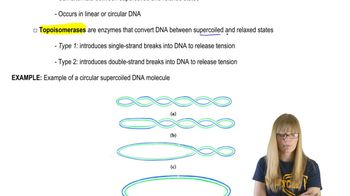
 04:25
04:25