Skip to main content
Cell Biology
My Course
Learn
Exam Prep
AI Tutor
Study Guides
Flashcards
Explore
Try the app
My Course
Learn
Exam Prep
AI Tutor
Study Guides
Flashcards
Explore
Try the app
Back
Basics of Meiotic Genetics quiz #1
You can tap to flip the card.
What does a sperm cell contribute to an embryo?
You can tap to flip the card.
👆
What does a sperm cell contribute to an embryo?
A sperm cell contributes half of the genetic information (one set of chromosomes) to the embryo.
Track progress
Control buttons has been changed to "navigation" mode.
1/22
Related flashcards
Related practice
Recommended videos
Basics of Meiotic Genetics definitions
Basics of Meiotic Genetics
12 Terms
Basics of Meiotic Genetics
17. Meiosis and Sexual Reproduction
7 problems
Topic
Mendel and the Laws of Inheritance
17. Meiosis and Sexual Reproduction
7 problems
Topic
17. Meiosis and Sexual Reproduction
3 topics
9 problems
Chapter
Guided course
04:45
Meiotic Genetics
1
views
Terms in this set (22)
Hide definitions
What does a sperm cell contribute to an embryo?
A sperm cell contributes half of the genetic information (one set of chromosomes) to the embryo.
What is a diploid cell?
A diploid cell is a cell that contains two sets of chromosomes, one from each parent.
Is a skin cell haploid or diploid?
A skin cell is diploid.
Is a sperm cell haploid or diploid?
A sperm cell is haploid.
Which type of cell is diploid: somatic cell or germ cell?
A somatic cell is diploid.
What is a reproductive cell?
A reproductive cell is a germ cell, such as an egg or sperm, that contains one set of chromosomes (haploid).
What kind of cell has two copies of each chromosome?
A diploid cell has two copies of each chromosome.
What is the female sex cell called?
The female sex cell is called an egg.
What is the term for a female reproductive cell?
The term for a female reproductive cell is an egg.
What is a haploid cell?
A haploid cell is a cell that contains only one set of chromosomes.
How many chromosomes are in a human body cell?
A human body cell contains 46 chromosomes.
How many chromosomes do humans have in each body cell?
Humans have 46 chromosomes in each body cell.
How many chromosomes are in a human skin cell?
A human skin cell contains 46 chromosomes.
How many chromosomes are in a skin cell?
A skin cell contains 46 chromosomes.
How many chromosomes are in a somatic cell?
A somatic cell contains 46 chromosomes.
How many chromosomes are in a human somatic cell?
A human somatic cell contains 46 chromosomes.
How many chromosomes are in a somatic cell?
A somatic cell contains 46 chromosomes.
What abbreviation is used to indicate a diploid cell?
The abbreviation '2n' is used to indicate a diploid cell.
When do oogonia undergo mitosis?
Oogonia undergo mitosis during the early stages of female development to increase their number before entering meiosis.
What type of cell passes on mutations to offspring?
Germ cells (reproductive cells such as egg and sperm) pass on mutations to offspring.
What is the difference between somatic cells and germ cells in terms of chromosome number?
Somatic cells are diploid with two sets of chromosomes, while germ cells are haploid with one set of chromosomes.
What is the main advantage of sexual reproduction over asexual reproduction?
Sexual reproduction increases genetic diversity, allowing for adaptation and selection against detrimental mutations.
 BackBack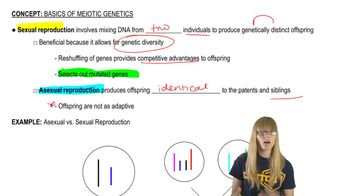
 04:45
04:45