Skip to main content
Cell Biology
My Course
Learn
Exam Prep
AI Tutor
Study Guides
Flashcards
Explore
Try the app
My Course
Learn
Exam Prep
AI Tutor
Study Guides
Flashcards
Explore
Try the app
Back
Basics of Meiotic Genetics definitions
You can tap to flip the card.
Sexual Reproduction
You can tap to flip the card.
👆
Sexual Reproduction
Mixes genetic material from two individuals, resulting in genetically diverse offspring with increased adaptability.
Track progress
Control buttons has been changed to "navigation" mode.
1/12
Related flashcards
Related practice
Recommended videos
Basics of Meiotic Genetics quiz #1
Basics of Meiotic Genetics
22 Terms
Basics of Meiotic Genetics
17. Meiosis and Sexual Reproduction
7 problems
Topic
Mendel and the Laws of Inheritance
17. Meiosis and Sexual Reproduction
7 problems
Topic
17. Meiosis and Sexual Reproduction
3 topics
9 problems
Chapter
Guided course
04:45
Meiotic Genetics
1
views
Terms in this set (12)
Hide definitions
Sexual Reproduction
Mixes genetic material from two individuals, resulting in genetically diverse offspring with increased adaptability.
Asexual Reproduction
Produces offspring genetically identical to the parent, limiting adaptability but beneficial in stable environments.
Genetic Diversity
Variation in genetic information among offspring, enhancing survival and adaptability in changing environments.
Mutation
A change in genetic information that can provide competitive advantages or be eliminated through selection.
Germ Cells
Specialized reproductive cells, such as egg and sperm, containing only one set of chromosomes.
Somatic Cells
Non-reproductive body cells containing two sets of chromosomes, one from each parent.
Haploid Cells
Cells with a single set of chromosomes, carrying half the genetic information needed for offspring.
Diploid Cells
Cells with two sets of chromosomes, containing the full genetic information from both parents.
Homologous Chromosomes
Pairs of chromosomes in diploid cells, each inherited from a different parent, carrying the same genes.
Sex Chromosomes
Chromosome pair (X and Y) determining sex, differing in genetic content compared to other chromosome pairs.
Meiosis
Cell division process reducing chromosome number from diploid to haploid, ensuring genetic diversity.
Fertilization
Union of two haploid cells, restoring diploid chromosome number and combining genetic material.
 BackBack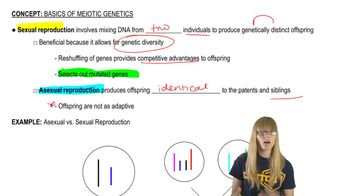
 04:45
04:45