How do transcriptional regulators typically control gene expression?
Transcriptional regulators usually work in combination with other proteins, with each protein increasing the binding affinity and effectiveness of the complex to regulate gene expression.
What is the significance of increasing binding affinity among transcription regulators?
Increasing binding affinity allows the regulatory complex to function more effectively, reducing the number of regulators needed to control gene expression.
How can a single regulatory protein act as an on/off switch for gene expression?
A single regulatory protein can be the final factor required to initiate transcription, so without it, gene expression does not occur even if other regulators are present.
How do combinations of transcription regulators contribute to cell differentiation?
Specific combinations of transcription regulators control sets of genes responsible for differentiating cells into particular types, such as kidney cells.
What are response elements and how do they function?
Response elements are DNA sequences in promoters that bind regulatory proteins activated by external signals, such as heat or hormones, to regulate gene transcription.
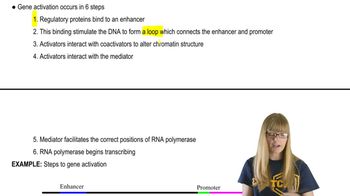
What is the first step in gene activation?
The first step is the binding of regulatory proteins to an enhancer region on the DNA.
How does the enhancer interact with the promoter during gene activation?
The DNA forms a loop that brings the enhancer and promoter into close proximity, facilitating further steps in gene activation.
What role do co-activators play in gene activation?
Co-activators interact with activators to alter chromatin structure, making the DNA more accessible for transcription.
What is the function of the mediator protein in gene activation?
The mediator protein helps position RNA polymerase correctly at the promoter, enabling transcription to begin.
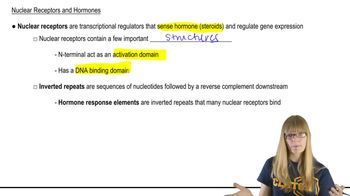
What are nuclear receptors and what do they sense?
Nuclear receptors are transcriptional regulators that sense hormones, such as steroids, and regulate gene expression in response.
What are the two main structural domains of nuclear receptors?
Nuclear receptors have an N-terminal activation domain and a DNA-binding domain.
What are inverted repeats and where are they found?
Inverted repeats are sequences of nucleotides followed downstream by their reverse complement, and they are commonly found in hormone response elements.
What is a hormone response element?
A hormone response element is a DNA region, often containing inverted repeats, where nuclear receptors bind to regulate gene expression in response to hormones.
How do hormones influence gene transcription through nuclear receptors?
Hormones activate nuclear receptors, which then bind to hormone response elements and initiate transcription, leading to changes in cell function.
What is the final outcome of gene activation by transcriptional regulators?
The final outcome is the transcription of the gene by RNA polymerase, resulting in protein production and altered cell function.
 Back
Back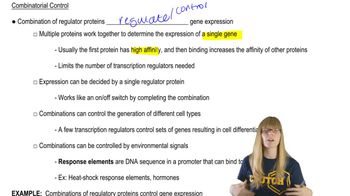
 03:56
03:56