Skip to main content
Cell Biology
My Course
Learn
Exam Prep
AI Tutor
Study Guides
Flashcards
Explore
Try the app
My Course
Learn
Exam Prep
AI Tutor
Study Guides
Flashcards
Explore
Try the app
Back
Action of Transcriptional Regulators definitions
You can tap to flip the card.
Transcriptional Regulator
You can tap to flip the card.
👆
Transcriptional Regulator
Protein that collaborates with others to modulate gene expression, often acting as a molecular switch for turning genes on or off.
Track progress
Control buttons has been changed to "navigation" mode.
1/15
Related flashcards
Related practice
Recommended videos
Action of Transcriptional Regulators quiz
Action of Transcriptional Regulators
15 Terms
Action of Transcriptional Regulators
7. Gene Expression
7 problems
Topic
Post-Transcriptional Regulators
7. Gene Expression
7 problems
Topic
7. Gene Expression
5 topics
15 problems
Chapter
Guided course
03:56
Combinatorial Control
4
views
1
rank
Guided course
02:16
Nuclear Receptors and Hormones
4
views
Guided course
01:43
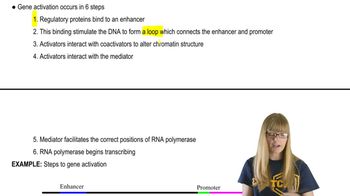
Gene Activation
3
views
Terms in this set (15)
Hide definitions
Transcriptional Regulator
Protein that collaborates with others to modulate gene expression, often acting as a molecular switch for turning genes on or off.
Gene Expression
Process by which genetic information is used to synthesize functional products, tightly controlled by regulatory proteins.
Enhancer
DNA sequence distant from the promoter that, when bound by proteins, increases the likelihood of gene transcription.
Promoter
DNA region near a gene where transcription machinery assembles, serving as the initiation site for RNA synthesis.
Chromatin Structure
Arrangement of DNA and proteins that influences gene accessibility and can be altered to permit or restrict transcription.
RNA Polymerase
Enzyme responsible for synthesizing RNA from a DNA template during the transcription process.
Mediator
Multiprotein complex that bridges regulatory proteins and RNA polymerase, ensuring accurate transcription initiation.
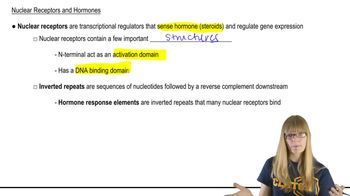
Nuclear Receptor
Protein that detects hormones like steroids and modulates gene expression by binding specific DNA elements.
Hormone Response Element
DNA sequence recognized by hormone-activated nuclear receptors, often containing inverted repeats for binding specificity.
Inverted Repeat
DNA sequence followed downstream by its reverse complement, providing recognition sites for certain regulatory proteins.
Response Element
DNA segment within a promoter that interacts with regulatory proteins activated by environmental or hormonal signals.
Coactivator
Protein that interacts with activators to modify chromatin and facilitate transcription without directly binding DNA.
Cell Differentiation
Process by which cells acquire specialized functions, orchestrated by combinations of regulatory proteins.
Activation Domain
Region within a regulatory protein that responds to signals, such as hormones, to initiate gene transcription.
DNA Binding Domain
Structural region of a protein that enables specific interaction with DNA sequences to regulate gene activity.
 BackBack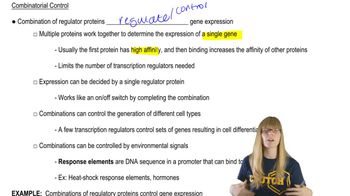
 03:56
03:56