Ch. 9 - First-Order Differential Equations
Hass - Thomas' Calculus 15th Edition
Hass15th EditionThomas' CalculusISBN: 9780137616077Not the one you use?Change textbook
Chapter 9, Problem 9.1.8

Integral Equations
In Exercises 7–12, write an equivalent first-order differential equation
and initial condition for y.


y = ∫₁ ͯ 1/t dt

Verified step by step guidance
1
Identify the given integral equation: \(y = \int_{1}^{x} \frac{1}{t} \, dt\).
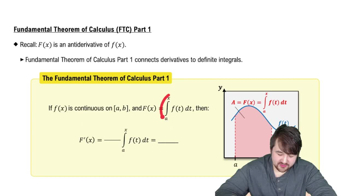
Recall the Fundamental Theorem of Calculus, which states that if \(y = \int_{a}^{x} f(t) \, dt\), then \(\frac{dy}{dx} = f(x)\).
Apply the theorem to differentiate both sides with respect to \(x\): \(\frac{dy}{dx} = \frac{1}{x}\).
Write the equivalent first-order differential equation: \(\frac{dy}{dx} = \frac{1}{x}\).
Determine the initial condition by evaluating \(y\) at the lower limit of integration: since \(y = \int_{1}^{x} \frac{1}{t} \, dt\), then \(y(1) = 0\).

Verified video answer for a similar problem:

This video solution was recommended by our tutors as helpful for the problem above.
Video duration:
2m
Was this helpful?

Key Concepts

Here are the essential concepts you must grasp in order to answer the question correctly.

Fundamental Theorem of Calculus

This theorem connects differentiation and integration, stating that if a function is defined as an integral with a variable upper limit, its derivative is the integrand evaluated at that limit. It allows converting integral expressions into differential equations by differentiating both sides.
Recommended video:
06:11
Fundamental Theorem of Calculus Part 1

Differentiation of Integral Functions

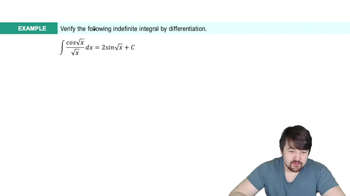
When a function is defined as an integral with a variable limit, differentiating it requires applying the Leibniz rule or the Fundamental Theorem of Calculus. This process transforms the integral equation into a differential equation involving the original function and its derivative.
Recommended video:
04:22
Integrals Resulting in Basic Trig Functions Example 1

Initial Conditions in Differential Equations

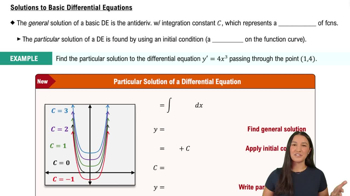
Initial conditions specify the value of the unknown function at a particular point, ensuring a unique solution to a differential equation. For integral-defined functions, the initial condition often comes from evaluating the integral at the lower limit.
Recommended video:
04:00
Solutions to Basic Differential Equations