Ch. 9 - First-Order Differential Equations
Hass - Thomas' Calculus 15th Edition
Hass15th EditionThomas' CalculusISBN: 9780137616077Not the one you use?Change textbook
Chapter 9, Problem 9.2.4

First-Order Linear Equations
Solve the differential equations in Exercises 1–14.


y' + (tanx)y = cos²x, -π/2 < x < π/2

Verified step by step guidance
1
Identify the given differential equation as a first-order linear differential equation of the form \(y' + P(x)y = Q(x)\), where \(P(x) = \tan x\) and \(Q(x) = \cos^{2} x\).
Find the integrating factor \(\mu(x)\) using the formula \(\mu(x) = e^{\int P(x) \, dx} = e^{\int \tan x \, dx}\).
Compute the integral \(\int \tan x \, dx\) to determine the explicit form of the integrating factor \(\mu(x)\).
Multiply both sides of the original differential equation by the integrating factor \(\mu(x)\) to rewrite the left side as the derivative of the product \(\mu(x) y\).
Integrate both sides with respect to \(x\) to find \(\mu(x) y = \int \mu(x) Q(x) \, dx + C\), then solve for \(y\) by dividing both sides by \(\mu(x)\).

Verified video answer for a similar problem:

This video solution was recommended by our tutors as helpful for the problem above.
Video duration:
6m
Was this helpful?

Key Concepts

Here are the essential concepts you must grasp in order to answer the question correctly.

First-Order Linear Differential Equations

These are differential equations of the form y' + P(x)y = Q(x), where y' is the derivative of y with respect to x. They can be solved using an integrating factor, which simplifies the equation into an exact derivative, allowing integration to find the solution.
Recommended video:
07:39
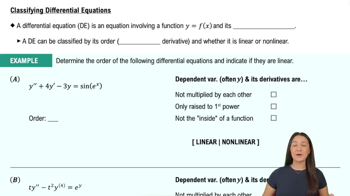
Classifying Differential Equations

Integrating Factor Method

The integrating factor is a function, usually denoted μ(x) = e^(∫P(x)dx), used to multiply both sides of a linear differential equation. This transforms the left side into the derivative of (μ(x)y), making it easier to integrate and solve for y.
Recommended video:
07:33
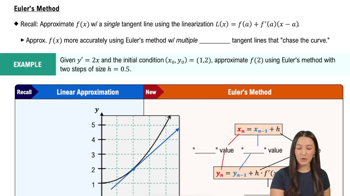
Euler's Method

Trigonometric Functions in Differential Equations

Understanding the properties and integrals of trigonometric functions like tan(x) and cos²(x) is essential. These functions appear in P(x) and Q(x), and their integrals determine the integrating factor and the particular solution of the differential equation.
Recommended video:
6:04
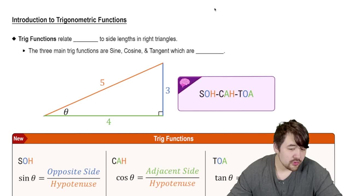
Introduction to Trigonometric Functions