Ch. 8 - Techniques of Integration
Hass - Thomas' Calculus 15th Edition
Hass15th EditionThomas' CalculusISBN: 9780137616077Not the one you use?Change textbook
Chapter 8, Problem 8.8.8

The integrals in Exercises 1–34 converge. Evaluate the integrals without using tables.
∫₀¹ dr / r^0.999

Verified step by step guidance
1
Identify the integral to be evaluated: \(\int_0^1 \frac{dr}{r^{0.999}}\).
Rewrite the integrand using exponent rules: \(\frac{1}{r^{0.999}} = r^{-0.999}\), so the integral becomes \(\int_0^1 r^{-0.999} \, dr\).
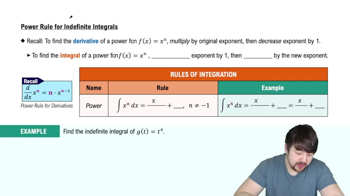
Recall the power rule for integration: For \(\int r^n \, dr\), where \(n \neq -1\), the antiderivative is \(\frac{r^{n+1}}{n+1} + C\).
Apply the power rule to the integral: \(\int_0^1 r^{-0.999} \, dr = \left[ \frac{r^{-0.999 + 1}}{-0.999 + 1} \right]_0^1 = \left[ \frac{r^{0.001}}{0.001} \right]_0^1\).
Evaluate the definite integral by substituting the limits: calculate \(\frac{1^{0.001}}{0.001} - \frac{0^{0.001}}{0.001}\), noting the behavior of \(r^{0.001}\) as \(r\) approaches 0.

Verified video answer for a similar problem:

This video solution was recommended by our tutors as helpful for the problem above.
Video duration:
3m
Was this helpful?

Key Concepts

Here are the essential concepts you must grasp in order to answer the question correctly.

Improper Integrals

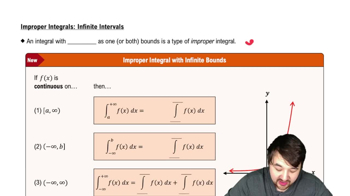
Improper integrals involve integrands that are unbounded or have infinite limits. When the integrand approaches infinity at a boundary, the integral is evaluated as a limit to determine convergence or divergence.
Recommended video:
11:11
Improper Integrals: Infinite Intervals

Power Rule for Integration

The power rule states that ∫x^n dx = (x^(n+1))/(n+1) + C for n ≠ -1. This rule is essential for integrating functions with variable exponents, allowing direct evaluation of integrals involving powers of the variable.
Recommended video:
04:04
Power Rule for Indefinite Integrals

Convergence of Integrals with Singularities

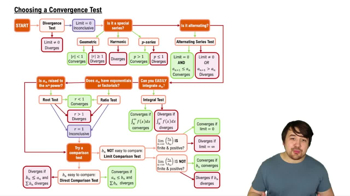
When the integrand has a singularity (like r^(-0.999) near zero), determining if the integral converges requires analyzing the behavior near the singularity. If the integral's limit exists and is finite, the integral converges.
Recommended video:
07:51
Choosing a Convergence Test