Ch. 8 - Techniques of Integration
Hass - Thomas' Calculus 15th Edition
Hass15th EditionThomas' CalculusISBN: 9780137616077Not the one you use?Change textbook
Chapter 8, Problem 8.7.38

[Technology Exercise] When solving Exercises 33-40, you may need to use a calculator or a computer.
Use numerical integration to estimate the value of
π = 4 ∫ (from 0 to 1) [ 1 / (1 + x²) ] dx.

Verified step by step guidance
1
Recognize that the integral given is \( \int_0^1 \frac{1}{1 + x^2} \, dx \), which is related to the arctangent function and is used to estimate \( \pi \) by the formula \( \pi = 4 \times \int_0^1 \frac{1}{1 + x^2} \, dx \).
Choose a numerical integration method to approximate the integral, such as the Trapezoidal Rule, Simpson's Rule, or a numerical integration function on a calculator or computer.
Divide the interval \([0,1]\) into \(n\) subintervals of equal width \( \Delta x = \frac{1 - 0}{n} = \frac{1}{n} \).
Calculate the function values \( f(x) = \frac{1}{1 + x^2} \) at the endpoints and at each subinterval point \( x_i = i \Delta x \) for \( i = 0, 1, 2, ..., n \).
Apply the chosen numerical integration formula to approximate the integral \( \int_0^1 \frac{1}{1 + x^2} \, dx \), then multiply the result by 4 to estimate \( \pi \).

Verified video answer for a similar problem:

This video solution was recommended by our tutors as helpful for the problem above.
Video duration:
6m
Was this helpful?

Key Concepts

Here are the essential concepts you must grasp in order to answer the question correctly.

Definite Integral

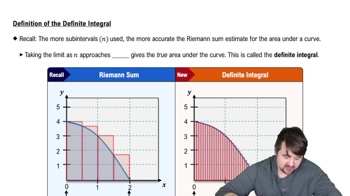
A definite integral calculates the accumulated area under a curve between two limits. In this problem, the integral from 0 to 1 of 1/(1 + x²) represents the area under the curve of the function 1/(1 + x²), which is related to the arctangent function and helps approximate π.
Recommended video:
05:43
Definition of the Definite Integral

Numerical Integration

Numerical integration involves approximating the value of an integral using computational methods when an exact solution is difficult or unnecessary. Techniques like the trapezoidal rule or Simpson's rule estimate the area under a curve by summing areas of simpler shapes, useful for evaluating integrals like the one given.
Recommended video:
6:47
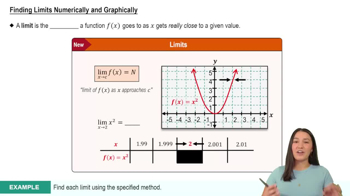
Finding Limits Numerically and Graphically

Relationship Between Integral and π

The integral of 1/(1 + x²) from 0 to 1 equals arctan(1), which is π/4. Multiplying this integral by 4 yields π. This connection allows π to be approximated by evaluating the integral numerically, linking calculus with fundamental constants.
Recommended video:
05:23
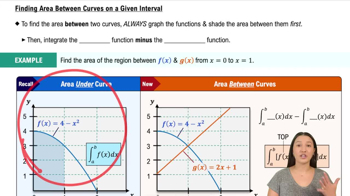
Finding Area Between Curves on a Given Interval