Ch. 8 - Techniques of Integration
Hass - Thomas' Calculus 15th Edition
Hass15th EditionThomas' CalculusISBN: 9780137616077Not the one you use?Change textbook
Chapter 8, Problem 8.5.30

In Exercises 21–32, express the integrand as a sum of partial fractions and evaluate the integrals.
∫ (x² + x) / (x⁴ - 3x² - 4) dx

Verified step by step guidance
1
First, factor the denominator \(x^{4} - 3x^{2} - 4\). Recognize it as a quadratic in terms of \(x^{2}\): let \(u = x^{2}\), so the expression becomes \(u^{2} - 3u - 4\). Factor this quadratic to get \((u - 4)(u + 1)\), which translates back to \((x^{2} - 4)(x^{2} + 1)\).
Next, factor \(x^{2} - 4\) further as a difference of squares: \((x - 2)(x + 2)\). So the full factorization of the denominator is \((x - 2)(x + 2)(x^{2} + 1)\).
Set up the partial fraction decomposition for the integrand \(\frac{x^{2} + x}{(x - 2)(x + 2)(x^{2} + 1)}\) as follows: \(\frac{x^{2} + x}{(x - 2)(x + 2)(x^{2} + 1)} = \frac{A}{x - 2} + \frac{B}{x + 2} + \frac{Cx + D}{x^{2} + 1}\), where \(A\), \(B\), \(C\), and \(D\) are constants to be determined.
Multiply both sides of the equation by the denominator \((x - 2)(x + 2)(x^{2} + 1)\) to clear the fractions, resulting in: \(x^{2} + x = A(x + 2)(x^{2} + 1) + B(x - 2)(x^{2} + 1) + (Cx + D)(x - 2)(x + 2)\).
Expand the right-hand side and collect like terms in powers of \(x\). Then, equate the coefficients of corresponding powers of \(x\) on both sides to form a system of equations. Solve this system to find the values of \(A\), \(B\), \(C\), and \(D\). Once found, rewrite the integral as a sum of simpler integrals corresponding to each partial fraction term, which can then be integrated using standard techniques.

Verified video answer for a similar problem:

This video solution was recommended by our tutors as helpful for the problem above.
Video duration:
12m
Was this helpful?

Key Concepts

Here are the essential concepts you must grasp in order to answer the question correctly.

Partial Fraction Decomposition

Partial fraction decomposition is a technique used to express a complex rational function as a sum of simpler fractions. This method is especially useful when integrating rational functions, as it breaks down the integrand into terms that are easier to integrate individually.
Recommended video:
10:07
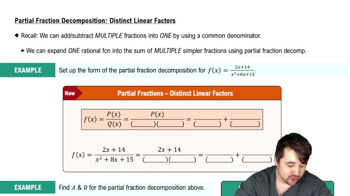
Partial Fraction Decomposition: Distinct Linear Factors

Factoring Polynomials

Factoring the denominator polynomial is essential to apply partial fraction decomposition. By expressing the denominator as a product of linear or irreducible quadratic factors, we can set up the correct form for the partial fractions and solve for unknown coefficients.
Recommended video:
07:00
Taylor Polynomials

Integration of Rational Functions

After decomposing the integrand into partial fractions, each term can be integrated using standard integral formulas. This often involves integrating terms like 1/(x - a), 1/(x² + bx + c), or polynomials, requiring knowledge of logarithmic and inverse trigonometric integrals.
Recommended video:
6:04
Intro to Rational Functions