
Ch. 8 - Techniques of Integration
Hass - Thomas' Calculus 15th Edition
Hass15th EditionThomas' CalculusISBN: 9780137616077Not the one you use?Change textbook
Chapter 8, Problem 8.4.56

Solve the initial value problems in Exercises 53–56 for y as a function of x.
(x² + 1)² (dy/dx) = √(x² + 1), where y(0) = 1

Verified step by step guidance
1
Rewrite the given differential equation to isolate \( \frac{dy}{dx} \): \( (x^{2} + 1)^{2} \frac{dy}{dx} = \sqrt{x^{2} + 1} \) becomes \( \frac{dy}{dx} = \frac{\sqrt{x^{2} + 1}}{(x^{2} + 1)^{2}} \).
Simplify the right-hand side by expressing the square root as a power: \( \sqrt{x^{2} + 1} = (x^{2} + 1)^{\frac{1}{2}} \), so \( \frac{dy}{dx} = (x^{2} + 1)^{\frac{1}{2} - 2} = (x^{2} + 1)^{-\frac{3}{2}} \).
Set up the integral to find \( y \) by separating variables: \( dy = (x^{2} + 1)^{-\frac{3}{2}} dx \), then integrate both sides: \( y = \int (x^{2} + 1)^{-\frac{3}{2}} dx + C \).
Use an appropriate substitution or recognize the integral form to evaluate \( \int (x^{2} + 1)^{-\frac{3}{2}} dx \). For example, consider a trigonometric substitution such as \( x = \tan \theta \) or use a standard integral formula.
Apply the initial condition \( y(0) = 1 \) to solve for the constant of integration \( C \) after finding the antiderivative expression for \( y \).

Verified video answer for a similar problem:

This video solution was recommended by our tutors as helpful for the problem above.
Video duration:
10m
Was this helpful?

Key Concepts

Here are the essential concepts you must grasp in order to answer the question correctly.

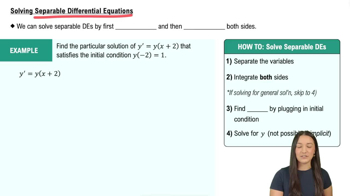
Separable Differential Equations

A separable differential equation can be written as a product of a function of x and a function of y, allowing the variables to be separated on opposite sides of the equation. This enables integration with respect to each variable independently to find the solution.
Recommended video:
06:06
Solving Separable Differential Equations

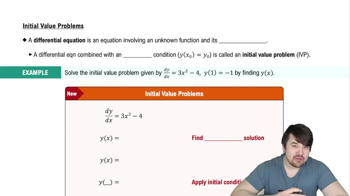
Initial Value Problem (IVP)

An initial value problem specifies the value of the unknown function at a particular point, providing a condition to determine the unique solution of a differential equation. This ensures the solution curve passes through the given initial point.
Recommended video:
05:03
Initial Value Problems

Integration Techniques for Functions Involving Radicals

Solving the given differential equation requires integrating expressions with square roots and polynomial terms. Familiarity with substitution methods and recognizing integrable forms involving radicals is essential to find the antiderivative.
Recommended video:
07:01
Integrals Involving Natural Logs: Substitution