Ch. 8 - Techniques of Integration
Hass - Thomas' Calculus 15th Edition
Hass15th EditionThomas' CalculusISBN: 9780137616077Not the one you use?Change textbook
Chapter 8, Problem 8.8.38

In Exercises 35–68, use integration, the Direct Comparison Test, or the Limit Comparison Test to test the integrals for convergence. If more than one method applies, use whatever method you prefer.
∫ from 0 to ∞ of (dθ / (θ² - 1))

Verified step by step guidance
1
First, identify the integral to be tested for convergence: \(\displaystyle \int_0^{\infty} \frac{d\theta}{\theta^2 - 1}\).
Notice that the integrand has vertical asymptotes where the denominator is zero, i.e., at \(\theta = 1\). This means the integral is improper at \(\theta = 1\) and at the upper limit \(\infty\).
Split the integral into two improper integrals at the point of discontinuity: \(\displaystyle \int_0^1 \frac{d\theta}{\theta^2 - 1} + \int_1^{\infty} \frac{d\theta}{\theta^2 - 1}\).
To test convergence near \(\theta = 1\), analyze the behavior of the integrand as \(\theta \to 1\). For the limit at infinity, compare the integrand to a simpler function such as \(\frac{1}{\theta^2}\) using the Direct Comparison Test or Limit Comparison Test.
Apply the Direct Comparison Test or Limit Comparison Test by computing the limit \(\displaystyle \lim_{\theta \to \infty} \frac{1/(\theta^2 - 1)}{1/\theta^2}\) and check if the integral converges or diverges based on the known behavior of \(\int_1^{\infty} \frac{1}{\theta^2} d\theta\).

Verified video answer for a similar problem:

This video solution was recommended by our tutors as helpful for the problem above.
Video duration:
10m
Was this helpful?

Key Concepts

Here are the essential concepts you must grasp in order to answer the question correctly.

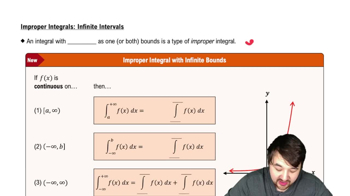
Improper Integrals

Improper integrals involve integration over an infinite interval or integrands with infinite discontinuities. To evaluate convergence, one must consider limits approaching infinity or points of discontinuity, determining if the integral approaches a finite value.
Recommended video:
11:11
Improper Integrals: Infinite Intervals

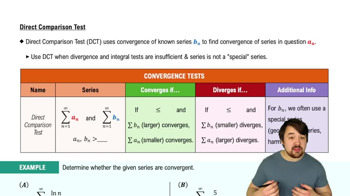
Direct Comparison Test

The Direct Comparison Test determines convergence by comparing the given integral's integrand to a simpler function with known behavior. If the integrand is smaller than a convergent function or larger than a divergent one, conclusions about convergence or divergence can be drawn.
Recommended video:
09:25
Direct Comparison Test

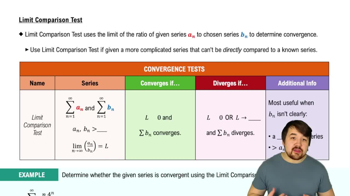
Limit Comparison Test

The Limit Comparison Test compares two functions by examining the limit of their ratio as the variable approaches infinity or a point of discontinuity. If the limit is a positive finite number, both integrals either converge or diverge together, aiding in determining the original integral's behavior.
Recommended video:
07:45
Limit Comparison Test