Ch. 8 - Techniques of Integration
Hass - Thomas' Calculus 15th Edition
Hass15th EditionThomas' CalculusISBN: 9780137616077Not the one you use?Change textbook
Chapter 8, Problem 8.8.74

In Exercises 69–80, determine whether the improper integral converges or diverges. If it converges, evaluate the integral.
∫₋₂¹ (1 / x⁴) dx

Verified step by step guidance
1
Identify the type of improper integral: Since the integrand is \( \frac{1}{x^4} \) and the interval is from \( -2 \) to \( 1 \), note that the function is undefined at \( x = 0 \) because division by zero is not allowed. This means the integral is improper due to a discontinuity at \( x = 0 \).
Split the integral at the point of discontinuity to handle it properly: Write the integral as the sum of two integrals, \( \int_{-2}^{0} \frac{1}{x^4} \, dx + \int_{0}^{1} \frac{1}{x^4} \, dx \). Each of these integrals will be evaluated as limits approaching 0 from the left and right, respectively.
Set up the limits for each integral: For the left integral, write \( \lim_{t \to 0^-} \int_{-2}^{t} \frac{1}{x^4} \, dx \), and for the right integral, write \( \lim_{s \to 0^+} \int_{s}^{1} \frac{1}{x^4} \, dx \).
Find the antiderivative of \( \frac{1}{x^4} \): Recall that \( \frac{1}{x^4} = x^{-4} \). The antiderivative is \( \int x^{-4} \, dx = \frac{x^{-3}}{-3} + C = -\frac{1}{3x^3} + C \).
Evaluate each integral using the antiderivative and then take the limits: Substitute the limits into the antiderivative expressions for both integrals, then analyze the behavior as \( t \to 0^- \) and \( s \to 0^+ \) to determine if the limits exist (converge) or not (diverge). If both limits exist and are finite, sum them to find the value of the original integral.

Verified video answer for a similar problem:

This video solution was recommended by our tutors as helpful for the problem above.
Video duration:
2m
Was this helpful?

Key Concepts

Here are the essential concepts you must grasp in order to answer the question correctly.

Improper Integrals

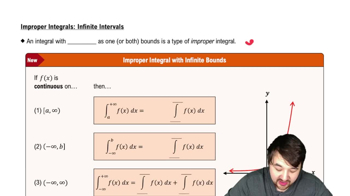
Improper integrals involve integrals with infinite limits or integrands with discontinuities within the interval. To evaluate them, we use limits to approach the problematic points and determine if the integral converges (has a finite value) or diverges.
Recommended video:
11:11
Improper Integrals: Infinite Intervals

Behavior of Functions Near Discontinuities

When the integrand has a discontinuity, such as division by zero, it is crucial to analyze the function's behavior near that point. This helps determine if the integral converges by examining if the area under the curve remains finite despite the singularity.
Recommended video:
5:46
Graphs of Exponential Functions

Evaluating Limits for Convergence

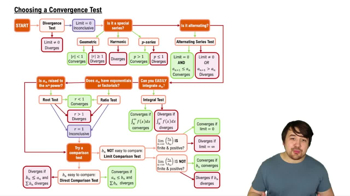
To decide if an improper integral converges, we split the integral at points of discontinuity and compute limits of definite integrals approaching those points. If all limits exist and are finite, the integral converges; otherwise, it diverges.
Recommended video:
07:51
Choosing a Convergence Test