Ch. 8 - Techniques of Integration
Hass - Thomas' Calculus 15th Edition
Hass15th EditionThomas' CalculusISBN: 9780137616077Not the one you use?Change textbook
Chapter 8, Problem 8.2.82

Equations (4) and (5) lead to different formulas for the integral of arctan x:
a. ∫ arctan x dx = x arctan x - ln sec(arctan x) + C [Eq. (4)]
b. ∫ arctan x dx = x arctan x - ln √(1 + x²) + C [Eq. (5)]
Can both integrations be correct? Explain.

Verified step by step guidance
1
Step 1: Understand that both formulas represent the integral \( \int \arctan x \, dx \) but are expressed differently. Our goal is to verify if these two expressions differ by only a constant, which means they are equivalent up to an additive constant \( C \).
Step 2: Recall the trigonometric identity relating \( \sec(\theta) \) and \( \tan(\theta) \): \[ \sec^2(\theta) = 1 + \tan^2(\theta) \] Since \( \theta = \arctan x \), substitute to get: \[ \sec(\arctan x) = \sqrt{1 + x^2} \]
Step 3: Substitute \( \sec(\arctan x) \) in the first formula with \( \sqrt{1 + x^2} \) from the identity above. This shows that: \[ \ln \sec(\arctan x) = \ln \sqrt{1 + x^2} \]
Step 4: Recognize that the difference between the two integral expressions is just the constant of integration \( C \), since the logarithmic terms are equivalent by the identity. Therefore, both formulas are correct and represent the same family of antiderivatives.
Step 5: Conclude that different-looking expressions for an integral can be equivalent if they differ by a constant, which is always possible due to the arbitrary constant in indefinite integrals.

Verified video answer for a similar problem:

This video solution was recommended by our tutors as helpful for the problem above.
Video duration:
10m
Was this helpful?

Key Concepts

Here are the essential concepts you must grasp in order to answer the question correctly.

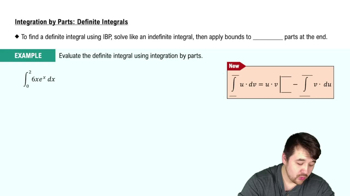
Integration by Parts

Integration by parts is a technique used to integrate products of functions. It is based on the product rule for differentiation and is expressed as ∫u dv = uv - ∫v du. This method is often applied to integrals involving inverse trigonometric functions like arctan x.
Recommended video:
06:18
Integration by Parts for Definite Integrals

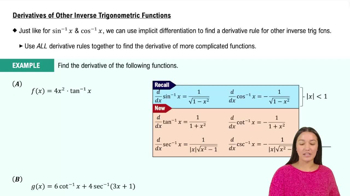
Inverse Trigonometric Functions and Their Properties

The arctan function is the inverse of the tangent function, mapping real numbers to angles. Understanding its properties, such as its range and how it relates to right triangles, helps simplify expressions involving arctan, especially when converting between trigonometric and algebraic forms.
Recommended video:
06:35
Derivatives of Other Inverse Trigonometric Functions

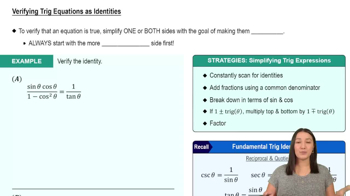
Logarithmic Identities and Simplification

Logarithmic expressions can often be rewritten using identities like ln(sec(arctan x)) = ln(√(1 + x²)). Recognizing these equivalences is crucial to show that different integral forms are actually the same up to a constant, confirming the correctness of both results.
Recommended video:
7:17
Verifying Trig Equations as Identities