Ch. 8 - Techniques of Integration
Hass - Thomas' Calculus 15th Edition
Hass15th EditionThomas' CalculusISBN: 9780137616077Not the one you use?Change textbook
Chapter 8, Problem 8.PE.50

Heat capacity of a gas
Heat capacity 
C_v
is the amount of heat required to raise the temperature of a given mass of gas with constant volume by 1°C, measured in units of cal/deg-mol (calories per degree gram molecular weight).
The heat capacity of oxygen depends on its temperature T and satisfies the formula
C_v = 8.27 + 10^(-5) * (26T − 1.87T²)
Use Simpson’s Rule to find the average value of C_v and the temperature at which it is attained for
20°C ≤ T ≤ 675°C.

Verified step by step guidance
1
Identify the function to analyze: the heat capacity function is given by \(C_v(T) = 8.27 + 10^{-5} \times (26T - 1.87T^2)\), where \(T\) is the temperature in degrees Celsius.
Recall that the average value of a continuous function \(f(T)\) on the interval \([a, b]\) is given by the formula \(\displaystyle \bar{f} = \frac{1}{b - a} \int_a^b f(T) \, dT\). Here, \(a = 20\) and \(b = 675\).
Use Simpson's Rule to approximate the definite integral \(\int_{20}^{675} C_v(T) \, dT\). To do this, divide the interval \([20, 675]\) into an even number \(n\) of subintervals, calculate the values of \(C_v(T)\) at the endpoints and midpoints, and apply the Simpson's Rule formula: \(\displaystyle \int_a^b f(T) \, dT \approx \frac{\Delta T}{3} \left[f(T_0) + 4 \sum_{i=1,3,5,...}^{n-1} f(T_i) + 2 \sum_{i=2,4,6,...}^{n-2} f(T_i) + f(T_n) \right]\) where \(\Delta T = \frac{b - a}{n}\) and \(T_i = a + i \Delta T\).
Calculate the average heat capacity \(\bar{C_v}\) by dividing the approximate integral value by \((675 - 20)\), i.e., \(\bar{C_v} = \frac{1}{675 - 20} \int_{20}^{675} C_v(T) \, dT\).
To find the temperature at which \(C_v\) attains this average value, solve the equation \(C_v(T) = \bar{C_v}\) for \(T\) within the interval \([20, 675]\). This may require algebraic manipulation or numerical methods such as graphing or using a root-finding algorithm.

Verified video answer for a similar problem:

This video solution was recommended by our tutors as helpful for the problem above.
Video duration:
10m
Was this helpful?

Key Concepts

Here are the essential concepts you must grasp in order to answer the question correctly.

Heat Capacity at Constant Volume (C_v)

Heat capacity at constant volume, C_v, is the amount of heat needed to raise the temperature of a gas by one degree Celsius without changing its volume. It depends on the gas type and temperature, reflecting how internal energy changes with temperature. In this problem, C_v varies with temperature, requiring integration to find average values.
Recommended video:
02:27
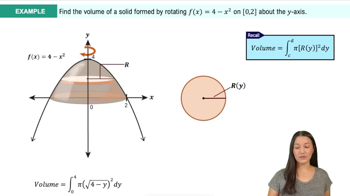
Disk Method Using y-Axis Example 5

Simpson’s Rule for Numerical Integration

Simpson’s Rule is a numerical method to approximate definite integrals by dividing the interval into even segments and fitting parabolas through the points. It provides an accurate estimate of the integral of a function when an exact integral is difficult to find analytically. Here, it is used to compute the average heat capacity over a temperature range.
Recommended video:
05:56
Additional Rules for Indefinite Integrals

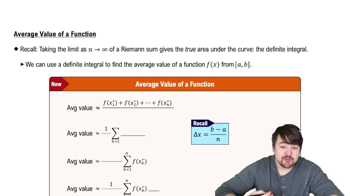
Average Value of a Function over an Interval

The average value of a function over an interval [a, b] is found by integrating the function over that interval and dividing by the interval length (b - a). It represents the mean output of the function within the range. For C_v, this average gives a representative heat capacity over the temperature range.
Recommended video:
06:37
Average Value of a Function