Ch. 8 - Techniques of Integration
Hass - Thomas' Calculus 15th Edition
Hass15th EditionThomas' CalculusISBN: 9780137616077Not the one you use?Change textbook
Chapter 8, Problem 8.PE.31b

Evaluate the integrals in Exercises 29–32 (b) using a trigonometric substitution.
∫ [x / √(4 − x²)] dx

Verified step by step guidance
1
Identify the form of the integral: the integrand contains \( \sqrt{4 - x^2} \), which suggests using the trigonometric substitution \( x = 2 \sin(\theta) \) because \( 4 - x^2 = 4 - 4\sin^2(\theta) = 4\cos^2(\theta) \).
Compute the differential \( dx \) in terms of \( d\theta \): since \( x = 2 \sin(\theta) \), then \( dx = 2 \cos(\theta) d\theta \).
Rewrite the integral in terms of \( \theta \): substitute \( x = 2 \sin(\theta) \), \( dx = 2 \cos(\theta) d\theta \), and \( \sqrt{4 - x^2} = 2 \cos(\theta) \) into the integral \( \int \frac{x}{\sqrt{4 - x^2}} dx \).
Simplify the integral expression after substitution: the integral becomes \( \int \frac{2 \sin(\theta)}{2 \cos(\theta)} \times 2 \cos(\theta) d\theta \), which simplifies to \( \int 2 \sin(\theta) d\theta \).
Integrate with respect to \( \theta \): find \( \int 2 \sin(\theta) d\theta \), then substitute back \( \theta = \arcsin(\frac{x}{2}) \) to express the answer in terms of \( x \).

Verified video answer for a similar problem:

This video solution was recommended by our tutors as helpful for the problem above.
Video duration:
2m
Was this helpful?

Key Concepts

Here are the essential concepts you must grasp in order to answer the question correctly.

Trigonometric Substitution

Trigonometric substitution is a technique used to simplify integrals involving square roots of quadratic expressions by substituting a trigonometric function for the variable. For expressions like √(a² - x²), substituting x = a sin(θ) transforms the integral into a trigonometric form that is easier to evaluate.
Recommended video:
6:04
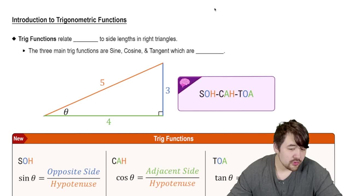
Introduction to Trigonometric Functions

Integration of Trigonometric Functions

After substitution, the integral often involves trigonometric functions such as sine and cosine. Understanding how to integrate these functions, including using identities and basic integral formulas, is essential to solve the integral and then revert back to the original variable.
Recommended video:
6:04
Introduction to Trigonometric Functions

Back Substitution

Once the integral is evaluated in terms of the trigonometric variable, back substitution is used to rewrite the answer in terms of the original variable x. This involves using the inverse trigonometric functions or right triangle relationships derived from the substitution.
Recommended video:
04:27
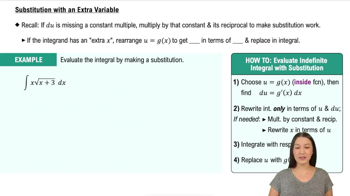
Substitution With an Extra Variable
Related Practice
Textbook Question

Evaluate the integrals in Exercises 69–134. The integrals are listed in random order so you need to decide which integration technique to use.

123. ∫ √x * √(1 + √x) dx

Textbook Question

You are planning to use Simpson’s Rule to estimate the value of the integral Estimate ∫ from 1 to 2 of f(x) dx with an error magnitude less than 10⁻⁵ using Simpson’s Rule.

You have determined that |f⁽⁴⁾(x)| ≤ 3 throughout the interval of integration. How many subintervals should you use to ensure the required accuracy?

(Remember that for Simpson’s Rule the number of subintervals must be even.)

Textbook Question

Heat capacity of a gas

Heat capacity 

C_v

is the amount of heat required to raise the temperature of a given mass of gas with constant volume by 1°C, measured in units of cal/deg-mol (calories per degree gram molecular weight).

The heat capacity of oxygen depends on its temperature T and satisfies the formula

C_v = 8.27 + 10^(-5) * (26T − 1.87T²)

Use Simpson’s Rule to find the average value of C_v and the temperature at which it is attained for

20°C ≤ T ≤ 675°C.

Textbook Question

Evaluate the integrals in Exercises 69–134. The integrals are listed in random order so you need to decide which integration technique to use.

∫ sinx·cos²x dx

Textbook Question

Evaluate the integrals in Exercises 69–134. The integrals are listed in random order so you need to decide which integration technique to use.

129. ∫ (x^(ln x) * ln x) / x dx

1
views
Textbook Question

Evaluate the integrals in Exercises 69–134. The integrals are listed in random order so you need to decide which integration technique to use.

∫ (2 − cosx + sinx) / sin²x dx